I was talking to a friend who runs a mid sized logistics company last week. He was frustrated. He had a "nice" website—clean photos, mobile responsive, the works. But his team was still spending four hours a day manually moving data from contact forms into spreadsheets.
Customers would ask for updates, and he’d have to dig through three different tabs to find an answer. His website was basically a digital billboard. It looked pretty, but it didn't actually do anything.
That’s the wall most businesses are hitting as we move into 2026. A website tells people who you are. A web application does the work for you.
The death of the "Digital Brochure"
For a long time, having a website was the goal. You just needed to be "findable." If you had a gallery and a phone number, you were winning.
But people’s patience has hit a floor. In 2026, nobody wants to "reach out for a quote" and wait 24 hours. They want to log in, see their data, click a button, and solve their problem.
If your digital presence is just a one way street of information, you’re making your customers work too hard. And when people have to work, they leave.
Why a standard site fails the modern test
Most people don't realize how much time they lose to small tasks. When you move from a website to an app, you're usually fixing these issues:
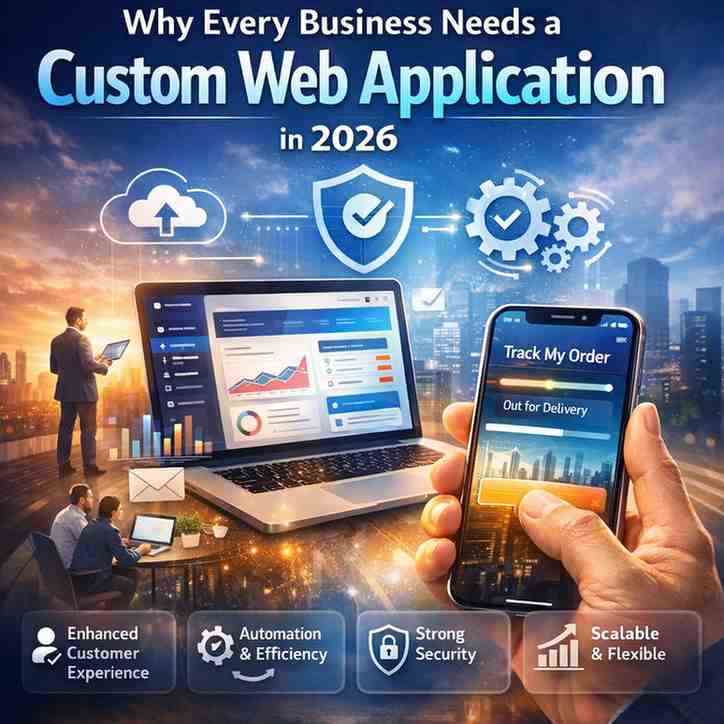
Customers can track their own orders without calling you
Your team stops copy pasting data from emails into your CRM
You get real time reports instead of waiting for a monthly recap
New clients can onboard themselves without a 30 minute phone call
Working around the software, not with it
We’ve all been there. You buy a "standard" software as a service (SaaS) tool because it’s cheap and easy. Then you realize your business doesn't actually work the way the software wants it to.
So you start doing "workarounds." You export a CSV here, upload it there, and suddenly your "efficient" system is a mess of manual tasks.
A custom web application is the opposite. It’s built around the way you already move. It doesn't ask you to change your workflow; it automates it.
Automation is no longer a luxury
Think about your most repetitive task. Is it onboarding clients? Managing inventory? Updating project statuses?
If a human is doing it more than three times a day, a web app should probably be doing it instead. By 2026, the gap between businesses that automate and those that don't is going to be a canyon. You can’t out hustle a well coded script.
The "App Like" expectation
Have you noticed how much time you spend in actual apps versus just "browsing"?
Whether it's ordering food or checking a bank balance, we expect a level of interactivity that a standard website can't give. We want dashboards. We want real time notifications.
When you provide a custom portal for your clients, you aren't just giving them information. You’re giving them a tool. That tool becomes part of their daily life. It’s much harder to fire a company whose software you use every day than one whose website you visit once a year.
Scaling without the chaos
Growth usually brings a specific kind of pain. More customers mean more emails, more mistakes, and more "where is that file?" moments.
A custom application acts as a spine for that growth. It holds everything in place so when you add ten more clients, your system doesn't buckle. It just processes more data.
Finding the right foundation
I see a lot of people try to build these things on top of basic templates. It’s like trying to build a skyscraper on a backyard deck. It might hold for a minute, but the cracks will show fast.
To get this right, you need people who understand the difference between "making it look good" and "making it work." If you're looking for the Best Website Design Services in California or a specialized dev team, look for the ones who ask about your business process before they ask about your color palette.
The design matters, sure. But the logic underneath is what pays the bills.
Security that actually sleeps
Off the shelf plugins are easy targets. Every hacker knows exactly how they work because millions of people use them.
A custom application is a different beast. Because the codebase is unique to you, it’s not an easy "one size fits all" target. In a world where data leaks are a daily headline, having a locked down, proprietary system isn't just a tech choice—it’s a trust choice.
The hidden cost of "Standard"
People often look at the price of a custom app and winced. They see the upfront cost and compare it to a $50/month subscription.
But they forget the "hidden tax":
The hours your team wastes on manual data entry
The lost leads that fall through the cracks of a basic form
The "software fatigue" that makes your best employees frustrated
The cost of paying for five different tools that don't talk to each other
When you add it up over two or three years, that "cheap" subscription is usually the most expensive thing in the building.
Moving forward
You don't need to turn your whole business into a tech company overnight. But you should look at your current website and ask: is this helping me scale, or is it just sitting there?
If you're still relying on spreadsheets and manual emails to keep the lights on, you’re essentially running a 2026 business with 2010 tools.
The goal isn't just to have an app. The goal is to get your time back. Build something that works while you aren't