

Despite the best efforts of prescriptive grammarians, casual speech tends to follow its own rules. As any speaker of Japanese knows, that language is no exception. Dropped particles, flipped word order, and some truly impressive spelling changes are all a part of colloquial Japanese. The same is true in English, where words like “gonna” look …
Japanese Vocabulary
A way to level up in any language is to move beyond simple sentences with conjunctions like “and” or “or.” Conjunctions, words that connect two clauses together, allow you to express complex thoughts and emotions and can make you sound much more fluent, as well. In this article, we’ll look at how to use the …

Anyone who has lived through 2020 knows that it’s sometimes hard to keep going. Indeed, occasional feelings of pessimism and negativity are a universal across all cultures. Because of this, it’s a good way to know how to encourage people when learning a new language. Let’s take a look at five ways to say “don’t …
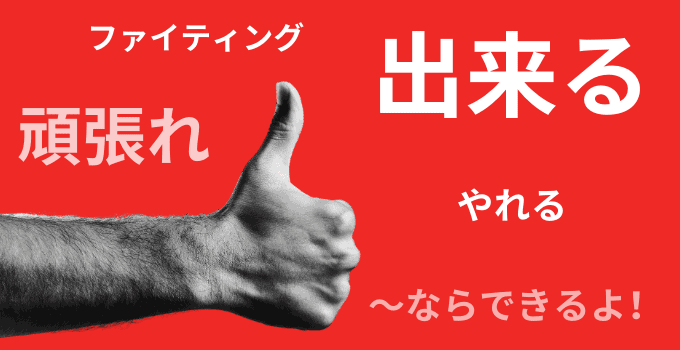
“You can do it!” is a useful sentence to know in any language. It’s also often linguistically simple, meaning it’s an easy expression to add to your vocabulary. In this article, we’ll take a look at five ways you can encourage people with this or a similar expression in Japanese. How do you say …

We’re covering a really fun expression in Japanese in this article: kakatte koi. Anyone who enjoys Japanese media has probably heard this more than a few times, and you might even have a rough idea of what it means, just from the context and emphatic nature of the expression. But in the next few hundred …

Translation is an art, rather than a science, and in some cases there isn’t an exact duplicate of a word or phrase in other languages. This is especially true for Japanese and English, two languages with very different origins and two very different approaches to grammar and meaning. As an example, let’s consider the English …

One useful trick for language-learning is to make a point of figuring out how to ask for help early on. If you’re visiting a traditional Japanese inn and the front desk staff just asked you a question, your trip is going to go a lot more smoothly if you can clue them in to the …

Japanese thrives on context. Although it has a reputation for being unusual in that regard, in fact context is important in nearly all languages. In addition to the linguistic context of a specific sentence, many languages also have special rules for specific social or cultural contexts. In English, for example, the way you speak to …

English has a few different words that can mean “have,” like possess, own or keep. Japanese is the same way, with a few different words that can mean slightly different things in different contexts. In this article, we’ll look at Japanese words you can use to mean “have.” How do you say “have” in …