
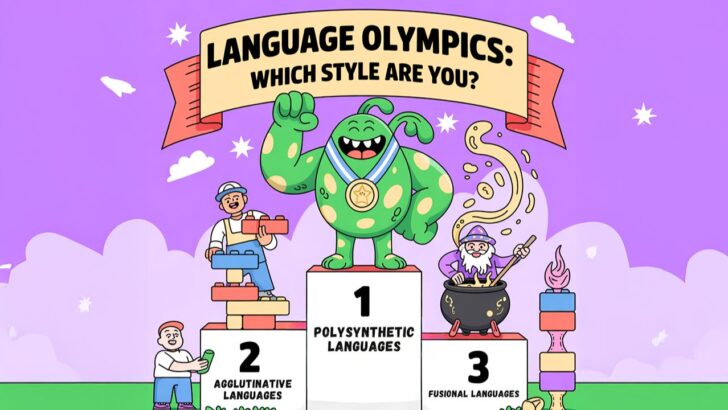
There’s something magical about how languages aren’t just about what we say, but how we build what we say.
Some languages stack meanings like Lego bricks. Others melt ideas together into a single tiny ending. And a few even pack entire sentences into one enormous word!
This whole world of how languages build their words is called linguistic typology. Today, I’m excited to walk you through the four main styles.
You might just find yourself looking at every word a little differently after this.
And if you’re feeling brave, stick around until the end — we’ve got a fun little quiz where you’ll classify 40 different languages based on what you’ve learned!
1. Isolating Languages
In isolating languages, each word typically stands alone and has a single meaning.
Instead of adding endings or changing the word, you just put the words together like building blocks.
Example: Mandarin Chinese
- “měi” = America
- “guó” = country
- “rén” = person
Together: “měi guó rén” = “American”
Key idea:
? Words don’t really change — you just add them next to each other.
2. Agglutinative Languages
Agglutinative languages stick pieces together to create new meanings.
Each piece (called a morpheme) has one clear meaning, and you can see every part easily.
Example: Tamil
- “pe:su” = speak
- “kir” = present tense
- “e:n” = first-person (“I”)
Together: “pe:su-kir-e:n” = “I am speaking”
Key idea:
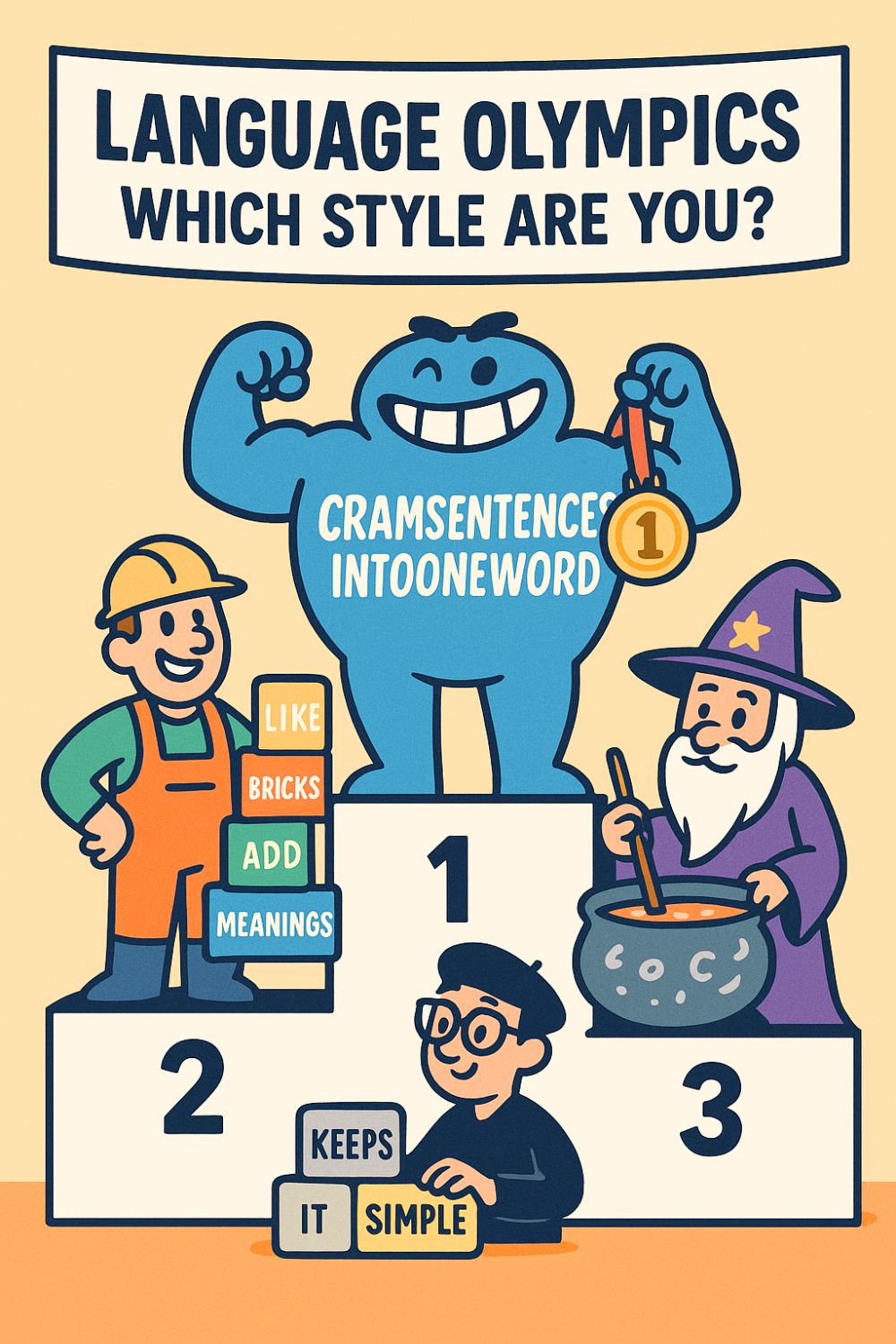
? It’s like snapping Lego bricks together — each brick adds a meaning!
3. Fusional Languages
Fusional languages combine different meanings into one small change.
A single ending can tell you a lot, like who is doing something, when it’s happening, and how.
Example: Spanish
- “hablar” = to speak
- “hablo” = “I speak” (the ending “-o” shows “I” and “present tense”)
Key idea:
? Pieces are melted together — it’s harder to pull them apart than in agglutinative languages.
4. Polysynthetic Languages
Polysynthetic languages pack a whole sentence into one long word.
They add lots of parts (sometimes 5 or more!) into a single word.
Example: Mohawk
One long word can mean: “She opened the door for him again.”
Key idea:
? One word = one full sentence!
? Ready to See Where You Belong?
Are you a Word Monster, a Meaning Melter, a Master Stacker — or something even wilder?
Put your new skills to the test with our 40-language quiz!
See how many you can match… and find out which language-building style fits you best.
Here’s the list of languages to match:
- Mandarin Chinese
- Vietnamese
- Yoruba
- English
- Turkish
- Finnish
- Korean
- Japanese
- Hungarian
- Swahili
- Spanish
- Russian
- German
- French
- Italian
- Latin
- Greek
- Hindi
- Arabic
- Sanskrit
- Mohawk
- Inuktitut
- Greenlandic
- Cherokee
- Nahuatl
- Cree
- Maori
- Burmese
- Thai
- Cantonese
- Zulu
- Xhosa
- Quechua
- Aymara
- Basque
- Mongolian
- Tamil
- Malay
- Lao
- Khmer
And once you did that, you will find the answer key right here.
And if you would like to get the exercise itself, you can find it here.

Hey fellow Linguaholics! It’s me, Marcel. I am the proud owner of linguaholic.com. Languages have always been my passion and I have studied Linguistics, Computational Linguistics and Sinology at the University of Zurich. It is my utmost pleasure to share with all of you guys what I know about languages and linguistics in general.