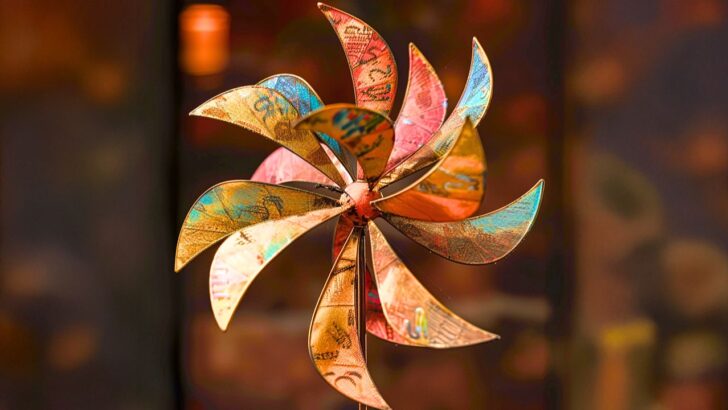
Let’s talk whirligig.
That’s right. Whirligig. A word that sounds like it’s been spun around in a circle, dropped on the floor, and picked up again just for fun.
This is one of those old-timey English words that feels like it should come with a walking stick and a top hat.
But it’s not just a relic from the past—whirligig is still kicking around today, hiding in poems, literature, and maybe even your grandma’s garden.
Let’s start with the basics.
What is the meaning of whirligig?
A whirligig is any object that spins or whirls around.
That’s it. That’s the core. A spinning thing.
But hold on—we’re not talking about just any spinny thing. This word has range. It can mean a spinning toy, a weather vane, a mechanical contraption, or even the wild, chaotic movement of life itself.
It’s got a bit of metaphor baked in, too. Shakespeare used it in Twelfth Night to describe the “whirligig of time,” which brings about justice. So now we’re dealing with philosophical tops, not just the ones from medieval fairs.
Let’s zoom out a bit and figure out where this little verbal carousel came from.
The Origins of Whirligig
So, whirligig first pops up in Middle English as whirlegigg. And, yeah, it kind of sounds like the name of an off-brand carnival ride.
It’s a mash-up of two old words:
- “Whirlen” meaning to spin, whirl, or rotate
- “Gigg”, an old term that meant “top” (as in spinning top)
Put those together and you’ve got a “whirling top.” Pretty straightforward.
But “gigg” is actually an older word than you might think. It’s from the same family that gave us giggle, gig, and even the name of that little carriage known as a gig.
All of them are playful, light, or a little bit bouncy. So whirligig is a word that literally spins with joy.
The earliest whirligigs were toys—spinning tops made of wood, sometimes string-powered, sometimes just flicked with a finger.
These things go back hundreds, even thousands of years. Archaeologists have found tops in ancient Egypt, and we know they were around in medieval Europe.
In other words: kids have always liked watching stuff spin.
So What Counts as a Whirligig?
Today, “whirligig” can refer to a few different things.
- Toys – The classic spinning top. If you’ve ever played with a wooden top or a paper pinwheel, congratulations, you’ve used a whirligig.
- Garden Decorations – Those brightly painted contraptions that spin when the wind blows? Yep, whirligigs. Often shaped like birds flapping their wings or tiny farmers sawing logs.
- Mechanical Devices – In older usage, it could mean anything with spinning parts. Think old-school contraptions, not iPhones.
- Figurative Use – Metaphors for chaos, change, or life’s unpredictable swirl. “Life’s a whirligig” is basically saying, “I have no clue what’s going on, but we’re all spinning together.”
Whirligigs in Literature: Enter Shakespeare
Like we mentioned earlier, our guy Shakespeare used whirligig in Twelfth Night:
“And thus the whirligig of time brings in his revenges.”
Translation: What goes around, comes around. Literally. The spinning of time will catch up to you, and eventually, you’ll get what’s coming.
So yeah, Shakespeare used whirligig as a metaphor for fate. And now you can quote the Bard while watching a pinwheel in your backyard and feel kind of profound about it.
The Whirligig of… Life?
If your day feels chaotic—emails flying in, kids running around, your cat knocking stuff off shelves—congratulations, you’re living in a whirligig.
There’s something oddly comforting about it, though. A whirligig might spin out of control, but it’s built for that. It’s meant to whirl.
So when things get hectic, just think: you’re not overwhelmed, you’re participating in a centuries-old tradition of spinning through life.
You’re a Renaissance toy with a Gmail account.
Final Thoughts: Why Use “Whirligig” Today?
Because honestly, it’s just fun to say.
It’s the kind of word that makes you feel a little bit magical and a little bit like a court jester. It’s also a perfect word for poetry, chaos, childhood, old books, and that general sense of “I have no idea what’s happening but let’s roll with it.”
And if you want to sound literary or slightly whimsical while describing your daily mental state—go ahead and say:
“My brain’s a whirligig right now.”
Because sometimes, a good spin is exactly what you need.

Hey fellow Linguaholics! It’s me, Marcel. I am the proud owner of linguaholic.com. Languages have always been my passion and I have studied Linguistics, Computational Linguistics and Sinology at the University of Zurich. It is my utmost pleasure to share with all of you guys what I know about languages and linguistics in general.