

Researchers have shown that being polite has a ‘positive social value’ in many cases. In other words, it pays to be polite. One of the easiest ways to do that, as any parent knows, is to say “please” and “thank you.” But where do the commas go if you’re thanking someone? Read on, please, to …
Marcel Iseli

The written system of non-lexical items in texts is known as punctuation. Punctuation marks are guiding signs for readers so the words do not crash into one another, thereby preventing word traffic collision. In short, punctuation marks are the traffic signals in the crowded community of paragraphs. And why are these marks important? Of course, …

Punctuations provide prosodic cues that convey the intention and tone of texts. The rhythm of the text can be manipulated by the mastery of punctuation placement, such as commas. Put simply, sentences without punctuations are like songs without beats while punctuation misplacement is equivalent to a person who could sing, yet hits the wrong notes …

A way to level up in any language is to move beyond simple sentences with conjunctions like “and” or “or.” Conjunctions, words that connect two clauses together, allow you to express complex thoughts and emotions and can make you sound much more fluent, as well. In this article, we’ll look at how to use the …

Some words or phrases are often or always used in a way that means they will need to be followed by a comma. Other words or phrases can take up several different positions in a sentence. Whether or not a comma is needed will vary based on where the word is. “Currently” is an example …

Writing could sometimes feel like grasping at straws when we have to decide whether or not to put a comma before or after a certain word. As perplexing as it may seem, punctuations such as commas are actually fairly easy to use. Punctuation should become much less difficult, especially if we know our cohesive devices …

One of the things that makes English such a great language is how versatile it is. As an example, it’s possible to turn many nouns or verbs into adjectives by adding a -y on the end. Things get complicated when the word ends in an “e,” though. As an example of which, people often ask …

Anyone who has lived through 2020 knows that it’s sometimes hard to keep going. Indeed, occasional feelings of pessimism and negativity are a universal across all cultures. Because of this, it’s a good way to know how to encourage people when learning a new language. Let’s take a look at five ways to say “don’t …
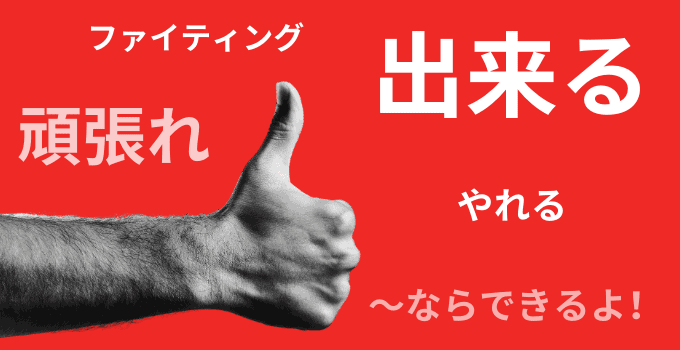
“You can do it!” is a useful sentence to know in any language. It’s also often linguistically simple, meaning it’s an easy expression to add to your vocabulary. In this article, we’ll take a look at five ways you can encourage people with this or a similar expression in Japanese. How do you say …