
Converters & translators
Atbash Cipher Decoder & Translator
Encode and decode the Atbash cipher, which swaps each letter with its mirror (A↔Z, B↔Y), with the alphabet chart, step-by-step working and examples.
Updated · Free, no sign-up
Share this tool
Know someone who’d love it?
What is the Atbash cipher?
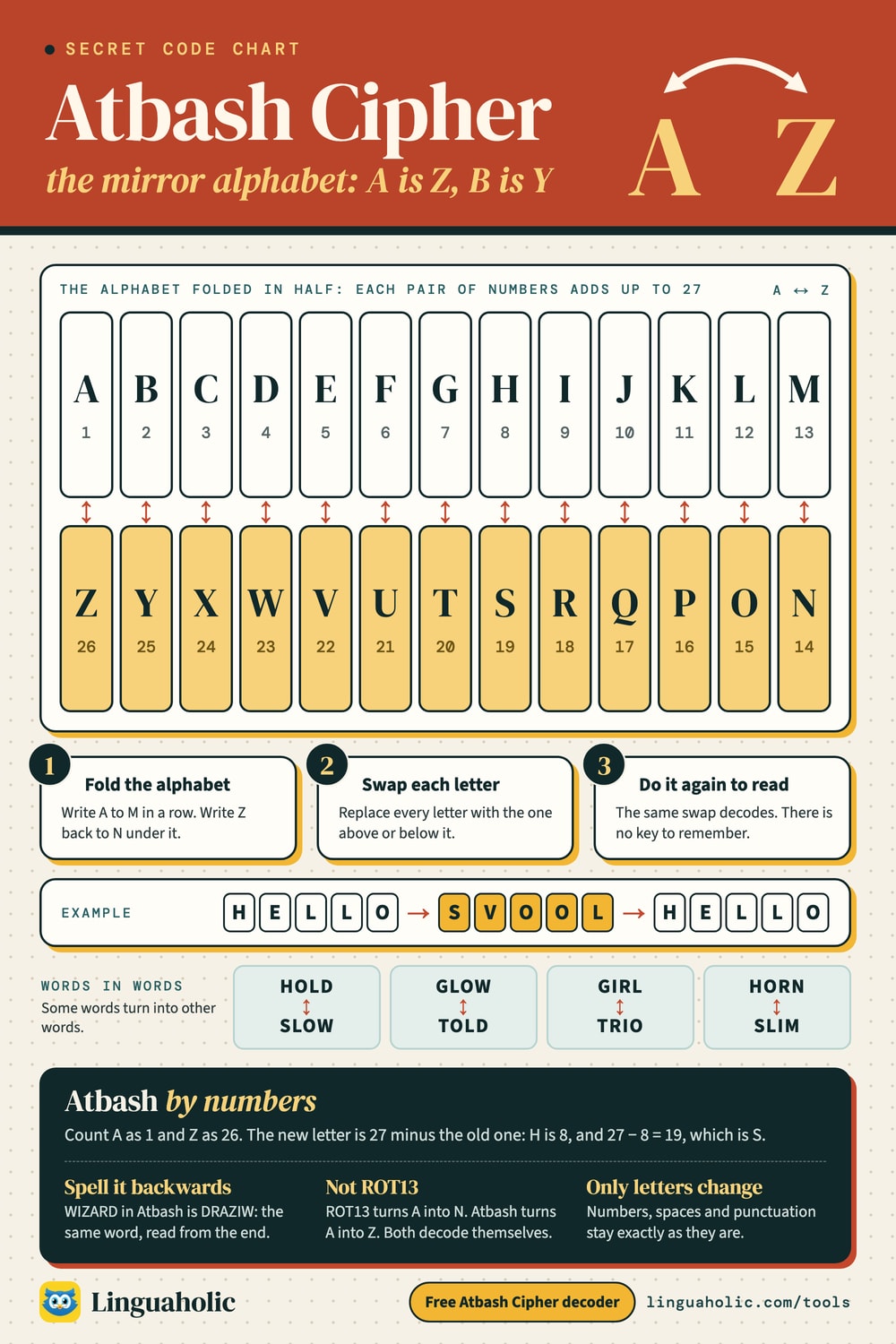
The Atbash cipher swaps each letter with its mirror image in the alphabet: the first letter with the last, the second with the second to last, and so on. A becomes Z, B becomes Y, C becomes X, and M and N swap in the middle. Nothing else is involved: there is no key and no number to choose. Because the swap works both ways, encoding and decoding are the same step, so this tool has no Encode or Decode switch.
Atbash began as a cipher for the Hebrew alphabet and is one of the oldest known letter ciphers. Today it turns up in puzzle books, escape rooms, treasure hunts and television mysteries, often as the first code a solver learns.
How to use the Atbash cipher decoder and translator
- Type or paste your text. The Atbash version appears below as you type.
- To decode, paste Atbash text in the same box: the result is the original message. Capital and small letters keep their case; spaces, digits and punctuation do not change.
- Press Copy, or Use as input to flip the result back and check it.
Open Step by step to see the mirrored alphabet and the working for each letter, or Letter frequencies to compare a message’s letters with English. If a text is not Atbash after all, Crack it tries all 312 single-alphabet keys of the affine cipher (every Caesar shift is among them) and Which cipher is this? suggests what else it might be. A link such as ?text=Svool opens the tool already filled in.
Atbash cipher chart

Atbash cipher alphabet
The whole cipher is these 13 pairs. Each letter turns into its partner, in either direction:
| Letter | A | B | C | D | E | F | G | H | I | J | K | L | M |
|---|---|---|---|---|---|---|---|---|---|---|---|---|---|
| ↕ swaps with | Z | Y | X | W | V | U | T | S | R | Q | P | O | N |
A handy way to remember it: write A to M on one line and Z back to N underneath. Every letter sits above or below its partner.
How to encode and decode Atbash by hand
Number the letters from A = 0 to Z = 25. The Atbash letter is 25 minus the number. Here is HELLO:
| Letter | Number | 25 − number | Atbash |
|---|---|---|---|
| H | 7 | 18 | S |
| E | 4 | 21 | V |
| L | 11 | 14 | O |
| L | 11 | 14 | O |
| O | 14 | 11 | L |
So HELLO becomes SVOOL, and SVOOL becomes HELLO again. A longer example: MEET ME AT THE OLD OAK TREE is NVVG NV ZG GSV LOW LZP GIVV in Atbash.
Counting from 1 instead (A = 1 … Z = 26), the rule is 27 minus the number, which some people find easier to do in their head: H is 8, and 27 − 8 = 19, which is S.
Atbash cipher examples
| Plain text | Atbash |
|---|---|
| Hello World | Svool Dliow |
| Secret message | Hvxivg nvhhztv |
| Treasure map | Givzhfiv nzk |
| Good morning | Tllw nlimrmt |
| Wizard | Draziw |
Look at the last one: Wizard becomes Draziw, which is the word spelled backward: W and D, I and R, Z and A are mirror pairs, and they sit in mirrored places in the word. Little surprises like this make Atbash a favorite with puzzle writers.
Making an Atbash key card
You do not need a wheel or a table to use Atbash. Fold a strip of paper in half and write A to M along the top half from left to right. Then write N to Z along the bottom half from right to left, so N ends up under M and Z under A. Unfold it and you have a key card: every letter is directly above or below its partner. Children can make one in a minute, and it works for both writing and reading messages.
Atbash in math terms
Atbash is the special case of the affine cipher with a = 25 and b = 25: (25 × x + 25) mod 26 is the same as 25 − x. The tool’s affine engine gives exactly the Atbash alphabet with those keys. That is why the crack section lists Atbash among the 312 affine keys. It is also a mirror rather than a rotation, so it is not one of the 25 Caesar shifts: ROT13 turns HELLO into URYYB, while Atbash gives SVOOL.
How to recognize Atbash text
The most common English words have easy-to-spot Atbash forms:
| Word | the | and | is | of | you |
|---|---|---|---|---|---|
| Atbash | gsv | zmw | rh | lu | blf |
If you see “gsv” again and again, you are looking at Atbash. The vowels A, E, I, O and U become Z, V, R, L, F, so Atbash text is full of Z’s, V’s and R’s, letters that are rare in ordinary English. Opening the tool’s Letter frequencies section shows that clearly: the bars for common English letters are low and the bars for their mirror letters are high.
How to crack an Atbash cipher
There is nothing to crack: Atbash has no key, so anyone who suspects it can decode the message in seconds. The real question is whether a message is Atbash at all. Paste it into the tool. If the result reads as English, you are done. If not, open Crack it: the tool scores the Atbash reading and all 312 affine keys, which cover every Caesar shift too, and ranks them by how much they read like English. If none of them works, the message uses a more general cipher; try the cryptogram solver.
Words that Atbash turns into other words
Most words become nonsense in Atbash, but a few mirror into other real words. Among the common words with four or more letters in our dictionary, there are 6:
- girl ↔ trio
- glow ↔ told
- hold ↔ slow
- holy ↔ slob
- horn ↔ slim
- kiln ↔ prom
Puzzle makers can use pairs like these to hide one word inside another, so a clue that looks innocent is really a second clue.
The Hebrew origin of Atbash
Atbash was first a Hebrew cipher. Its name describes the rule: the first letter of the Hebrew alphabet, aleph (א), swaps with the last, tav (ת), and the second, bet (ב), swaps with the second to last, shin (ש). Aleph–tav–bet–shin gives “at-bash”. With the 22 letters of the Hebrew alphabet, that makes 11 pairs:
| Letter | Name | Swaps with | Name |
|---|---|---|---|
| א | Aleph | ת | Tav |
| ב | Bet | ש | Shin |
| ג | Gimel | ר | Resh |
| ד | Dalet | ק | Qof |
| ה | He | צ | Tsadi |
| ו | Vav | פ | Pe |
| ז | Zayin | ע | Ayin |
| ח | Het | ס | Samekh |
| ט | Tet | נ | Nun |
| י | Yod | מ | Mem |
| כ | Kaf | ל | Lamed |
The best-known examples are in the Book of Jeremiah in the Hebrew Bible. The word “Sheshach” (in Jeremiah 25:26 and 51:41) is the Atbash form of “Babel”, that is, Babylon, and “Leb Kamai” (Jeremiah 51:1) is the Atbash form of “Kasdim”, the Chaldeans. Whether these were meant to hide the names or were a kind of wordplay, they are among the oldest letter-substitution ciphers on record.
Atbash in the classroom
Atbash is a good first lesson in codes because it needs no arithmetic and no secret key, yet it still shows the big ideas. A simple plan:
- Have everyone make the folded key card described above.
- Write a short Atbash message on the board and let pairs decode it with their cards.
- Ask why “gsv” keeps appearing. That question leads straight to letter frequency and to why simple ciphers are easy to break.
- Let each pair write a message for another pair, then compare Atbash with the Caesar cipher, where both sides must agree on a shift.
The tool’s Step by step section shows the mirrored alphabet and the working for each letter, which makes it easy to check answers on a projector or a phone.
Decoding Atbash without spaces
Puzzle makers often remove the spaces so that short words do not give the game away. Atbash does not care: decode the whole run of letters, then look for the words in the result, just as you would read a message with no spaces. Start from the beginning and find the first word that makes sense, then carry on. The tool keeps the text exactly as you paste it, so you can also add spaces to the coded text yourself as you work out where the words break.
Atbash cipher practice puzzles
Decode these by hand with the table above, then check with the tool.
Puzzle 1 (Easy)
OLLP YVSRMW GSV WLLI
Show the answer
LOOK BEHIND THE DOOR
Puzzle 2 (Medium)
GSV HVXIVG DLIW RH ORTSGSLFHV
Show the answer
THE SECRET WORD IS LIGHTHOUSE
Puzzle 3 (Hard (no spaces))
NVVGZGGSVULFMGZRMZGMLLM
Show the answer
MEET AT THE FOUNTAIN AT NOON
Tips for using Atbash in puzzles
- It is a great first cipher. There is no key to share, so a solver only needs the idea of a mirrored alphabet. Give younger players the A–M over Z–N line as a hint.
- Remove the spaces for experienced solvers; it hides giveaway words like “gsv”.
- Layer it. Turn the Atbash letters into numbers with A1Z26, or send the result as Morse code, for a two-step puzzle.
- Don’t rely on it for secrets. Anyone who knows it reads it instantly.
How Atbash compares with other simple ciphers
| Cipher | Rule | Keys | Same step decodes? |
|---|---|---|---|
| Atbash | Mirror the alphabet | None | Yes |
| ROT13 | Turn the alphabet 13 places | None | Yes |
| Caesar | Turn the alphabet any number of places | 25 | No, shift back |
| Affine | Multiply, then shift | 312 | No, use the inverse |
| Substitution | Any scrambled alphabet | About 4 × 10²⁶ | No, use the alphabet backward |
All of these replace each letter with one fixed letter, so all of them keep the letter patterns of the message, and all of them can be broken with letter counts and word shapes. Atbash is simply the one where the code breaker does not even need to guess a key.
Atbash, ROT13 and other self-inverse ciphers
A cipher is self-inverse when applying it twice gets you back to the start. Atbash and ROT13 are the two famous ones among letter ciphers: Atbash mirrors the alphabet, ROT13 turns it halfway round. Both are handy for hiding text in plain sight, because the reader uses the same table to read it that you used to write it. For a cipher that actually needs a key, try the Vigenère cipher.
Free and private
This Atbash tool runs entirely in your browser: free, with no sign-up, and nothing you type is uploaded or stored.
For teachers, bloggers & clubs
Put the Atbash Cipher on your website
Give your readers this tool right on your page. Copy the code, paste it into your site, done: no sign-up, no account.
- Free for any website
- No ads, no cookies
- Fits phones and sidebars
- Always up to date
Please keep the small credit line under the tool; you may add rel="nofollow" to its link. How it works & the rules

› Show the code
Frequently asked questions
- What is the Atbash cipher?
- A cipher that swaps every letter with its mirror in the alphabet: A with Z, B with Y, C with X and so on, up to M with N. It has no key.
- How do you decode the Atbash cipher?
- Apply Atbash again. Because each letter swaps with its partner, the same step that encodes a message also decodes it. Paste the code into the tool and read the result.
- What does HELLO look like in Atbash?
- HELLO becomes SVOOL: H and S, E and V, L and O are mirror pairs.
- What is the Atbash formula?
- With A = 0 to Z = 25, the Atbash letter is 25 minus the letter's number. Counting from A = 1, it is 27 minus the number.
- Where does the name Atbash come from?
- From the Hebrew alphabet: aleph, the first letter, swaps with tav, the last, and bet, the second, swaps with shin, the second to last. Aleph-tav-bet-shin gives at-bash.
- Is Atbash in the Bible?
- Yes. In the Book of Jeremiah, Sheshach (25:26 and 51:41) is the Atbash form of Babel, and Leb Kamai (51:1) is the Atbash form of Kasdim, the Chaldeans.
- Is Atbash the same as ROT13?
- No. Both decode themselves, but ROT13 turns the alphabet halfway round (A to N), while Atbash mirrors it (A to Z). They pair different letters.
- Does Atbash change numbers and punctuation?
- No. Only the letters A to Z are swapped. Digits, spaces and punctuation stay the same, and letters keep their case.
- Can the Atbash cipher be cracked?
- There is nothing to crack, because it has no key: anyone who suspects Atbash can read the message at once. If the result is not English, the tool's Crack it section tries every Caesar and affine key instead.
About this page
The Atbash Cipher is a free tool from Linguaholic, made by Marcel Iseli. It runs in your browser, with no sign-up. Last updated .
The code breaker's English letter frequencies and word checks come from Linguaholic’s English dictionary, built from the open ENABLE and SCOWL word lists. Licenses and notices.
Keep exploring
More free tools
 ROT13Hide or reveal text with ROT13, or switch to ROT5, ROT18 or ROT47.
 Caesar CipherShift letters to encode or decode, or crack a Caesar message without knowing the key.
 Affine CipherEncode or decode with keys a and b, see the math, or crack it by trying all 312 keys.
 Substitution CipherEncode with any alphabet or keyword, or crack a cryptogram and fix letters yourself.
 A1Z26 CipherLetters to numbers and back: A=1 to Z=26, with a chart, decoder and puzzle ideas.
 Morse Code TranslatorTranslate text to Morse code and back, hear it as sound at any speed, and see the full Morse alphabet chart.