
Converters & translators
Roman Numeral Converter
Convert numbers to Roman numerals and back in one box, write big numbers with the bar on top, turn any date into Roman numerals for a tattoo, add and multiply Roman numerals, and practice with a quick quiz — plus a full chart.
Updated · Free, no sign-up
Works up to 3,999,999 — from 4,000 a bar over a letter multiplies it by 1,000 (V̅ = 5,000).
Share this tool
Know someone who’d love it?
What is a Roman numeral converter?
A Roman numeral converter turns ordinary numbers into Roman numerals and Roman numerals back into numbers. This one does it in a single box — type 2026 or MMXXVI and it works out which way to convert. It also shows the place-value breakdown, writes big numbers with the bar on top (up to 3,999,999), turns any date into Roman numerals for tattoos, adds and multiplies Roman numerals, and lets you practice with a quick quiz.
How to use the converter
- Convert: type a number (like 1990) or a Roman numeral (like MCMXC). Lowercase, spaces, and pasted Unicode numerals (Ⅻ) all work. Non-standard forms such as
IIIIare read and the standard spelling is shown. Choose capitals, lowercase, or Unicode letters, then tap Copy. - Date: pick a day, month, and year, choose the order (US month-day-year or day-month-year) and a separator, and preview it in tattoo-style fonts. Copy the text or download a PNG for your tattoo artist.
- Calculator: add, subtract, multiply, or divide — type Roman numerals or numbers in either box.
- Practice: ten quick questions, Number → Roman, Roman → Number, or mixed, from 1–20 up to 1–3999. Your best score is saved on your device.
Roman numerals chart

Roman numeral letters and their values
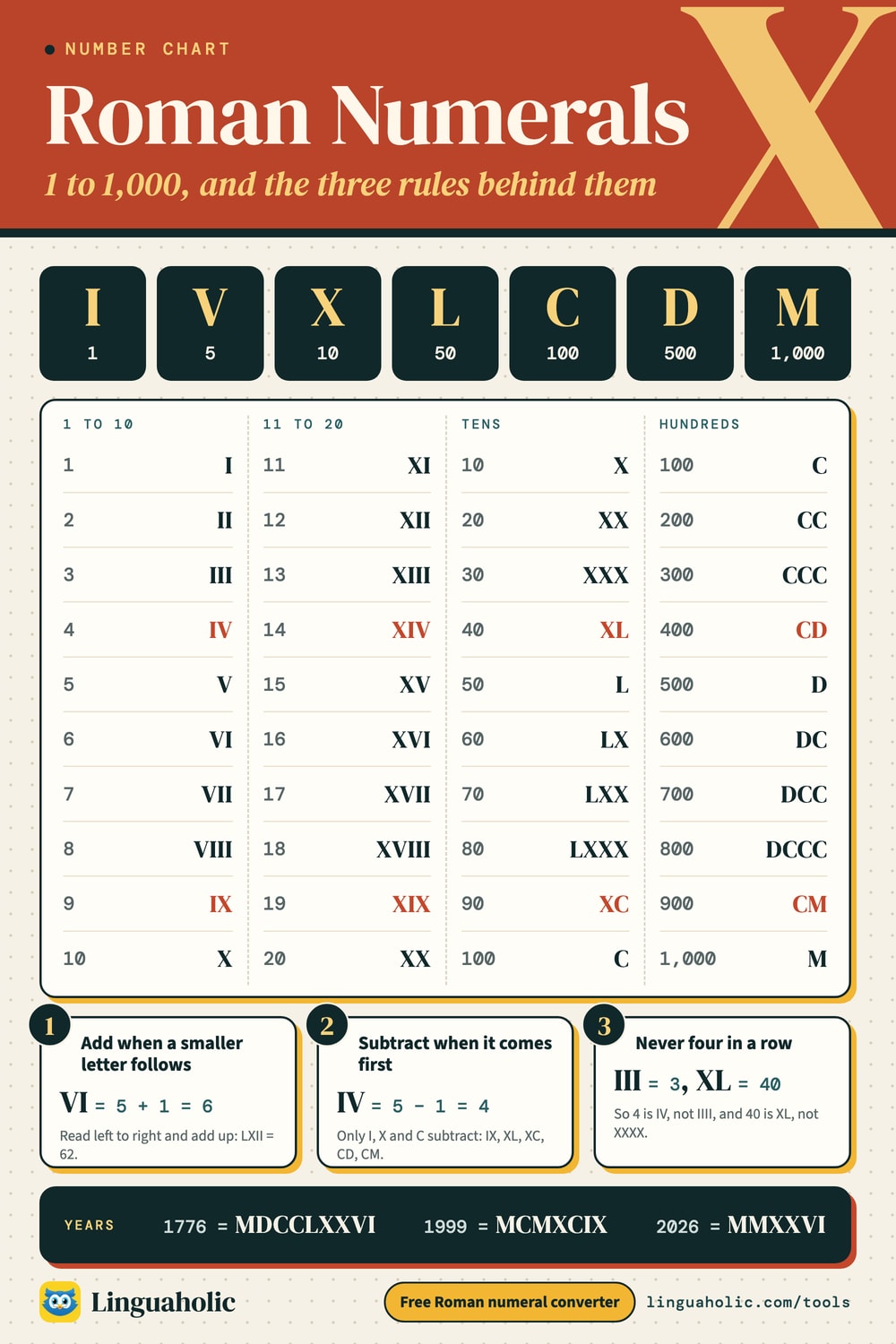
Roman numerals use seven letters. Every number from 1 to 3999 is written with combinations of these:
| Roman numeral letter | Value |
|---|---|
| I | 1 |
| V | 5 |
| X | 10 |
| L | 50 |
| C | 100 |
| D | 500 |
| M | 1,000 |
Tricky numbers (subtractive form)
| Number | Roman numeral |
|---|---|
| 4 | IV |
| 9 | IX |
| 14 | XIV |
| 19 | XIX |
| 40 | XL |
| 49 | XLIX |
| 90 | XC |
| 99 | XCIX |
| 400 | CD |
| 900 | CM |
| 1999 | MCMXCIX |
| 3999 | MMMCMXCIX |
How to read Roman numerals, step by step
- Read from left to right, starting with the biggest values.
- If a letter is the same or bigger than the next one, add it:
VI= 5 + 1 = 6. - If a letter is smaller than the next one, subtract it:
IV= 5 − 1 = 4. - Group the pairs, then add everything up. Example:
MCMXC= M (1000) + CM (900) + XC (90) = 1990.
How to write a number in Roman numerals
Split the number into thousands, hundreds, tens, and ones, write each part, and join them. For 2026: 2000 = MM, 20 = XX, 6 = VI, so 2026 = MMXXVI. For 1984: 1000 = M, 900 = CM, 80 = LXXX, 4 = IV → MCMLXXXIV. The converter shows this breakdown under every result.
Three rules keep a numeral standard:
- I, X, C, and M can repeat up to three times in a row (III = 3, XXX = 30); V, L, and D never repeat.
- Only I, X, and C are used to subtract, and only from the next two letters up: IV, IX, XL, XC, CD, CM. So 99 is XCIX, not IC.
- Bigger values always come first, except for those six subtractive pairs.
Roman numerals chart
Every number from 1 to 100, plus the tens, hundreds, and thousands — handy for homework, chapter numbers, and outlines.
Roman numerals 1 to 100
| Number | Roman numeral |
|---|---|
| 1 | I |
| 2 | II |
| 3 | III |
| 4 | IV |
| 5 | V |
| 6 | VI |
| 7 | VII |
| 8 | VIII |
| 9 | IX |
| 10 | X |
| 11 | XI |
| 12 | XII |
| 13 | XIII |
| 14 | XIV |
| 15 | XV |
| 16 | XVI |
| 17 | XVII |
| 18 | XVIII |
| 19 | XIX |
| 20 | XX |
| 21 | XXI |
| 22 | XXII |
| 23 | XXIII |
| 24 | XXIV |
| 25 | XXV |
| 26 | XXVI |
| 27 | XXVII |
| 28 | XXVIII |
| 29 | XXIX |
| 30 | XXX |
| 31 | XXXI |
| 32 | XXXII |
| 33 | XXXIII |
| 34 | XXXIV |
| 35 | XXXV |
| 36 | XXXVI |
| 37 | XXXVII |
| 38 | XXXVIII |
| 39 | XXXIX |
| 40 | XL |
| 41 | XLI |
| 42 | XLII |
| 43 | XLIII |
| 44 | XLIV |
| 45 | XLV |
| 46 | XLVI |
| 47 | XLVII |
| 48 | XLVIII |
| 49 | XLIX |
| 50 | L |
| 51 | LI |
| 52 | LII |
| 53 | LIII |
| 54 | LIV |
| 55 | LV |
| 56 | LVI |
| 57 | LVII |
| 58 | LVIII |
| 59 | LIX |
| 60 | LX |
| 61 | LXI |
| 62 | LXII |
| 63 | LXIII |
| 64 | LXIV |
| 65 | LXV |
| 66 | LXVI |
| 67 | LXVII |
| 68 | LXVIII |
| 69 | LXIX |
| 70 | LXX |
| 71 | LXXI |
| 72 | LXXII |
| 73 | LXXIII |
| 74 | LXXIV |
| 75 | LXXV |
| 76 | LXXVI |
| 77 | LXXVII |
| 78 | LXXVIII |
| 79 | LXXIX |
| 80 | LXXX |
| 81 | LXXXI |
| 82 | LXXXII |
| 83 | LXXXIII |
| 84 | LXXXIV |
| 85 | LXXXV |
| 86 | LXXXVI |
| 87 | LXXXVII |
| 88 | LXXXVIII |
| 89 | LXXXIX |
| 90 | XC |
| 91 | XCI |
| 92 | XCII |
| 93 | XCIII |
| 94 | XCIV |
| 95 | XCV |
| 96 | XCVI |
| 97 | XCVII |
| 98 | XCVIII |
| 99 | XCIX |
| 100 | C |
Tens (10–100)
| Number | Roman numeral |
|---|---|
| 10 | X |
| 20 | XX |
| 30 | XXX |
| 40 | XL |
| 50 | L |
| 60 | LX |
| 70 | LXX |
| 80 | LXXX |
| 90 | XC |
| 100 | C |
Hundreds (100–1000)
| Number | Roman numeral |
|---|---|
| 100 | C |
| 200 | CC |
| 300 | CCC |
| 400 | CD |
| 500 | D |
| 600 | DC |
| 700 | DCC |
| 800 | DCCC |
| 900 | CM |
| 1000 | M |
Thousands
| Number | Roman numeral |
|---|---|
| 1000 | M |
| 2000 | MM |
| 3000 | MMM |
Years in Roman numerals
Years are among the most-searched Roman numerals — for birth years, weddings, graduations, and film credits. 2026 in Roman numerals is MMXXVI, 2025 is MMXXV, and 2000 is simply MM. Years from 1990 to 2040:
| Year | Roman numeral |
|---|---|
| 1990 | MCMXC |
| 1991 | MCMXCI |
| 1992 | MCMXCII |
| 1993 | MCMXCIII |
| 1994 | MCMXCIV |
| 1995 | MCMXCV |
| 1996 | MCMXCVI |
| 1997 | MCMXCVII |
| 1998 | MCMXCVIII |
| 1999 | MCMXCIX |
| 2000 | MM |
| 2001 | MMI |
| 2002 | MMII |
| 2003 | MMIII |
| 2004 | MMIV |
| 2005 | MMV |
| 2006 | MMVI |
| 2007 | MMVII |
| 2008 | MMVIII |
| 2009 | MMIX |
| 2010 | MMX |
| 2011 | MMXI |
| 2012 | MMXII |
| 2013 | MMXIII |
| 2014 | MMXIV |
| 2015 | MMXV |
| 2016 | MMXVI |
| 2017 | MMXVII |
| 2018 | MMXVIII |
| 2019 | MMXIX |
| 2020 | MMXX |
| 2021 | MMXXI |
| 2022 | MMXXII |
| 2023 | MMXXIII |
| 2024 | MMXXIV |
| 2025 | MMXXV |
| 2026 | MMXXVI |
| 2027 | MMXXVII |
| 2028 | MMXXVIII |
| 2029 | MMXXIX |
| 2030 | MMXXX |
| 2031 | MMXXXI |
| 2032 | MMXXXII |
| 2033 | MMXXXIII |
| 2034 | MMXXXIV |
| 2035 | MMXXXV |
| 2036 | MMXXXVI |
| 2037 | MMXXXVII |
| 2038 | MMXXXVIII |
| 2039 | MMXXXIX |
| 2040 | MMXL |
Roman numeral dates and tattoos
A Roman numeral date is one of the most popular tattoos — a birthday, wedding day, or a date to remember. The three parts are written separately, usually with dots or middle dots between them:
| Style | 14 February 2026 |
|---|---|
| US (month · day · year) | II · XIV · MMXXVI |
| UK / Europe (day · month · year) | XIV · II · MMXXVI |
| With periods | II.XIV.MMXXVI |
| Year only | MMXXVI |
Before you book the appointment:
- Decide on the order. II · XIV could be read as February 14 or the 2nd of the 14th month by someone used to the other style — pick the one that feels natural to you.
- Check every letter. Mistakes like IIII for 4 or IL for 49 are common in tattoos. Paste your design into the Convert tab — it flags any non-standard numeral.
- Try the fonts. Classic Roman capitals (like the Classic and Bold styles in the preview) suit short dates; thin or italic letters work well for small, delicate tattoos.
- Download the PNG and bring it to your artist so the spacing is exactly what you want.
Why do clocks use IIII instead of IV?
Many clock and watch faces show 4 as IIII rather than IV. It’s a long tradition rather than a mistake: IIII balances visually with the VIII on the other side of the dial, and it keeps the first four hours made of only I’s. Both forms have been used since Roman times, but IV is the standard today — so the converter reads IIII as 4 and tells you the standard spelling.
Large numbers: the bar over Roman numerals
Standard Roman numerals stop at 3999 (MMMCMXCIX). For bigger numbers, a bar called a vinculum is drawn over a numeral to multiply it by 1,000 — V̅ is 5,000 and X̅ is 10,000. One million is M̅ (M with a bar: 1000 × 1000). The converter writes numbers up to 3,999,999 this way, and the copied text uses a combining overline so the bar survives when you paste it.
| Number | Roman numeral | How to read it |
|---|---|---|
| 4,000 | IV | IV with a bar on top (4 × 1,000) |
| 5,000 | V | V with a bar on top (5 × 1,000) |
| 10,000 | X | X with a bar on top (10 × 1,000) |
| 50,000 | L | L with a bar on top (50 × 1,000) |
| 100,000 | C | C with a bar on top (100 × 1,000) |
| 500,000 | D | D with a bar on top (500 × 1,000) |
| 1,000,000 | M | M with a bar on top (1,000 × 1,000) |
Lowercase Roman numerals
Lowercase Roman numerals — i, ii, iii, iv, v — are used to number the front pages of books (prefaces and introductions), items in outlines and legal documents, and sub-points in lists. They mean exactly the same as capitals. Switch the converter to lowercase to copy them.
Copy and paste Roman numeral symbols
Usually you just type capital letters — I, V, X, L, C, D, and M — on any keyboard. Unicode also has special Roman numeral characters, including single-character forms of 1 to 12, which are handy for clock faces and lists:
Ⅰ Ⅱ Ⅲ Ⅳ Ⅴ Ⅵ Ⅶ Ⅷ Ⅸ Ⅹ Ⅺ Ⅻ Ⅼ Ⅽ Ⅾ Ⅿ
ⅰ ⅱ ⅲ ⅳ ⅴ ⅵ ⅶ ⅷ ⅸ ⅹ ⅺ ⅻ ⅼ ⅽ ⅾ ⅿ
Pick Unicode in the Convert tab to write any number with these characters. For normal writing, plain letters are better — they’re easier to search and read aloud.
Roman numerals that multiply to 35
A popular online password puzzle asks for Roman numerals that multiply to 35. Since 35 = 5 × 7, you can write the two numerals V and VII separately (V × VII = 35), or simply write XXXV, which is 35 on its own. An extra I counts as 1, so it doesn’t change the product. Use the Calculator tab to check other combinations — for example, X × X = C (100).
Is there a zero in Roman numerals?
No. The Roman system had no symbol for zero and no negative numbers — it was made for counting and recording amounts, not for place-value arithmetic. Medieval scholars sometimes wrote nulla (“nothing”) or N for zero. Zero as a number reached Europe later, through the Hindu–Arabic numerals we use today.
English words made of Roman numerals
Some everyday words use only the letters I, V, X, L, C, D, and M. From our English dictionary, only MIX (1009) is also a correctly written Roman numeral. The rest break the rules — but here’s what their letters add up to:
| Word | Real numeral? | Letters added up |
|---|---|---|
| MIX | Yes — 1009 | 1011 |
| CIVIC | No | 207 |
| CIVIL | No | 157 |
| LIVID | No | 557 |
| MIMIC | No | 2102 |
| VIVID | No | 512 |
| DILL | No | 601 |
| MILD | No | 1551 |
| MILL | No | 1101 |
| DID | No | 1001 |
| DIM | No | 1501 |
| ILL | No | 101 |
| LID | No | 551 |
Practice reading Roman numerals
The quickest way to get fluent is a few minutes of practice. Open the Practice tab, start with 1–20, and move up to 1–100 and 1–1000 as you get faster. It’s a simple Roman numeral game for classrooms too — put it on the board and let students shout out the answers. For more number fun, try the Binary Game or the Binary Converter.
Is anything sent to a server?
No. This Roman numeral converter runs entirely in your browser. Nothing you enter is uploaded or stored — only your best practice score is saved, on your own device.
Credits
Tattoo preview fonts: Cinzel (© The Cinzel Project Authors) and Cormorant Garamond (© The Cormorant Project Authors), both used under the SIL Open Font License 1.1.
For teachers, bloggers & clubs
Put the Roman Numeral Converter on your website
Give your readers this tool right on your page. Copy the code, paste it into your site, done: no sign-up, no account.
- Free for any website
- No ads, no cookies
- Fits phones and sidebars
- Always up to date
Please keep the small credit line under the tool; you may add rel="nofollow" to its link. How it works & the rules

› Show the code
Frequently asked questions
- How do I convert a number to Roman numerals?
- Type the number into the Convert box and the Roman numeral appears instantly — 2026 becomes MMXXVI. Type a Roman numeral instead and it converts back to a number. The breakdown under the result shows how it's built: MM (2000) + XX (20) + VI (6).
- How do Roman numerals work?
- Seven letters have fixed values: I=1, V=5, X=10, L=50, C=100, D=500, M=1000. You add them left to right (VI = 6). When a smaller value comes before a larger one, you subtract it (IV = 4, IX = 9). I, X, C, and M repeat at most three times in a row.
- What is 4 in Roman numerals?
- 4 is IV (5 minus 1), and 9 is IX (10 minus 1). The same pattern gives 40 = XL, 90 = XC, 400 = CD, and 900 = CM. Clock faces often show 4 as IIII by tradition, but IV is the standard form.
- What is 2026 in Roman numerals?
- 2026 is MMXXVI: MM (2000) + XX (20) + VI (6). 2025 is MMXXV and 2000 is MM.
- How do I write a date in Roman numerals for a tattoo?
- Open the Date tab, enter the day, month, and year, and choose the order — month · day · year (US) or day · month · year. 14 February 2026 becomes II · XIV · MMXXVI or XIV · II · MMXXVI. Preview it in tattoo fonts, then copy it or download a PNG for your artist.
- How do you write 1 million in Roman numerals?
- One million is M with a bar over it (M̅). A bar, called a vinculum, multiplies a numeral by 1,000 — so V̅ is 5,000 and X̅ is 10,000. The converter writes numbers up to 3,999,999 this way.
- Which Roman numerals multiply to 35?
- V and VII, because 5 × 7 = 35. Write them as two separate numerals. XXXV is also 35 on its own, and an extra I (1) doesn't change the product.
- Why is there no zero in Roman numerals?
- The Roman system was made for counting and recording amounts, so it never needed a symbol for zero — or for negative numbers. Zero reached European mathematics much later, through the Hindu–Arabic numerals we use today.
About this page
The Roman Numeral Converter is a free tool from Linguaholic, made by Marcel Iseli. It runs in your browser, with no sign-up. Last updated .
Keep exploring
More free tools
 Morse Code TranslatorTranslate text to Morse code and back, hear it as sound at any speed, and see the full Morse alphabet chart.
 Binary TranslatorConvert text to binary code and binary back to text.
 Binary ConverterConvert between binary, decimal, hex, and octal as you type.
 Binary CalculatorAdd, subtract, multiply and divide binary with every carry, borrow and two's complement shown.
 NATO Phonetic AlphabetSpell any name in Alpha, Bravo, Charlie — with audio and a printable chart.
 Braille TranslatorText to braille and back (UEB grade 1), with dot numbers, name cards and a printable chart.