
Converters & translators
Binary Translator — Text to Binary & Binary to Text
Translate text to binary and binary code back to text — auto-detects what you paste, works with every language and emoji (UTF-8), shows each character's code, decimal, hex and binary, and includes a full binary alphabet chart.
Updated · Free, no sign-up
Character by character
| Char | Code point | Decimal | Hex | Binary (UTF-8) |
|---|---|---|---|---|
| H | U+0048 | 72 | 48 | 01001000 |
| e | U+0065 | 101 | 65 | 01100101 |
| l | U+006C | 108 | 6C | 01101100 |
| l | U+006C | 108 | 6C | 01101100 |
| o | U+006F | 111 | 6F | 01101111 |
Share this tool
Know someone who’d love it?
What is a binary translator?
A binary translator converts text into binary code — the 0s and 1s computers use — and binary code back into readable text. Every letter, number, and symbol is stored as a number, and binary is the base-2 way of writing those numbers. This translator works in both directions, detects what you pasted automatically, and handles every language and emoji.
How to use the binary translator
- Type or paste into the box. Auto-detect recognizes binary (only 0s and 1s) and decodes it to text; anything else is translated to binary.
- Choose how to separate the bytes — spaces (the usual way), nothing, commas, or new lines. When decoding, both spaced and unspaced binary work.
- Tap Swap to turn the result around, or Copy to save it.
- Check the character-by-character table to see each letter’s code point, decimal, hex, and binary value.
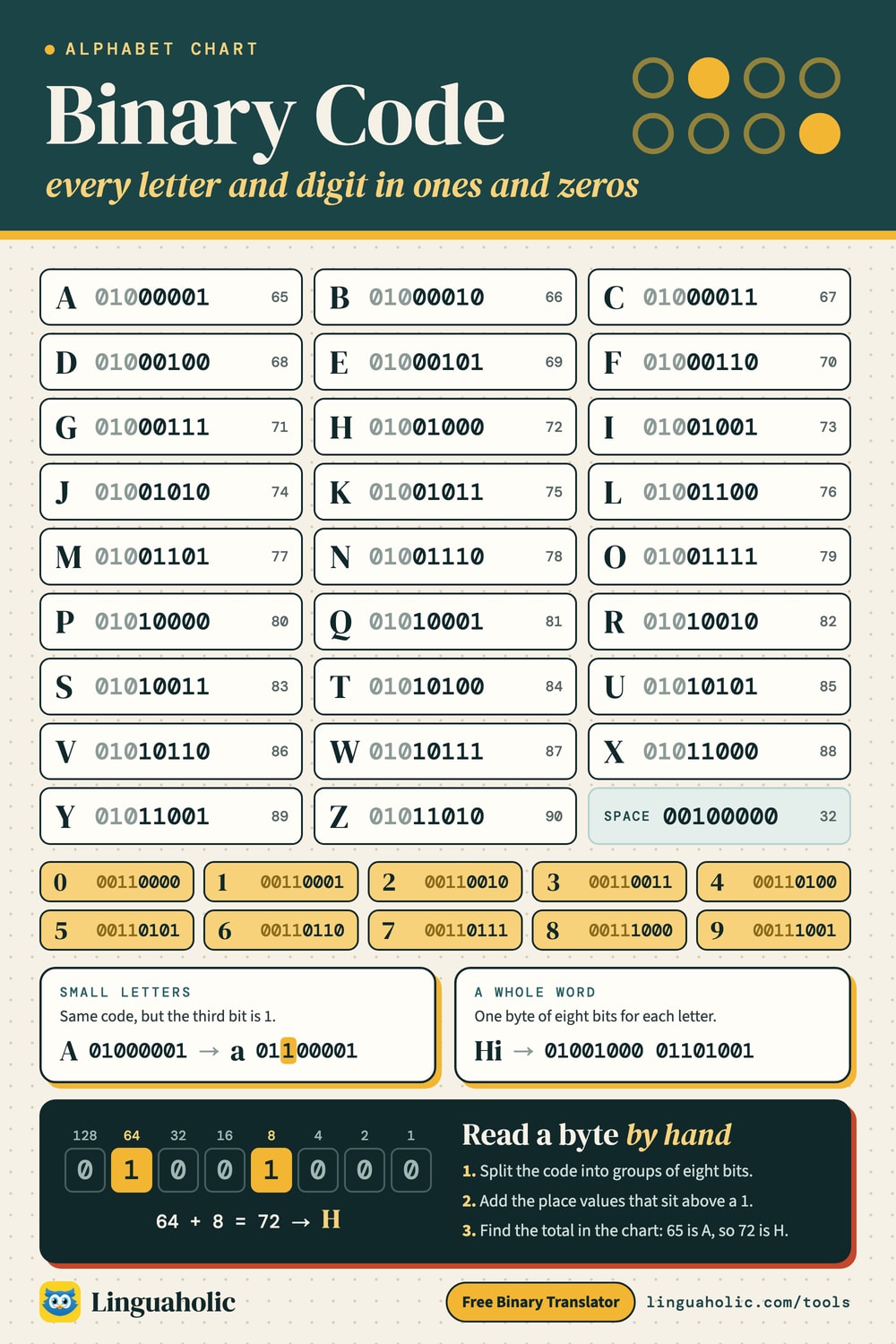
Binary alphabet chart

Binary to English (and every other language)
This translator uses UTF-8, the encoding used by almost every website and app. Plain English letters take one byte (8 bits) each, exactly as in the classic ASCII table. Accented letters, other alphabets, and emoji take two to four bytes — so they translate correctly instead of turning into question marks:
| Character | Binary (UTF-8) |
|---|---|
| é (French, Spanish) | 11000011 10101001 |
| ñ (Spanish) | 11000011 10110001 |
| ü (German) | 11000011 10111100 |
| € (euro sign) | 11100010 10000010 10101100 |
| 中 (Chinese) | 11100100 10111000 10101101 |
| 😊 (emoji) | 11110000 10011111 10011000 10001010 |
Need the older one-number-per-character format? Switch Encoding to Unicode code points.
How binary code works
Binary is a base-2 number system: each digit (a bit) is 0 or 1, and the place values double from right to left — 1, 2, 4, 8, 16, 32, 64, 128. Eight bits make one byte, which can store 256 values (0–255). Text is turned into numbers by a standard such as ASCII or UTF-8, and those numbers are written in binary. The letter H is number 72, which is 01001000: 64 + 8 = 72.
How to read binary code, step by step
- Split the binary into bytes — groups of 8 bits:
01001000 01101001. - Write the place values above each byte: 128, 64, 32, 16, 8, 4, 2, 1.
- Add up the place values wherever there’s a 1:
01001000= 64 + 8 = 72, and01101001= 64 + 32 + 8 + 1 = 105. - Look the numbers up in the ASCII table (or the chart below): 72 = H and 105 = i — the message is “Hi”.
Want to get fast at it? Practice with the Binary Game.
Binary alphabet chart
Every uppercase and lowercase letter, digit, and common punctuation mark in 8-bit binary. Uppercase letters start at 65 (A = 01000001) and lowercase letters are exactly 32 higher (a = 01100001) — only the third bit changes.
Letters A–Z in binary (8-bit ASCII)
| Character | Binary (8-bit ASCII) |
|---|---|
| A | 01000001 |
| B | 01000010 |
| C | 01000011 |
| D | 01000100 |
| E | 01000101 |
| F | 01000110 |
| G | 01000111 |
| H | 01001000 |
| I | 01001001 |
| J | 01001010 |
| K | 01001011 |
| L | 01001100 |
| M | 01001101 |
| N | 01001110 |
| O | 01001111 |
| P | 01010000 |
| Q | 01010001 |
| R | 01010010 |
| S | 01010011 |
| T | 01010100 |
| U | 01010101 |
| V | 01010110 |
| W | 01010111 |
| X | 01011000 |
| Y | 01011001 |
| Z | 01011010 |
Lowercase letters a–z in binary
| Character | Binary (8-bit ASCII) |
|---|---|
| a | 01100001 |
| b | 01100010 |
| c | 01100011 |
| d | 01100100 |
| e | 01100101 |
| f | 01100110 |
| g | 01100111 |
| h | 01101000 |
| i | 01101001 |
| j | 01101010 |
| k | 01101011 |
| l | 01101100 |
| m | 01101101 |
| n | 01101110 |
| o | 01101111 |
| p | 01110000 |
| q | 01110001 |
| r | 01110010 |
| s | 01110011 |
| t | 01110100 |
| u | 01110101 |
| v | 01110110 |
| w | 01110111 |
| x | 01111000 |
| y | 01111001 |
| z | 01111010 |
Digits 0–9 in binary
| Character | Binary (8-bit ASCII) |
|---|---|
| 0 | 00110000 |
| 1 | 00110001 |
| 2 | 00110010 |
| 3 | 00110011 |
| 4 | 00110100 |
| 5 | 00110101 |
| 6 | 00110110 |
| 7 | 00110111 |
| 8 | 00111000 |
| 9 | 00111001 |
Space and punctuation in binary
| Character | Binary (8-bit ASCII) |
|---|---|
| space | 00100000 |
| ! | 00100001 |
| , | 00101100 |
| . | 00101110 |
| ? | 00111111 |
| ' | 00100111 |
| " | 00100010 |
| - | 00101101 |
| : | 00111010 |
| ; | 00111011 |
| ( | 00101000 |
| ) | 00101001 |
| @ | 01000000 |
| # | 00100011 |
| & | 00100110 |
Common words and phrases in binary
Popular for gifts, cards, jewelry, and secret messages — here’s how they look in binary:
| Phrase | Binary |
|---|---|
| I love you | 01001001 00100000 01101100 01101111 01110110 01100101 00100000 01111001 01101111 01110101 |
| Hello | 01001000 01100101 01101100 01101100 01101111 |
| Hello world | 01001000 01100101 01101100 01101100 01101111 00100000 01110111 01101111 01110010 01101100 01100100 |
| Hi | 01001000 01101001 |
| Help | 01001000 01100101 01101100 01110000 |
| Yes | 01011001 01100101 01110011 |
| No | 01001110 01101111 |
| Thank you | 01010100 01101000 01100001 01101110 01101011 00100000 01111001 01101111 01110101 |
| Happy birthday | 01001000 01100001 01110000 01110000 01111001 00100000 01100010 01101001 01110010 01110100 01101000 01100100 01100001 01111001 |
| Good night | 01000111 01101111 01101111 01100100 00100000 01101110 01101001 01100111 01101000 01110100 |
Binary text vs. binary numbers
“Binary” can mean two different things. Translating text gives one byte per character (as above). Converting a number is base conversion: the number 42 is simply 101010 — use the Binary Converter for decimal, hex, and octal, and the Binary Calculator to add, subtract, multiply, and divide binary numbers.
Related tools
Also try the Hex to Text converter, the Morse Code Translator, and the ASCII Art Generator.
Is anything uploaded?
No. The binary translator runs entirely in your browser — nothing you type is uploaded or stored, and it works offline.
For teachers, bloggers & clubs
Put the Binary Translator on your website
Give your readers this tool right on your page. Copy the code, paste it into your site, done: no sign-up, no account.
- Free for any website
- No ads, no cookies
- Fits phones and sidebars
- Always up to date
Please keep the small credit line under the tool; you may add rel="nofollow" to its link. How it works & the rules

› Show the code
Frequently asked questions
- How do I translate binary to text?
- Paste the binary into the box — with or without spaces. Auto-detect recognizes it and decodes it to text instantly. Each group of 8 bits is one byte; the translator reads the bytes as UTF-8, so English and every other language come out correctly.
- How do I convert text to binary?
- Type your text and the binary code appears immediately. Choose whether to separate the bytes with spaces, nothing, commas, or new lines, then tap Copy.
- Does it work with accents, other languages, and emoji?
- Yes. The translator uses UTF-8, the standard encoding of the web: English letters take one byte each, while letters like é or ñ, other alphabets, and emoji take two to four bytes — and they decode back perfectly.
- How do you read binary code by hand?
- Split it into groups of 8 bits, add up the place values (128, 64, 32, 16, 8, 4, 2, 1) wherever there's a 1, and look the number up in the ASCII table: 01001000 = 72 = H.
- What is 'I love you' in binary?
- 01001001 00100000 01101100 01101111 01110110 01100101 00100000 01111001 01101111 01110101. Type any phrase to get its binary code.
- What's the difference between binary text and binary numbers?
- Translating text gives one byte per character. Converting a number is base conversion (42 = 101010) — use the Binary Converter for decimal, hex, and octal.
- Is anything uploaded?
- No. Everything runs in your browser — nothing you type is uploaded or stored.
About this page
The Binary Translator is a free tool from Linguaholic, made by Marcel Iseli. It runs in your browser, with no sign-up. Last updated .
Keep exploring
More free tools
 Morse Code TranslatorTranslate text to Morse code and back, hear it as sound at any speed, and see the full Morse alphabet chart.
 Roman Numeral ConverterNumbers to Roman numerals and back — plus dates, a chart, and a calculator.
 Binary ConverterConvert between binary, decimal, hex, and octal as you type.
 Binary CalculatorAdd, subtract, multiply and divide binary with every carry, borrow and two's complement shown.
 NATO Phonetic AlphabetSpell any name in Alpha, Bravo, Charlie — with audio and a printable chart.
 Braille TranslatorText to braille and back (UEB grade 1), with dot numbers, name cards and a printable chart.