
Converters & translators
NATO Phonetic Alphabet
Spell any name or code in the NATO phonetic alphabet (Alpha, Bravo, Charlie…), hear it word by word, decode code words, practice with quick drills, and print the chart — with the police and WWII alphabets too.
Updated · Free, no sign-up
Share this tool
Know someone who’d love it?
What is the NATO phonetic alphabet?
The NATO phonetic alphabet gives every letter a distinct code word — A is Alpha, B is Bravo, C is Charlie — so letters can be spelled clearly over radio or phone, even through noise, accents, or a bad connection. It’s also called the military alphabet, the ICAO alphabet, or officially the International Radiotelephony Spelling Alphabet. Pilots, air traffic controllers, ships, armed forces, emergency services, and call centers all use it.
How to use this tool
- Spell: type a name, email, or booking code and see it letter by letter in code words, with pronunciations. Switch between the NATO, police, and WWII alphabets. Tap Listen to hear it read out word by word, at slow, normal, or fast speed, and copy it as code words, a letter list, or pronunciations.
- Decode: paste code words (“Sierra Oscar Sierra”) to turn them back into text. It understands all three alphabets and spellings like Alfa, Juliet, and Niner.
- Practice: four quick drills — letter to code word, code word to letter, spelling real words, and listening. The spelling and listening words come from our English dictionary, so they’re different every time.
NATO phonetic alphabet chart

NATO phonetic alphabet chart
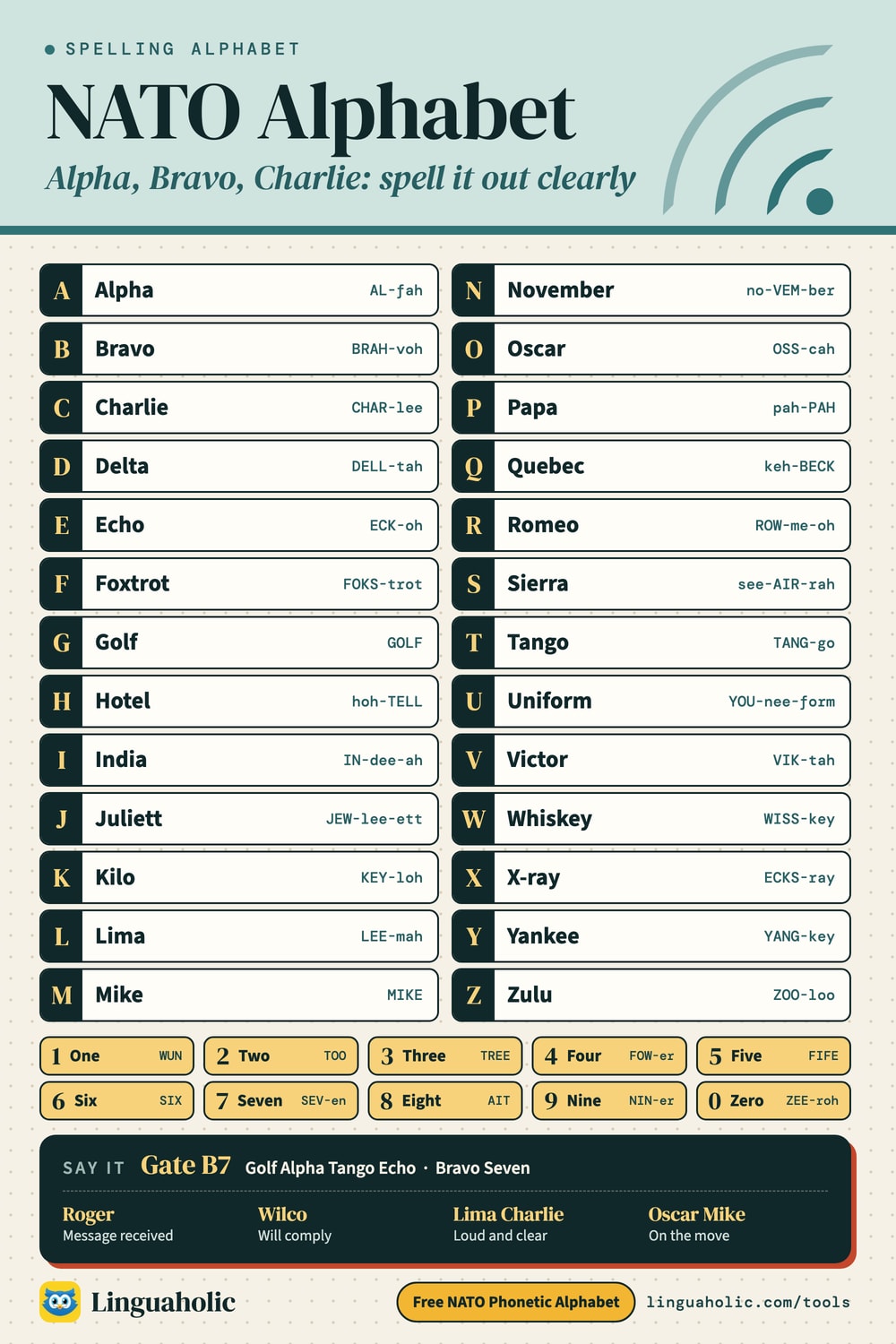
All 26 code words with their pronunciation (the stressed part is in capitals), the radio numbers, and a printable version. Tap any letter to hear it.
| Letter | Code word | Pronunciation |
|---|---|---|
| A | AL-fah | |
| B | BRAH-voh | |
| C | CHAR-lee | |
| D | DELL-tah | |
| E | ECK-oh | |
| F | FOKS-trot | |
| G | GOLF | |
| H | hoh-TELL | |
| I | IN-dee-ah | |
| J | JEW-lee-ett | |
| K | KEY-loh | |
| L | LEE-mah | |
| M | MIKE | |
| N | no-VEM-ber | |
| O | OSS-cah | |
| P | pah-PAH | |
| Q | keh-BECK | |
| R | ROW-me-oh | |
| S | see-AIR-rah | |
| T | TANG-go | |
| U | YOU-nee-form | |
| V | VIK-tah | |
| W | WISS-key | |
| X | ECKS-ray | |
| Y | YANG-key | |
| Z | ZOO-loo |
Numbers (0–9) and radio words
| Number | Word | Pronunciation |
|---|---|---|
| 0 | ZEE-roh | |
| 1 | WUN | |
| 2 | TOO | |
| 3 | TREE | |
| 4 | FOW-er | |
| 5 | FIFE | |
| 6 | SIX | |
| 7 | SEV-en | |
| 8 | AIT | |
| 9 | NIN-er | |
| . | DAY-see-mal | |
| 00 | HUN-dred | |
| 000 | TOU-sand |
How to pronounce the code words
The pronunciations above follow the official ICAO guide. A few are worth noting: Papa is stressed at the end (pah-PAH), Hotel is hoh-TELL, Quebec is keh-BECK, and Charlie may also be said “SHAR-lee.” The official spellings are Alfa and Juliett: with “ph,” speakers of some languages might not say an F sound, and the double T tells French speakers the final T isn’t silent. Most people write Alpha and Juliet, and both are understood.
Numbers in the phonetic alphabet
Numbers are spoken digit by digit, with a few special pronunciations so they can’t be confused: 3 is “tree,” 4 is “fower,” 5 is “fife,” and 9 is “niner” (so it isn’t mistaken for five, or for the German nein). Round numbers use “hundred” and “thousand”: 1,500 is “wun tousand fife hundred.” A decimal point is “decimal” (or “point”), so 118.1 is “wun wun ait decimal wun.”
The police alphabet (LAPD / APCO)
Many US police departments, including the LAPD, and other public-safety agencies use the APCO police alphabet instead of NATO’s. It uses first names and everyday words — Adam, Boy, Charles, David — which is why you hear “Adam,” “Lincoln,” or “Mary” on police radio. More and more agencies are switching to NATO for working with other services, but the police alphabet is still widely used. Here are the NATO, police, and WWII alphabets side by side:
| Letter | NATO | Police (APCO) | WWII (US) |
|---|---|---|---|
| A | Alpha | Adam | Able |
| B | Bravo | Boy | Baker |
| C | Charlie | Charles | Charlie |
| D | Delta | David | Dog |
| E | Echo | Edward | Easy |
| F | Foxtrot | Frank | Fox |
| G | Golf | George | George |
| H | Hotel | Henry | How |
| I | India | Ida | Item |
| J | Juliett | John | Jig |
| K | Kilo | King | King |
| L | Lima | Lincoln | Love |
| M | Mike | Mary | Mike |
| N | November | Nora | Nan |
| O | Oscar | Ocean | Oboe |
| P | Papa | Paul | Peter |
| Q | Quebec | Queen | Queen |
| R | Romeo | Robert | Roger |
| S | Sierra | Sam | Sugar |
| T | Tango | Tom | Tare |
| U | Uniform | Union | Uncle |
| V | Victor | Victor | Victor |
| W | Whiskey | William | William |
| X | X-ray | X-ray | X-ray |
| Y | Yankee | Young | Yoke |
| Z | Zulu | Zebra | Zebra |
The old military alphabet: Able, Baker, Charlie
Before NATO, the US Army and Navy used the Joint Army/Navy alphabet — Able, Baker, Charlie, Dog, Easy, Fox — throughout World War II. It worked well for English speakers but not for allies who spoke other languages. In the early 1950s the International Civil Aviation Organization (ICAO) worked with linguists to test words that are easy to say and hear in English, French, and Spanish. The result — Alfa, Bravo, Charlie — was adopted by ICAO and NATO in 1956 and is still used today. Pick WWII (Able Baker) in the tool to spell in the old alphabet.
Military and radio slang from the alphabet
The code words also turned into everyday radio shorthand:
| Phrase | Meaning |
|---|---|
| Roger | Message received (from the old R for Roger) |
| Wilco | Will comply |
| Bravo Zulu | Well done |
| Oscar Mike | On the move |
| Charlie Mike | Continue mission |
| Lima Charlie | Loud and clear |
| Mike / mikes | Minutes (“five mikes” = five minutes) |
| Romeo Tango Bravo | Return to base |
Spelling an email or booking code over the phone
- Say each letter as a code word and pause between groups: “Juliett Oscar Hotel November — at — …”.
- Say symbols as words: “at” (@), “dot” (.), “dash” or “hyphen” (-), “underscore” (_), “slash” (/).
- Say “number” before digits so they aren’t mistaken for letters: “number seven.”
- For booking codes, read them back to confirm. Copy the letter list from the Spell tab to have it in front of you.
How to memorize the phonetic alphabet
- Learn it in chunks of five or six letters (A–F, G–L, M–R, S–Z) instead of all 26 at once.
- Spell your own name, your street, and car number plates you see — out loud.
- Use the Practice tab: start with Letter → code word, then move on to spelling and listening drills.
- Notice the patterns: many words are familiar — Golf, Hotel, Tango, Whiskey, Zulu.
Is this the International Phonetic Alphabet (IPA)?
No. This is a spelling alphabet — code words for letters. The International Phonetic Alphabet (IPA) is a different system that linguists and dictionaries use to write down speech sounds, with symbols like /ʃ/ and /θ/. Despite the similar names, they have nothing in common.
More tools
Send messages in dots and dashes with the Morse Code Translator, or turn text into 0s and 1s with the Binary Translator.
Is anything sent to a server?
No. Everything runs in your browser, including the audio, so nothing you type is uploaded or stored. Your best practice scores are saved only on your own device.
For teachers, bloggers & clubs
Put the NATO Phonetic Alphabet on your website
Give your readers this tool right on your page. Copy the code, paste it into your site, done: no sign-up, no account.
- Free for any website
- No ads, no cookies
- Fits phones and sidebars
- Always up to date
Please keep the small credit line under the tool; you may add rel="nofollow" to its link. How it works & the rules

› Show the code
Frequently asked questions
- What is the NATO phonetic alphabet?
- A spelling alphabet that gives each letter a clear code word — A is Alpha, B is Bravo, C is Charlie — so letters are understood over radio or phone despite noise or accents. Officially it's the International Radiotelephony Spelling Alphabet, used by NATO, aviation, shipping, and the military.
- Is the NATO alphabet the same as the military alphabet?
- Yes. The 'military alphabet' is the NATO/ICAO phonetic alphabet (Alpha, Bravo, Charlie…). Armed forces, aviation, and shipping all use this same standard.
- How do I spell my name in the phonetic alphabet?
- Type your name into the Spell tab and it's spelled out letter by letter — Sam becomes Sierra Alpha Mike. Tap Listen to hear it word by word, or copy it as a letter list.
- What is the police phonetic alphabet?
- Many US police departments, including the LAPD, use the APCO alphabet: A is Adam, B is Boy, C is Charles, D is David, and so on. Choose Police in the tool to spell in it; the page has a side-by-side chart with NATO.
- What was the old military alphabet?
- In World War II the US used the Joint Army/Navy alphabet: Able, Baker, Charlie, Dog, Easy, Fox… It was replaced by today's NATO alphabet (Alfa, Bravo, Charlie) in 1956.
- How are numbers pronounced in the phonetic alphabet?
- Digit by digit, with a few special forms: 3 is 'tree', 4 is 'fower', 5 is 'fife', and 9 is 'niner'. Round numbers use 'hundred' and 'thousand', and a decimal point is 'decimal'.
- Is there a printable phonetic alphabet chart?
- Yes. Tap Print chart next to the chart and choose the NATO, police, or WWII alphabet for a clean one-page version.
- Is this the same as the International Phonetic Alphabet (IPA)?
- No. This is a spelling alphabet (code words for letters). The International Phonetic Alphabet is a different system linguists use to write speech sounds.
About this page
The NATO Phonetic Alphabet is a free tool from Linguaholic, made by Marcel Iseli. It runs in your browser, with no sign-up. Last updated .
Keep exploring
More free tools
 Morse Code TranslatorTranslate text to Morse code and back, hear it as sound at any speed, and see the full Morse alphabet chart.
 Roman Numeral ConverterNumbers to Roman numerals and back — plus dates, a chart, and a calculator.
 Binary TranslatorConvert text to binary code and binary back to text.
 Binary ConverterConvert between binary, decimal, hex, and octal as you type.
 Binary CalculatorAdd, subtract, multiply and divide binary with every carry, borrow and two's complement shown.
 Braille TranslatorText to braille and back (UEB grade 1), with dot numbers, name cards and a printable chart.