
Converters & translators
A1Z26 Cipher Decoder & Encoder
Decode and encode the A1Z26 cipher, where A=1, B=2 and Z=26: letters to numbers and numbers to letters, with a full chart and puzzle tips.
Updated · Free, no sign-up
Share this tool
Know someone who’d love it?
What is the A1Z26 cipher?
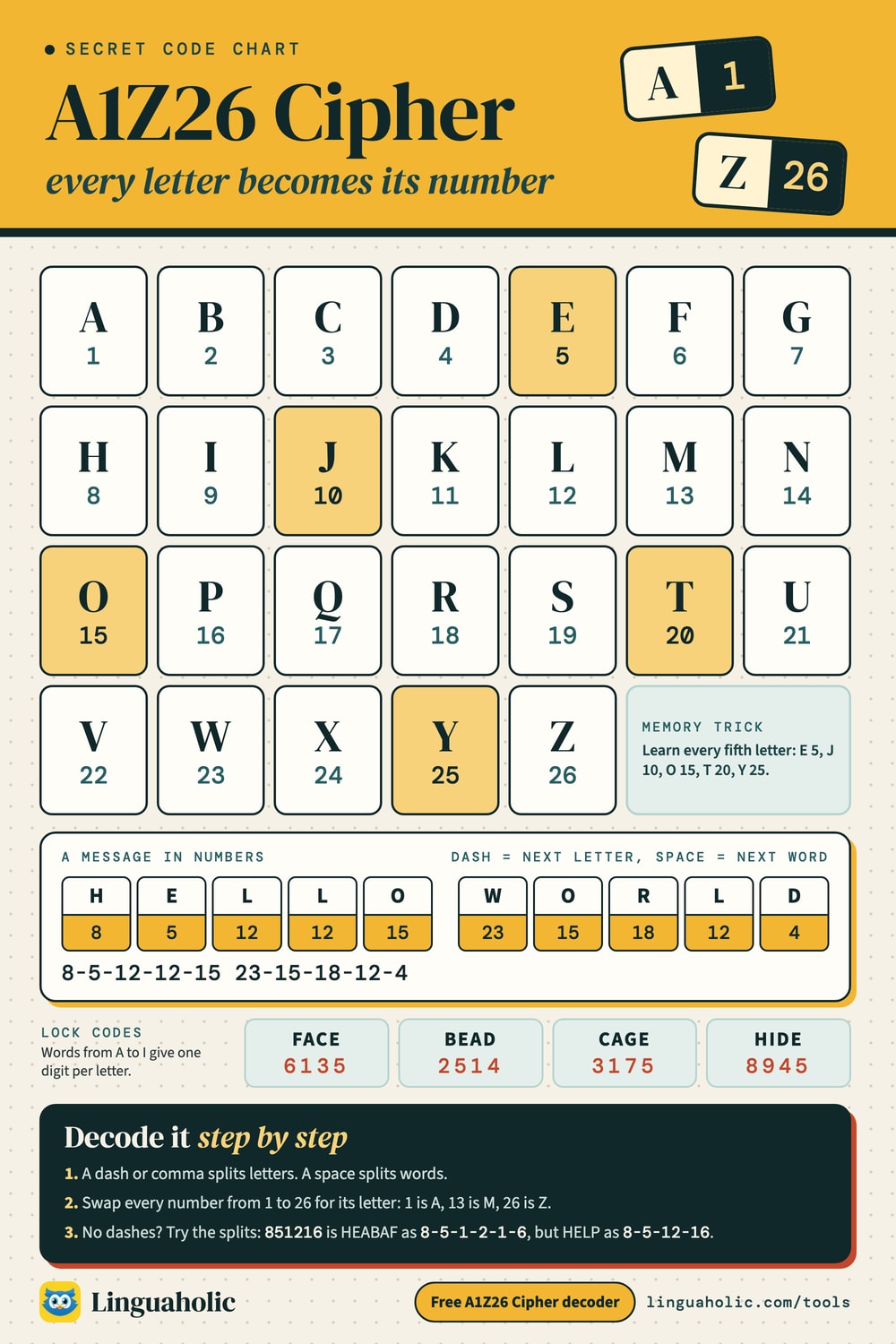
The A1Z26 cipher swaps every letter for its place in the alphabet. A is 1, B is 2, C is 3, and so on down to Z, which is 26. The name is the rule itself: A goes with 1 and Z goes with 26. You will also see it called the letter to number cipher, the alphabet number code, or simply numbers for letters.
It is the first code most people learn, because there is nothing to memorize and nothing to agree on in advance. That makes it a favorite for escape rooms, treasure hunts, birthday puzzles and classroom code breaking. For example, MEET ME AT NOON in A1Z26 is 13-5-5-20 13-5 1-20 14-15-15-14.
How to use the A1Z26 decoder and encoder
- Choose Encode to turn letters into numbers, or Decode to turn numbers back into letters.
- Type or paste your text. When you decode, the numbers can be separated by dashes, spaces, commas or slashes: anything that is not a digit counts as a break between letters, and a space marks a new word.
- Read the result as you type, then tap Copy.
When encoding, the tool joins the letters of a word with dashes and separates words with spaces, which is the most common way to write A1Z26. Numbers outside 1 to 26, punctuation and accents are skipped. The lookup table in the tool shows which number became which letter, so you can check a puzzle step by step. And if you are holding a string of numbers and are not sure it is A1Z26 at all, the cipher helper can suggest which code it looks like.
A1Z26 cipher chart

A1Z26 chart: letters to numbers
Here is the full alphabet with its numbers. The two extra columns are the most common variations, explained further down: reverse A1Z26, where Z is 1, and the zero-based version programmers use, where A is 0.
| Letter | A1Z26 | Reverse (Z=1) | Zero-based (A=0) |
|---|---|---|---|
| A | 1 | 26 | 0 |
| B | 2 | 25 | 1 |
| C | 3 | 24 | 2 |
| D | 4 | 23 | 3 |
| E | 5 | 22 | 4 |
| F | 6 | 21 | 5 |
| G | 7 | 20 | 6 |
| H | 8 | 19 | 7 |
| I | 9 | 18 | 8 |
| J | 10 | 17 | 9 |
| K | 11 | 16 | 10 |
| L | 12 | 15 | 11 |
| M | 13 | 14 | 12 |
| N | 14 | 13 | 13 |
| O | 15 | 12 | 14 |
| P | 16 | 11 | 15 |
| Q | 17 | 10 | 16 |
| R | 18 | 9 | 17 |
| S | 19 | 8 | 18 |
| T | 20 | 7 | 19 |
| U | 21 | 6 | 20 |
| V | 22 | 5 | 21 |
| W | 23 | 4 | 22 |
| X | 24 | 3 | 23 |
| Y | 25 | 2 | 24 |
| Z | 26 | 1 | 25 |
A quick way to find any letter without the chart: every fifth letter is a landmark. E is 5, J is 10, O is 15, T is 20 and Y is 25. Remember the made-up word EJOTY and you can count one or two steps from the nearest landmark. R, for instance, is two before T, so it is 18.
How to encode A1Z26 by hand
- Write your message in capital letters and leave out punctuation.
- Replace each letter with its number from the chart.
- Put a dash between the numbers of one word and a space (or a slash) between words.
Encoding MEET ME AT NOON word by word:
| Word | Letters | A1Z26 |
|---|---|---|
| MEET | M=13, E=5, E=5, T=20 | 13-5-5-20 |
| ME | M=13, E=5 | 13-5 |
| AT | A=1, T=20 | 1-20 |
| NOON | N=14, O=15, O=15, N=14 | 14-15-15-14 |
The finished message is 13-5-5-20 13-5 1-20 14-15-15-14. The separators matter more than they look, as the next section shows.
How to decode A1Z26 by hand: numbers to letters
Decoding is the same chart read the other way. Take 16-21-26-26-12-5 20-9-13-5:
| Numbers | Letters | Word |
|---|---|---|
16-21-26-26-12-5 | 16=P, 21=U, 26=Z, 26=Z, 12=L, 5=E | PUZZLE |
20-9-13-5 | 20=T, 9=I, 13=M, 5=E | TIME |
Two habits make hand decoding fast. First, anything from 14 up sits in the second half of the alphabet, so you can start counting from N (14) instead of from A. Second, work one word at a time and write each letter above its number, so you never lose your place.
When the numbers run together
If a puzzle prints the numbers with no separators, the message can often be read more than one way. HELP is 8-5-12-16, but written as 851216 it has 5 possible readings:
- HEABAF
- HEABP
- HEAUF
- HELAF
- HELP
Only one of them is a word, which is how you solve these: look for the reading that makes sense. A 1 or a 2 is the risky digit, because it can start a two-digit number (10 to 26). A 0 can never stand alone, so it always belongs to the number before it: 10 is J and 20 is T. When you write your own puzzles, use dashes or spaces unless the ambiguity is part of the challenge.
A1Z26 variations
Reverse A1Z26 (Z=1)
Counting from the other end gives Z=1, Y=2 and A=26. It is the same as applying the Atbash cipher (which flips the alphabet) and then A1Z26. To decode a reverse message here, decode it as usual and then run the result through Atbash. A useful shortcut: a letter’s normal number and its reverse number always add up to 27, so a 1 in a reverse message is 27 − 1 = 26, which is Z.
Zero-based A1Z26 (A=0)
In programming and in modular arithmetic, letters are usually numbered from 0, so A is 0 and Z is 25. The Caesar cipher and the affine cipher are both defined this way. If a message contains a 0 standing on its own, or never goes above 25, it may use this version: add 1 to every number and decode it normally.
A1Z26 with a shift or a second cipher
Puzzle makers like to stack A1Z26 on top of another cipher so the numbers do not give the answer away at once. The classic trio is Caesar, Atbash and A1Z26. Take the word TREASURE:
| Method | First step | Numbers |
|---|---|---|
| A1Z26 alone | TREASURE | 20-18-5-1-19-21-18-5 |
| Atbash, then A1Z26 | GIVZHFIV | 7-9-22-26-8-6-9-22 |
| Caesar shift 3, then A1Z26 | WUHDVXUH | 23-21-8-4-22-24-21-8 |
To solve a stacked puzzle, peel the layers in reverse: decode the numbers here first, and if the letters look like nonsense, try Atbash or the Caesar decoder on them.
Adding up letter values
Some puzzles ask for the value of a word: the sum of its letter numbers. CODE is 3 + 15 + 4 + 5 = 27. Word sums make good riddles (“find a pet worth 26”: DOG works, while CAT adds up to only 24) and good math practice, since every answer can be checked with the chart.
A1Z26 in escape rooms, puzzles and classrooms
- Number locks: pick a word whose letters all come before J, so each letter is a single digit, and the word becomes the lock code. FACE opens a lock set to
6135. Hide the word somewhere in the room and leave a small A=1 card as the hint. - Treasure hunts: write each clue as numbers on the back of the previous clue. Kids who can count to 26 can play, and older kids can be given reverse A1Z26 or a shifted version for a harder trail.
- Math practice: write each number as a sum or a product (4 + 4 for H, 3 × 5 for O) so the class solves the math before decoding the message.
- Layered puzzles: combine A1Z26 with Atbash, Caesar or a Polybius square for a puzzle with several steps.
- Secret notes: it is quick enough to write a whole sentence in a few minutes, which is why it shows up in notes passed between friends and in puzzles on TV shows and in games.
Is the A1Z26 cipher secure?
No. It has no key, so anyone who recognizes it can read it, and it is the first thing a solver tries when they see numbers no higher than 26. Even when it is stacked with another cipher, each letter is always replaced by the same number, so the letter-frequency panel in the tool quickly shows the usual pattern of English: one number turning up far more than the others is probably E (5) or T (20). Use it for fun and for teaching, never for anything private.
Letters to numbers: A1Z26 compared with other number codes
A1Z26 is not the only way to turn letters into digits or simple symbols. Here is the word HI in six of them:
| Code | HI | How it works |
|---|---|---|
| A1Z26 | 8-9 | Position in the alphabet |
| Polybius square | 23 24 | Row and column in a 5×5 grid |
| Tap code | 2-3 2-4 | Row and column, counted in taps |
| Bacon cipher | AABBB ABAAA | Five symbols of two kinds |
| Binary | 01001000 01001001 | The computer’s character code in base 2 |
| Morse code | .... .. | Dots and dashes |
If someone asks you to turn letters into numbers, A1Z26 is almost always what they mean. A phone keypad (2 for ABC, 3 for DEF) and letter grades are different systems with their own rules.
Free and private
This A1Z26 cipher tool runs entirely in your browser. It is free, needs no sign-up, and nothing you type is uploaded or stored.
For teachers, bloggers & clubs
Put the A1Z26 Cipher on your website
Give your readers this tool right on your page. Copy the code, paste it into your site, done: no sign-up, no account.
- Free for any website
- No ads, no cookies
- Fits phones and sidebars
- Always up to date
Please keep the small credit line under the tool; you may add rel="nofollow" to its link. How it works & the rules

› Show the code
Frequently asked questions
- What is the A1Z26 cipher?
- A1Z26 is a simple cipher that replaces each letter with its position in the alphabet: A=1, B=2, C=3 and so on up to Z=26. Letters in a word are usually joined with dashes and words separated by spaces, so HI is 8-9.
- How do you decode A1Z26?
- Replace each number with the letter at that position in the alphabet: 1 is A, 13 is M, 26 is Z. In the tool, choose Decode and paste the numbers; dashes, spaces, commas or slashes all work as separators.
- What does A1Z26 stand for?
- The name is the rule itself: A is 1 and Z is 26. It is also called the letter to number cipher or the alphabet number code.
- Is there a quick way to remember the A1Z26 numbers?
- Learn every fifth letter: E=5, J=10, O=15, T=20 and Y=25 (the made-up word EJOTY). Any other letter is one or two steps from one of them.
- What is reverse A1Z26?
- Reverse A1Z26 counts from the other end, so Z=1, Y=2 and A=26. It equals Atbash followed by A1Z26: decode the numbers normally, then run the result through an Atbash decoder.
- What if the A1Z26 numbers have no spaces or dashes?
- Then the message can often be read in several ways, because 1 and 2 can start a two-digit number. Try the splits that give real words: 851216 can be HEABAF or HELP, and only HELP makes sense.
- Is A1Z26 the same as a Caesar cipher?
- No. A Caesar cipher shifts letters to other letters, while A1Z26 turns letters into numbers. Puzzles often combine them, along with Atbash, so the numbers do not give the answer away at once.
- How can I use A1Z26 in an escape room?
- Use it for number locks: a word made of letters before J, such as FACE, becomes a code of single digits (6135). Hide the word in the room and leave a small A=1 card as the hint.
- Is A1Z26 secure?
- No. It has no key, so anyone who recognizes it can read it. It is great for puzzles, games and teaching, not for private messages.
- Is this A1Z26 tool free and private?
- Yes. It runs entirely in your browser with no sign-up, and nothing you type is uploaded or stored.
About this page
The A1Z26 Cipher is a free tool from Linguaholic, made by Marcel Iseli. It runs in your browser, with no sign-up. Last updated .
The code breaker's English letter frequencies and word checks come from Linguaholic’s English dictionary, built from the open ENABLE and SCOWL word lists. Licenses and notices.
Keep exploring
More free tools
 Caesar CipherShift letters to encode or decode, or crack a Caesar message without knowing the key.
 Atbash CipherMirror the alphabet (A↔Z, B↔Y) to encode or decode, with the full Atbash chart.
 Polybius SquareTurn letters into row-column number pairs on the 5×5 grid and back, with keyword squares.
 Bacon CipherTurn text into Bacon's five-letter A/B code and back, and hide a message in plain sight.
 Tap CodeTurn text into the 5×5 knock code prisoners tapped through walls, and decode taps back to text.
 Morse Code TranslatorTranslate text to Morse code and back, hear it as sound at any speed, and see the full Morse alphabet chart.