
Writing tools
Haiku Checker and Generator
Type a poem and see the syllables of every line checked against 5-7-5, with the words that can be said two ways marked and ideas to fix a line that is too long or too short. Also checks senryu, tanka, cinquain and lune, finds the season word, and puts together a haiku from our hand-written lines. Free, no sign-up.
Updated · Free, no sign-up
Three lines of 5, 7 and 5 syllables, usually about nature and a season.
✓ This is a haiku: 5-7-5
17 of 17 syllables · 3 lines
- Line 15 / 5 ✓first~1snow~1of~1the~1year~1
- Line 27 / 7 ✓the~1whole~1street~1is~1hushed~1and~1white~1
- Line 35 / 5 ✓a~1crow~1shakes~1its~1wings~1
Season word: snow (winter). Traditional haiku name or hint at a season like this.
Loading the dictionary… counts shown meanwhile are guesses from the spelling.
✓ Free · ✓ No sign-up · ✓ Nothing uploaded. Dictionary data: CMU Pronouncing Dictionary and WordNet 3.1 (sources & licenses).
Share this tool
Know someone who’d love it?
What is a haiku checker?
A haiku checker counts the syllables in each line of your poem and tells you whether it has the 5-7-5 shape of a haiku. This one uses a pronouncing dictionary of more than 50,000 English words, so “fire” and “every” are counted the way people say them, not guessed from the spelling. It marks the words that can be said two ways, shows how many syllables each line needs to gain or lose, and suggests words with the right number of syllables to fix it. It also checks senryu, tanka, cinquain and lune, and points out your season word.
No idea where to start? The haiku generator tab puts a haiku together from lines we wrote ourselves. Both are free, need no sign-up, and your poem never leaves your device.
How to use the haiku checker
- Type or paste your poem, one line of the poem on each line.
- Choose the form: Haiku (5-7-5) is the default. Tanka, cinquain, senryu, lune and a custom pattern are in the same menu.
- Read the result. A green check means the line fits. A red badge says add 2 or cut 1. Words with a dotted outline can be said two ways: tap one to count it the other way.
- Tap an idea under a line to swap in a word with the right number of syllables, or to drop a small word.
How to write a haiku

Haiku rules
A haiku is a short poem from Japan. In English, these are the rules teachers use, and the customs good haiku follow:
| Rule | What it means |
|---|---|
| Three lines | No more, no fewer. A haiku has no title. |
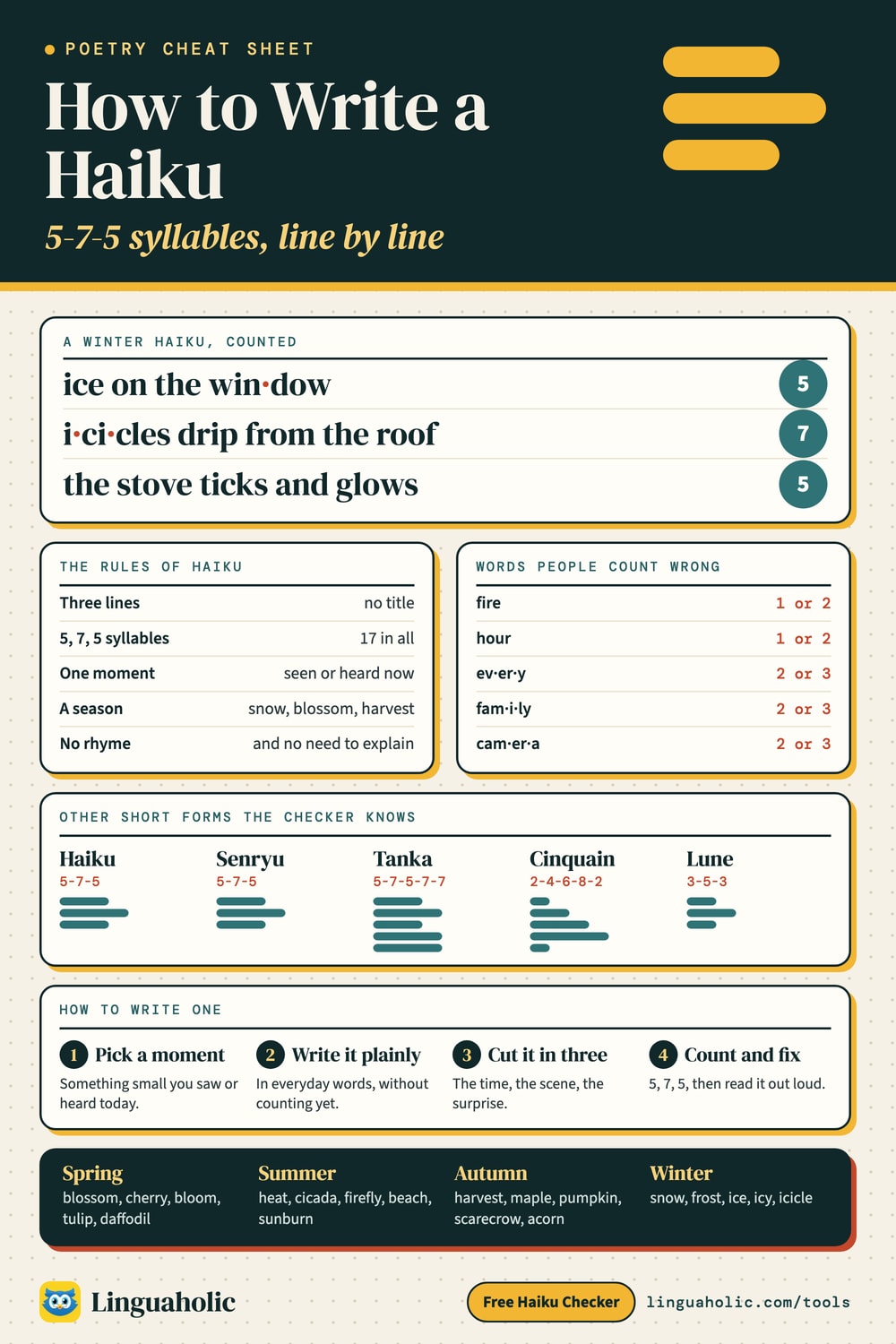
| 5-7-5 syllables | 5 in the first line, 7 in the second, 5 in the third: 17 in all. |
| One moment | A single thing seen or heard, now, in the present tense. |
| A season | A season word (kigo) such as snow or blossom tells when it happens. |
| A turn | Two images side by side, often with a pause between them (a cutting word, kireji, in Japanese). |
| Show, do not tell | Name what you see, not what you feel; let the reader feel it. |
| No rhyme | Haiku do not rhyme. Capital letters and punctuation are up to you. |
How to write a haiku
- Pick one moment. Something small you noticed: frost on a car, a dog asleep in the sun.
- Write it down in plain words, without counting yet: the first snow fell this morning and the street was very quiet and white, then a crow landed and shook the snow off.
- Cut it into three images. The time, the scene, the surprise: first snow / the quiet white street / a crow shakes its wings.
- Count and adjust. Paste it into the checker and add or cut syllables until it reads 5-7-5:
first snow of the year
the whole street is hushed and white
a crow shakes its wings
Read it out loud. If a line only works when you rush it, change a word instead of squeezing it.
Haiku examples
Ten haiku put together by the generator, one for each theme. The numbers are the syllables the checker counts in each line:
| Theme | Haiku | Syllables |
|---|---|---|
| Winter | first snow of the year the dog leaves a line of tracks the stars are so near | 5-7-5 |
| Christmas | a wreath on the door grandpa naps in his armchair a star on the top | 5-7-5 |
| Spring | soft April sunlight petals drift across the path a frog starts to sing | 5-7-5 |
| Summer | heat on the sidewalk bare feet run on the hot sand shade under the oak | 5-7-5 |
| Fall | apples in a crate a scarecrow leans in the wind soup on the stove now | 5-7-5 |
| Rain | drops on the window the cat watches from the sill the air smells so clean | 5-7-5 |
| Ocean | a gull on a post kids dig a moat for the sea the tide coming in | 5-7-5 |
| Moon & night | a thin silver moon a train whistle, far away then nothing at all | 5-7-5 |
| Cats | the cat on the sill one paw lands on my keyboard one eye, half open | 5-7-5 |
| Funny | one sock in the wash my brain is still in my bed maybe tomorrow | 5-7-5 |
Winter and Christmas haiku
Winter is the easiest season to write about: snow, ice and short days are season words everyone knows. Two more from the generator’s lists:
ice on the window
the kettle sings on the stove
hot cocoa, then sleep
a wreath on the door
the cat sleeps under the tree
and then, morning comes
Open the generator, choose Christmas or Winter, and swap lines until you like one. Then change a word so it is about your own house.
Words that are hard to count
Most counting mistakes come from a handful of words. Some have a single right answer that surprises people, others are said two ways, and both counts are fine in a haiku:
| Word | Syllables |
|---|---|
| fire | 1 or 2 |
| hour | 1 or 2 |
| our | 1 or 2 |
| ev·er·y | 2 or 3 |
| fam·i·ly | 2 or 3 |
| cam·er·a | 2 or 3 |
| dif·fer·ent | 2 or 3 |
| fa·vor·ite | 2 or 3 |
| po·em | 2 |
| qui·et | 2 |
| o·range | 2 |
| flow·er | 2 |
| chocolate | 2 |
| evening | 2 |
| real·ly | 2 |
| beau·ti·ful | 3 |
| peo·ple | 2 |
| o·cean | 2 |
For any other word, the Syllable Counter shows the syllables, the stressed syllable and the way to divide it.
Is a haiku always 5-7-5?
In school, yes: 5-7-5 is the rule, and the checker uses it. But the rule comes from Japanese, which counts on, short sound units, not syllables. Here is the most famous haiku, written by Matsuo Bashō in 1686, in Japanese with its on counted:
| Japanese | On | Count | Word for word |
|---|---|---|---|
| furuike ya | fu-ru-i-ke-ya | 5 | old pond (ya marks a pause) |
| kawazu tobikomu | ka-wa-zu-to-bi-ko-mu | 7 | a frog jumps in |
| mizu no oto | mi-zu-no-o-to | 5 | the sound of water |
Seventeen on take less time to say than seventeen English syllables, so many poets who write haiku in English use fewer syllables, often 10 to 14, in a short-long-short shape. Both are haiku. If your teacher asks for 5-7-5, use the checker; if you write for yourself, the lune (3-5-3) is a good shorter form to try. And a pattern of 7-5-7 is not a haiku: the long line is always in the middle.
Haiku, senryu, tanka and cinquain
| Form | Lines | Syllables | About |
|---|---|---|---|
| Haiku | 3 | 5-7-5 | Three lines of 5, 7 and 5 syllables, usually about nature and a season. |
| Senryu | 3 | 5-7-5 | Same 5-7-5 shape as a haiku, but about people and everyday life, often funny. |
| Tanka | 5 | 5-7-5-7-7 | Five lines: a haiku plus two lines of 7 syllables that turn or answer it. |
| Cinquain | 5 | 2-4-6-8-2 | Five lines that grow from 2 to 8 syllables and end on a short line of 2. |
| Lune | 3 | 3-5-3 | A shorter haiku for English: 3, 5 and 3 syllables. |
A tanka is older than the haiku: its first three lines are like a haiku, and the last two lines turn the picture into a thought or a feeling. A senryu uses the haiku’s shape for people and their habits, which is why most funny haiku are really senryu. Choose any of them in the checker’s Form menu, or type your own pattern.
Season words
Japanese poets keep long lists of season words. Here are everyday English ones the checker recognizes:
| Season | Season words |
|---|---|
| spring | spring, springtime, blossom, cherry, bloom, blooming, tulip, daffodil, robin, sprout, bud, thaw, April, May, lamb, nest |
| summer | summer, summertime, heat, cicada, firefly, fireflies, beach, sunburn, June, July, August, lemonade, swimming, watermelon, sunflower, thunderstorm |
| autumn | autumn, harvest, maple, pumpkin, scarecrow, acorn, geese, September, October, November, apples, rake, cider, chestnut, Halloween, Thanksgiving |
| winter | winter, wintertime, snow, snowy, snowfall, snowflake, snowman, frost, frosty, ice, icy, icicle, sled, sledding, December, January |
About the haiku generator
The generator does not write poems and uses no AI. It has 10 themes with 240 lines we wrote by hand: first lines of 5 syllables, middle lines of 7 and last lines of 5. It picks one of each from the theme you choose, and every line was written to fit with every other line of its theme. Each line was counted with the same dictionary the checker uses, so every haiku is 5-7-5. Use it to see how a haiku is built, then tap Edit it in the checker and make it yours: a haiku about your street, your cat, your weather.
Haiku in the classroom
Haiku are a favorite poetry lesson from 2nd grade up: short enough to finish in one lesson, with a clear rule to check. Some ideas for teachers and parents:
- Clap the syllables of each line first, then check with the tool. Children learn quickly that butterfly is three claps.
- Window haiku: everyone looks out of the same window for one minute and writes what they see. Compare how different the poems are.
- Fix-it game: start from the generator’s haiku and change one word in each line, keeping 5-7-5.
- Season walls: collect a haiku per student in December, March, June and September.
For other poems, the Rhyming Words finder helps with rhymes, and the Syllable Counter checks meter such as iambic pentameter.
Free and private
The haiku checker and the generator run in your browser. There is no sign-up and no app, and your poem is not uploaded or saved. Syllable counts come from the CMU Pronouncing Dictionary, the word suggestions from Princeton’s WordNet; the example poems and the generator’s lines were written by Linguaholic.
For teachers, bloggers & clubs
Put the Haiku Checker on your website
Give your readers this tool right on your page. Copy the code, paste it into your site, done: no sign-up, no account.
- Free for any website
- No ads, no cookies
- Fits phones and sidebars
- Always up to date
Please keep the small credit line under the tool; you may add rel="nofollow" to its link. How it works & the rules

› Show the code
Frequently asked questions
- How do I check if my poem is a haiku?
- Type or paste it with one line on each line. The checker counts the syllables of every line with a pronouncing dictionary and compares them with 5, 7 and 5. Each line gets a check mark, or says how many syllables to add or cut.
- How many syllables are in a haiku?
- Seventeen in English: 5 in the first line, 7 in the second and 5 in the third. Japanese haiku count sound units called on, which are shorter than English syllables, so some poets writing in English use fewer than 17 syllables.
- Is a haiku 5-7-5 or 7-5-7?
- 5-7-5: the middle line is the long one. A pattern of 7-5-7 is not a haiku form, although people often search for it by mistake.
- Why does a word count as two different numbers?
- Some words are said two ways. Fire, hour and our have 1 or 2 syllables, every, family and camera 2 or 3. The checker marks these words with a dotted outline; tap one to count it the other way.
- How does the checker help me fix a line?
- When a line is too long or too short, it suggests words with the right number of syllables to put in place of one of yours (taken from WordNet synonyms), points out a word you could say the other way, and small words like the or very that you could drop. Tap a suggestion to change your poem.
- Does a haiku have to rhyme?
- No. Haiku do not rhyme, and most haiku poets avoid rhyme. What matters is a clear picture from nature or daily life, a season, and often a turn between two images.
- What is a season word in a haiku?
- A season word (kigo in Japanese) tells the reader when the poem happens: blossom for spring, cicada for summer, harvest for autumn, snow for winter. The checker names the season word it finds. It is a custom of traditional haiku, not a rule.
- How does the haiku generator work?
- It puts together one first line, one middle line and one last line from lists we wrote for ten themes, such as winter, Christmas, rain and cats. Every line is counted, so each haiku is 5-7-5. It does not use AI and does not write new lines; change a word to make the poem your own.
- What other forms can it check?
- Senryu (5-7-5 about people), tanka (5-7-5-7-7), cinquain (2-4-6-8-2), lune (3-5-3) and any pattern you type, such as 8, 6, 8, 6 for a ballad stanza.
- What is the difference between a haiku and a senryu?
- Both have three lines of 5, 7 and 5 syllables. A haiku is about nature and the seasons, a senryu about people and everyday life, often with humor.
- Do I need to sign up or download an app?
- No. The checker is free, needs no sign-up and runs in your browser. Your poem is not uploaded or saved.
About this page
The Haiku Checker is a free tool from Linguaholic, made by Marcel Iseli. It runs in your browser, with no sign-up. Last updated .
Word data: Linguaholic’s English dictionary, built from the open ENABLE and SCOWL word lists, the CMU Pronouncing Dictionary (pronunciation and syllables) and Princeton WordNet (meanings). Licenses and notices.
Keep exploring
More free tools
 Syllable CounterCount syllables in any word, sentence, or poem, with a haiku checker.
 Rhyming WordsFind perfect and near rhymes for any word, grouped by syllables.
 Word CounterCount words, characters, sentences, and paragraphs as you type.
 Title Capitalization ToolCapitalize titles in APA, MLA, Chicago or AP style, with the rule behind every word.
 Fill-in-the-Blank StoriesPlay 270+ silly fill-in-the-blank stories, print them, or write and share your own.
 Word Scramble GeneratorMake printable word scrambles with answer keys: Christmas, spelling lists, your own words, sentences.