
Writing tools
Title Capitalization Tool: APA, MLA, Chicago and AP
Capitalize a title in APA, MLA, Chicago or AP style or in sentence case, see the reason for every word, and compare all styles side by side.
Updated · Free, no sign-up
APA Style (7th edition). Papers and headings in psychology, education, nursing and the social sciences.
APA title case
7 words change.
How to Write a Title That Is Easy to Read
Options
Why each word is written this way
- HowCapitalized: First word of the title: always capitalized.
- toLowercase: The to of an infinitive (to plus a verb): lowercase in APA.
- WriteCapitalized: Main word (noun, verb, adjective or adverb).
- aLowercase: Article (a, an, the): lowercase unless it is the first word.
- TitleCapitalized: Main word (noun, verb, adjective or adverb).
- ThatCapitalized: Four letters or more: APA capitalizes every word this long, conjunctions included.
- IsCapitalized: Verb: verbs are main words, even short ones like is and be.
- EasyCapitalized: Main word (noun, verb, adjective or adverb).
- toLowercase: The to of an infinitive (to plus a verb): lowercase in APA.
- ReadCapitalized: Main word (noun, verb, adjective or adverb).
CapitalizedLowercaseKept as typed
The same title in every style
| Style | Title |
|---|---|
| APA | How to Write a Title That Is Easy to Read |
| MLA | How to Write a Title That Is Easy to Read |
| Chicago | How to Write a Title That Is Easy to Read |
| AP | How To Write a Title That Is Easy To Read |
| Sentence case | How to write a title that is easy to read |
- “to”: APA, MLA and Chicago keep it lowercase (to is lowercase); AP capitalizes it (to before a verb).
The tool follows each guide’s written rules. It does not understand meaning, so where a word can be two parts of speech (up, so, after) it tells you what it assumed.
Share this tool
Know someone who’d love it?
What is title capitalization?
Title capitalization, also called title case or headline style, is the way titles of books, articles, essays, songs, films and headlines are written in English: the important words get a capital letter and the small connecting words stay lowercase. The look of “A Guide to the Birds of the Coast” is familiar to every reader, but the details are not obvious. Is “with” capitalized? What about “is”, “to” or “between”? The answer depends on which style guide you follow, and the four main guides in the United States disagree on purpose.
This tool capitalizes a title according to APA, MLA, Chicago or AP style, or puts it in sentence case. It then explains every word, so you can see the rule behind each capital and each lowercase letter, and it shows the same title in all styles side by side.
How to use the title capitalization tool
- Type or paste your title. To convert a list, put one title on each line (up to 200 lines).
- Choose a style: APA, MLA, Chicago, AP or Sentence case. The result updates at once, and the line under the buttons says what each style is used for.
- Read the status line. It tells you whether your title was already correct in that style or how many words changed.
- Look at Why each word is written this way to see the reason for every word, and at The same title in every style to see where the guides differ. Words that differ are highlighted.
- Tap Copy. With several titles, Copy all copies the whole list.
Under Options you can:
- keep words typed with unusual capitals, such as iPhone, eBay or NASA (on by default), so brand names and abbreviations are not flattened;
- treat the part after a colon or dash as a subtitle, whose first word is always capitalized (on by default);
- list names and words that must always stay exactly as you write them, for example a surname such as von Trapp;
- in Chicago style, follow the 17th edition instead of the 18th.
Title case rules chart

The general rule
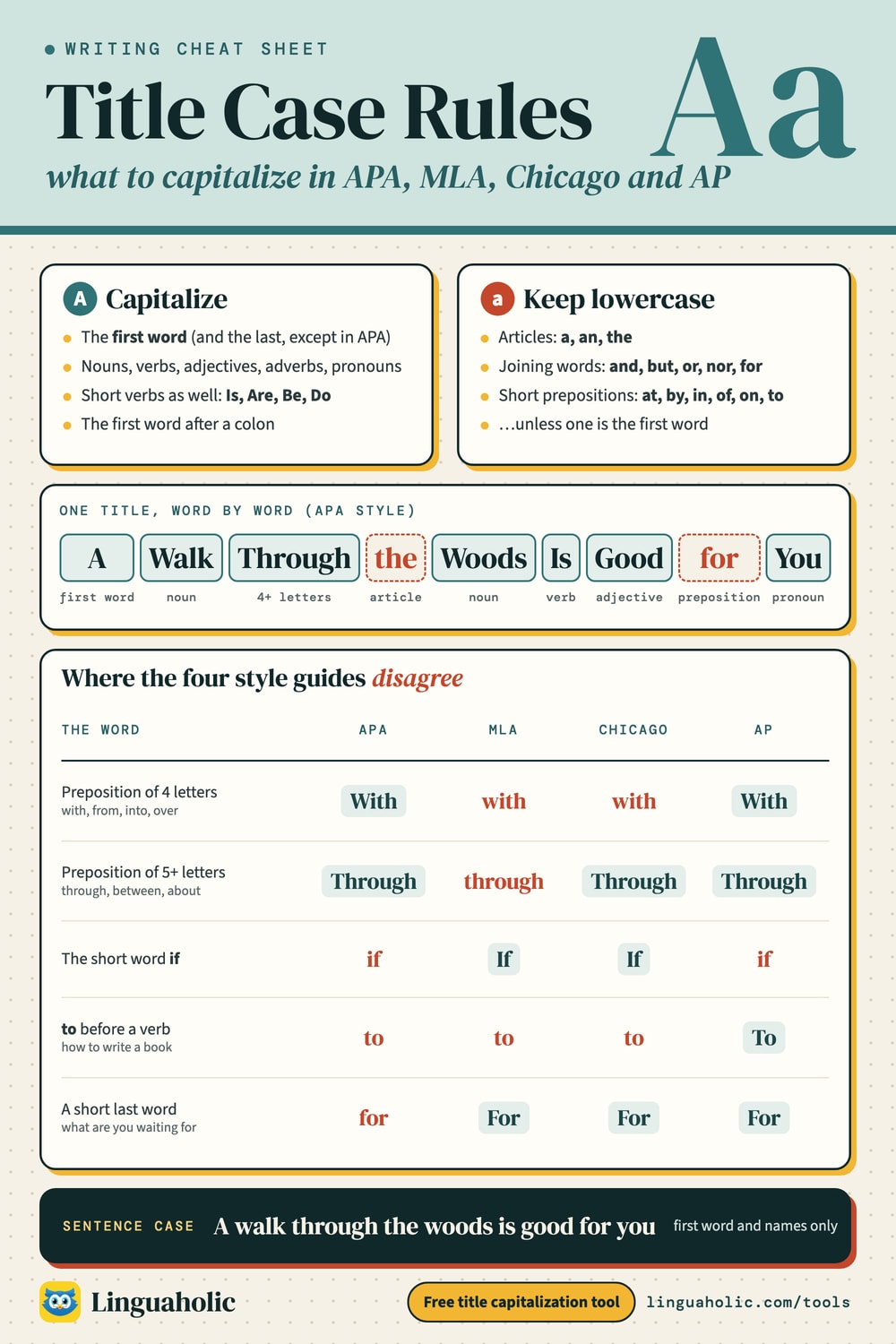
All four guides agree on the core. Capitalize the first word of the title and of a subtitle. Capitalize nouns, pronouns, verbs, adjectives and adverbs, however short: Is, Be, It and Up (in “Set Up”) all get capitals. Lowercase the articles a, an and the, the short coordinating conjunctions and, but, or, nor and for, and short prepositions such as in, of, on, at, by and to. Where they differ is in how long a preposition may be before it earns a capital, and in whether the last word is always capitalized.
Title capitalization rules by style guide
These are the rules the tool applies for each guide.
APA title capitalization (APA Style (7th edition))
Used for: papers and headings in psychology, education, nursing and the social sciences.
| Capitalize | Lowercase |
|---|---|
| The first word of the title and of any subtitle, and the first word after a colon, em dash or end punctuation | Articles: a, an, the |
| Nouns, verbs (including short ones like Is and Be), adjectives, adverbs and pronouns | Short conjunctions: and, as, but, for, if, nor, or, so, yet |
| Every word of four letters or more, so With, From, Between and That are capitalized | Short prepositions of three letters or fewer: as, at, by, for, in, of, off, on, out, per, to, up, via |
| Both parts of a hyphenated major word (Self-Report) | These short words stay lowercase at the end of a title too, because APA names only the first word |
MLA title capitalization (MLA Handbook (9th edition))
Used for: essays and works-cited lists in literature, languages and the humanities.
| Capitalize | Lowercase |
|---|---|
| The first and last word of the title and of any subtitle | Articles: a, an, the |
| All principal words: nouns, pronouns, verbs, adjectives, adverbs | Prepositions of any length: against, between, of, through, with |
| Subordinating conjunctions such as because, if, than, that, when, although | Coordinating conjunctions: and, but, for, nor, or, so, yet |
| Words after a hyphen in a compound, unless they are minor words (Self-Portrait) | The to in infinitives (How to Write) |
Chicago title capitalization (Chicago Manual of Style (18th edition))
Used for: books, magazines, history papers and many blogs.
| Capitalize | Lowercase |
|---|---|
| The first and last word of the title and of any subtitle | Articles: a, an, the |
| Nouns, pronouns, verbs, adjectives, adverbs, and conjunctions other than and, but, for, or, nor (so If, Yet and So are capitalized) | Prepositions of four letters or fewer: from, with, into, over (the 17th edition kept prepositions of any length lowercase) |
| The first part of a hyphenated word, and later parts unless they are articles, prepositions or conjunctions | The conjunctions and, but, for, or, nor |
| Prepositions of five letters or more, since the 18th edition (2024): About, Between, Through, Without | The word to (as a preposition or in an infinitive) and the word as (in any use) |
| After a prefix such as anti-, pre- or non-, the second part of a hyphenated word (Anti-intellectual) |
AP title capitalization (AP Stylebook)
Used for: news writing: titles of books, films, songs and shows.
| Capitalize | Lowercase |
|---|---|
| The first and last word, even when it is an article or a short word | Articles: a, an, the |
| All principal words: nouns, pronouns, verbs, adjectives, adverbs | Conjunctions of three letters or fewer: and, as, but, for, if, nor, or, so, yet |
| Prepositions and conjunctions of four letters or more: With, From, Into, That, Than | Prepositions of three letters or fewer: at, by, for, in, of, off, on, out, per, to, up, via |
| The to of an infinitive (to plus a verb): How To Train a Puppy |
Examples: the same titles in APA, MLA, Chicago and AP
Each title below contains at least one word that the guides treat differently. Compare the rows to see the rules at work.
| APA | MLA | Chicago | AP | Sentence case |
|---|---|---|---|---|
| A Walk Through the Woods: Notes From a Year Outdoors | A Walk through the Woods: Notes from a Year Outdoors | A Walk Through the Woods: Notes from a Year Outdoors | A Walk Through the Woods: Notes From a Year Outdoors | A walk through the woods: Notes from a year outdoors |
| How to Set Up a Home Office in a Small Apartment | How to Set Up a Home Office in a Small Apartment | How to Set Up a Home Office in a Small Apartment | How To Set Up a Home Office in a Small Apartment | How to set up a home office in a small apartment |
| What the River Is Made of | What the River Is Made Of | What the River Is Made Of | What the River Is Made Of | What the river is made of |
| Everything I Know About Baking With Rye | Everything I Know about Baking with Rye | Everything I Know About Baking with Rye | Everything I Know About Baking With Rye | Everything I know about baking with rye |
| The Long Road Back to the Sea | The Long Road Back to the Sea | The Long Road Back to the Sea | The Long Road Back to the Sea | The long road back to the sea |
| Why We Sleep Less Than We Used to | Why We Sleep Less Than We Used To | Why We Sleep Less Than We Used To | Why We Sleep Less Than We Used To | Why we sleep less than we used to |
| A Step-by-Step Guide to Self-Publishing | A Step-by-Step Guide to Self-Publishing | A Step-by-Step Guide to Self-Publishing | A Step-by-Step Guide to Self-Publishing | A step-by-step guide to self-publishing |
| Living Without a Car in a City Built for One | Living without a Car in a City Built for One | Living Without a Car in a City Built for One | Living Without a Car in a City Built for One | Living without a car in a city built for one |
Which words are capitalized in a title?
The small words cause nearly all the doubt. This table shows how each guide treats a word when it stands in the middle of a title (not first, not last, not after a colon). “Yes” means capitalized.
| Word | APA | MLA | Chicago | AP |
|---|---|---|---|---|
| a | No | No | No | No |
| an | No | No | No | No |
| the | No | No | No | No |
| and | No | No | No | No |
| but | No | No | No | No |
| or | No | No | No | No |
| nor | No | No | No | No |
| for | No | No | No | No |
| so | No | No | Yes | No |
| yet | No | No | Yes | No |
| as | No | No | No | No |
| at | No | No | No | No |
| by | No | No | No | No |
| in | No | No | No | No |
| of | No | No | No | No |
| on | No | No | No | No |
| to | No | No | No | No |
| up | No | No | No | No |
| off | No | No | No | No |
| per | No | No | No | No |
| via | No | No | No | No |
| is | Yes | Yes | Yes | Yes |
| be | Yes | Yes | Yes | Yes |
| are | Yes | Yes | Yes | Yes |
| was | Yes | Yes | Yes | Yes |
| it | Yes | Yes | Yes | Yes |
| its | Yes | Yes | Yes | Yes |
| if | No | Yes | Yes | No |
| not | Yes | Yes | Yes | Yes |
| no | Yes | Yes | Yes | Yes |
| do | Yes | Yes | Yes | Yes |
| all | Yes | Yes | Yes | Yes |
| that | Yes | Yes | Yes | Yes |
| this | Yes | Yes | Yes | Yes |
| than | Yes | Yes | Yes | Yes |
| who | Yes | Yes | Yes | Yes |
| with | Yes | No | No | Yes |
| from | Yes | No | No | Yes |
| into | Yes | No | No | Yes |
| onto | Yes | No | No | Yes |
| over | Yes | No | No | Yes |
| about | Yes | No | Yes | Yes |
| after | Yes | No | Yes | Yes |
| under | Yes | No | Yes | Yes |
| between | Yes | No | Yes | Yes |
| through | Yes | No | Yes | Yes |
| without | Yes | No | Yes | Yes |
The words every guide agrees on are a, an, the, and, but, or, nor, for, as, at, by, in, of, on, to, up, off, per, via (always lowercase in the middle of a title) and is, be, are, was, it, its, not, no, do, all, that, this, than, who (always capitalized). The rest depend on the guide.
Is “is” capitalized in a title?
Yes, in every style. “Is” is a verb, and verbs are always capitalized, however short. The same goes for Be, Are, Was, Am, Do and Has. Leaving “is” lowercase is the most common title mistake, because the word looks as small as “in” or “of”.
Is “with” capitalized in a title?
It depends. APA and AP capitalize words of four letters or more, so they write With and From. MLA keeps every preposition lowercase. Chicago capitalizes prepositions of five letters or more since its 18th edition, so “with” and “from” stay lowercase while About and Between get capitals.
Is “to” capitalized in a title?
As a preposition (“the Road to Rome”) it is lowercase everywhere. In an infinitive (“How to Train a Puppy”) it is lowercase in APA, MLA and Chicago, but AP capitalizes it: How To Train a Puppy.
Are “a”, “an” and “the” capitalized?
Only as the first word of a title or subtitle, and in most guides as the last word. In the middle of a title the articles are always lowercase.
Are “it”, “that” and “this” capitalized?
Yes. They are pronouns, and pronouns are capitalized in every guide, like nouns. “Its” and “who” follow the same rule.
Title case versus sentence case
Sentence case capitalizes a title the way you would a sentence: the first word, the first word after a colon, and proper nouns. Everything else is lowercase. Many news sites, most government websites and a growing number of blogs use it for headlines because it reads quickly and avoids the small-word questions altogether. APA uses sentence case for titles in a reference list, and title case for titles mentioned in the text and for headings.
Neither is more correct. Pick one for a publication, a website or a paper and keep to it. A page that mixes both looks careless.
Hyphenated words in titles
Always capitalize the first part of a hyphenated word. The second part is capitalized when it is a main word (Self-Publishing, Well-Known) and lowercase when it is an article, a short preposition or a conjunction (Step-by-Step, Mother-in-Law). After a prefix that cannot stand alone, such as anti, pre or co, some guides keep the second part lowercase unless it is a proper noun. The explanation list under the tool shows which rule was applied to each part.
After a colon: subtitles
The first word after a colon is capitalized in all four guides, even if it is an article: A Walk Through the Woods: A Year Outdoors. The same applies after an em dash that introduces a subtitle. If your colon is not introducing a subtitle (for example in a time such as 5:30), switch the subtitle option off.
Capitalizing headlines, blog titles, video titles and subject lines
- News headlines. Publications that follow AP style usually set headlines in sentence case, and use AP title case for the titles of books, films and songs mentioned in a story.
- Blog posts and web pages. Either works. Chicago or AP title case is common; sentence case is easier to keep consistent across many authors.
- Video titles. Title case in AP or Chicago style is the usual choice. Avoid writing the whole title in capitals: it is harder to read and looks like shouting.
- Email subject lines. Sentence case reads as personal, title case as formal or promotional. Choose by audience and stay consistent within a campaign.
- Book and chapter titles. Publishers in the United States mostly follow Chicago.
Titles in academic papers
APA papers use title case for the paper’s own title, for headings at levels 1 to 5, and for titles of works named in the text. In the reference list, the titles of articles, books and web pages are in sentence case, while journal names keep title case. MLA uses title case for your own title and for every title in the works-cited list. Both capitalize the first word of a subtitle.
If your instructor or journal names a guide, choose that style here rather than a general one. The differences are small, but they are exactly the kind of detail a marker or editor checks.
Common mistakes in title capitalization
- Lowercasing short verbs and pronouns. Is, Are, Be, It, He and My are capitalized in every style.
- Capitalizing every word. “A Guide To The Birds Of The Coast” follows no style guide. Articles and short prepositions stay lowercase.
- Forgetting the word after a colon. A subtitle starts with a capital, even with “a” or “the”.
- Treating “up”, “out” and “off” as prepositions when they belong to the verb. In “Set Up”, “Find Out” and “Log Off” they work as adverbs and are capitalized.
- Mixing styles. “A Walk through the Woods” (MLA) and “Notes From a Year” (APA) should not sit in the same list.
- Flattening names. Brand names and abbreviations keep their own capitals: iPhone, eBay, NASA, PhD.
How the tool decides, and where it can be wrong
The tool applies each guide’s written rules to the words of your title. It runs in your browser, and your titles are not uploaded. It does not understand meaning, so it cannot always tell whether a word such as “up”, “so” or “after” is working as a preposition, an adverb or a conjunction in your particular title. Where that matters, the explanation says what it assumed, so you can change the one word by hand. It also cannot know that a common word is a name in your title; add such names under Options.
Related tools and guides
For every other kind of capital-letter change (uppercase, lowercase, sentence case for long texts, camelCase and more), use the Case Converter. To check the rest of your writing, try the Punctuation Checker and the Run-On Sentence Checker, and count your words with the Word Counter or sentences with the Sentence Counter. Our guide on whether “into” is capitalized in titles looks at one small word in detail.
For teachers, bloggers & clubs
Put the Title Capitalization Tool on your website
Give your readers this tool right on your page. Copy the code, paste it into your site, done: no sign-up, no account.
- Free for any website
- No ads, no cookies
- Fits phones and sidebars
- Always up to date
Please keep the small credit line under the tool; you may add rel="nofollow" to its link. How it works & the rules

› Show the code
Frequently asked questions
- Which words are capitalized in a title?
- The first word, and every noun, pronoun, verb, adjective and adverb, however short. Articles (a, an, the), short coordinating conjunctions (and, but, or) and short prepositions (in, of, on, at, to) stay lowercase. Style guides differ on longer prepositions such as with, from and between.
- Is "is" capitalized in a title?
- Yes, in every style guide. Is is a verb, and verbs are always capitalized in a title, like Be, Are, Was and Do.
- Is "with" capitalized in a title?
- In APA and AP style yes, because they capitalize words of four letters or more. In MLA no, because all prepositions are lowercase. In Chicago no, because only prepositions of five letters or more are capitalized (since the 18th edition).
- Is "to" capitalized in a title?
- As a preposition it is lowercase in every guide. In an infinitive, such as How to Train a Puppy, it is lowercase in APA, MLA and Chicago, while AP capitalizes it.
- What is the difference between title case and sentence case?
- Title case capitalizes all the main words of a title. Sentence case capitalizes only the first word, the first word after a colon and proper nouns, like an ordinary sentence.
- How do APA, MLA, Chicago and AP title case differ?
- Mostly in how they treat prepositions. APA and AP capitalize words of four letters or more, MLA keeps every preposition lowercase, and Chicago capitalizes prepositions of five letters or more. AP also capitalizes the to of an infinitive, and APA does not require a capital on the last word.
- Is the word after a colon capitalized in a title?
- Yes. The first word of a subtitle is capitalized in all four guides, even if it is a, an or the.
- How are hyphenated words capitalized in a title?
- Capitalize the first part always. Capitalize the second part if it is a main word (Self-Publishing) and keep it lowercase if it is an article, short preposition or conjunction (Step-by-Step).
- Can I capitalize many titles at once?
- Yes. Put one title on each line, up to 200 lines, and copy the whole converted list with Copy all.
- Are my titles uploaded?
- No. The tool runs in your browser, and nothing you type is sent to a server or stored.
About this page
The Title Capitalization Tool is a free tool from Linguaholic, made by Marcel Iseli. It runs in your browser, with no sign-up. Last updated .
Keep exploring
More free tools
 Case ConverterTitle case by APA, MLA, Chicago or AP, sentence case, upper, lower and code cases.
 Punctuation CheckerFind comma, apostrophe, semicolon and quotation mark mistakes and fix them in a click.
 Run-On Sentence CheckerFind comma splices and fused sentences, see why each was flagged, and fix them in one click.
 Sentence CounterCount sentences and words per sentence, and spot sentences that run too long.
 Word CounterCount words, characters, sentences, and paragraphs as you type.
 Random Word GeneratorRandom English words with definitions for Pictionary, charades, and writing.