
Writing tools
Run-On Sentence Checker: Find and Fix Comma Splices
Paste your text to find comma splices and fused sentences. Every finding shows the join and the reason, with one-click fixes, undo and a copy button.
Updated · Free, no sign-up
0 / 20,000 characters
Sentence by sentence
Your sentences appear here, each with a verdict: comma splice, possible fused sentence, style note or OK. Tap Try a sample to see one of each.
Everything happens in your browser: your text is never uploaded or saved.
Share this tool
Know someone who’d love it?
How to use the run-on sentence checker
Paste or type your text in the box (up to 20,000 characters). The run-on sentence checker splits it into sentences and gives each one a verdict as you type. Nothing is uploaded: the checking happens in your browser, so essays, emails and private drafts stay on your device.
- Read the summary. The four boxes show the number of sentences, how many run-ons were found, your longest sentence and your average sentence length in words.
- Go through the sentences. Each sentence is marked Comma splice, Possible comma splice, Possible fused sentence, Style note or OK. In a flagged sentence, the words around the join are highlighted, and a note explains why it was flagged: which words form the first clause, and which subject and verb start the second.
- Pick a fix. The buttons under a finding rewrite that sentence in place: split it into two sentences, use a semicolon, add a comma with and, but or so, or use a semicolon with however or therefore. Choose the one that matches your meaning. Undo takes back the last change.
- Copy the corrected text. Copy text puts the whole text, with your fixes, on your clipboard.
One setting changes what counts as a long sentence: 30, 40, 50 words (40 is the default). Tap Try a sample to see a short text with correct sentences and one of each kind of problem. In the sample, the checker finds 3 run-ons in 8 sentences and adds 2 style notes.
Please read the results with one thing in mind: this is a rule-based tool, not an AI. It checks word patterns, such as a comma followed by a subject and a verb. It does not understand meaning. It is built to stay quiet when it is unsure, so it will miss some run-ons, and it can be wrong about an unusual sentence. That is why every finding shows its reason, and why the less certain ones are labeled “possible”. Every line break ends a sentence, so if your text was copied from a PDF and has line breaks in the middle of sentences, join the lines first with remove line breaks.
What is a run-on sentence?
A run-on sentence is a sentence in which two or more independent clauses are joined without the right punctuation or linking word. An independent clause has a subject and a verb and can stand alone as a sentence: It was late is one, and we went home is another. Put them together with nothing in between, or with only a comma, and you have a run-on.
Run-ons make readers work harder. Without a clear break, the reader has to figure out where one thought stops and the next one starts, and may have to read the sentence twice.
How long is a run-on sentence?
Any length. This surprises many people, because “run-on” sounds like “a sentence that runs on and on”. But a run-on is a joining mistake, not a length. It was late we went home. has only 6 words and is a run-on. A sentence of 41 words can be perfectly correct if its clauses are joined properly. So there is no number of words that makes a sentence a run-on, and counting words will not tell you whether you have one.
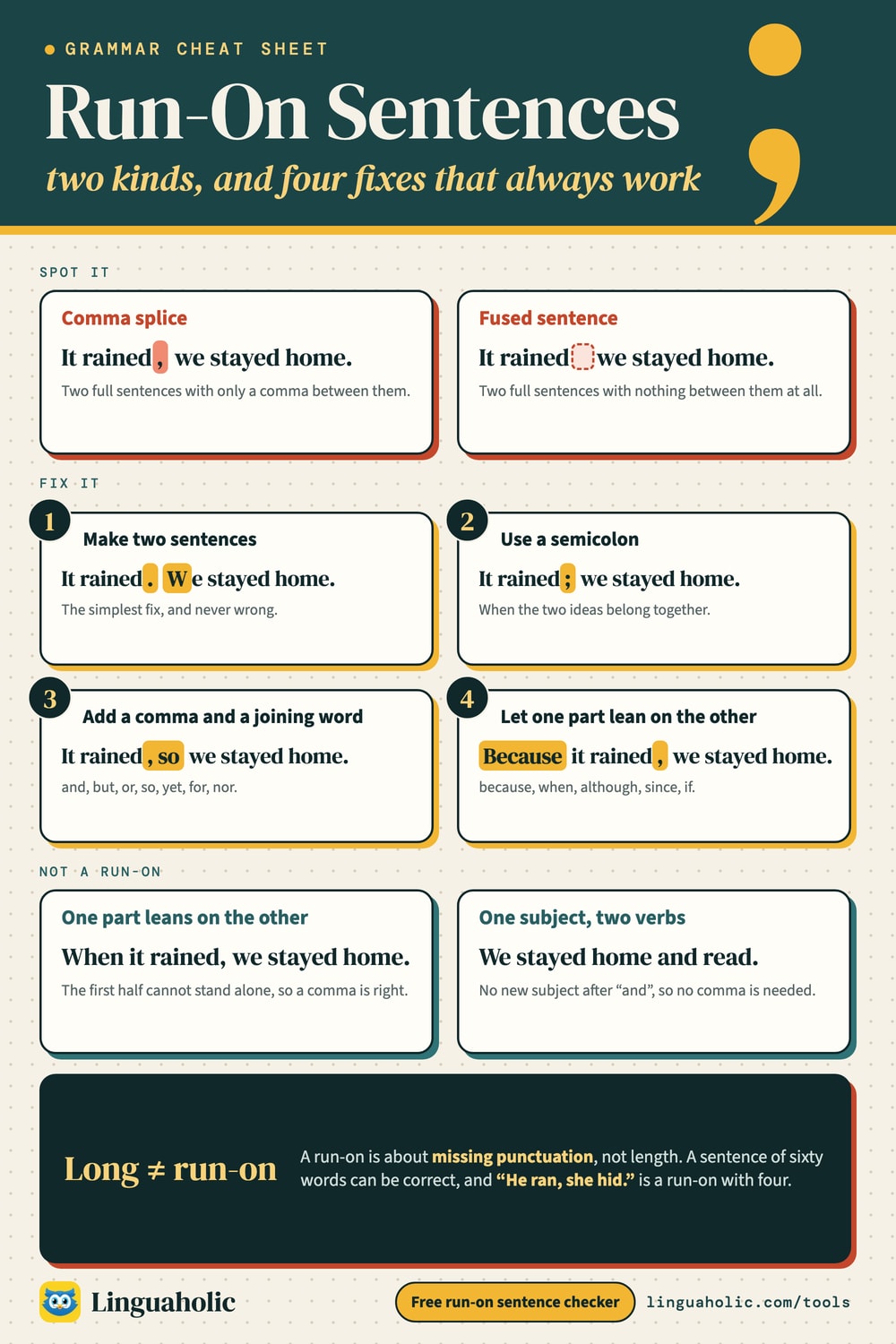
Run-on sentence chart

The two types of run-on sentences
There are two kinds, and the only difference is what sits between the clauses. Some teachers use “run-on” for the fused sentence only and treat the comma splice as a separate error; many handbooks use “run-on” for both. The fixes are the same either way.
Comma splice
A comma splice joins two independent clauses with only a comma. A comma is too weak for that job. Examples:
- The alarm went off, I slept through it.
- My phone died, I could not call you.
- We wanted to hike, the trail was closed.
In each one, the words before the comma could be a sentence, and so could the words after it. A second kind of comma splice uses a comma with a word like however, therefore or then. These words feel like conjunctions, but they are adverbs (more on that below).
Fused sentence
A fused sentence joins two independent clauses with nothing at all: no punctuation and no linking word. Examples:
- I was hungry I made a sandwich.
- She called me I was asleep.
- It was raining we stayed inside.
Fused sentences are harder for a program to find than comma splices, because there is no comma to mark the spot. In This is the house we bought, a subject and verb also follow a noun directly, and that sentence is correct. The tool therefore words these findings as “Possible fused sentence” and flags only clear patterns, such as an adjective or an object pronoun followed by a new subject and verb (I was tired I went to bed).
How to fix a run-on sentence: four ways
Every run-on can be fixed in four standard ways. Here is one comma splice, The store was closed, we went home., fixed with each of them:
| Fix | What you do | Result |
|---|---|---|
| 1. A period | Make two sentences. | The store was closed. We went home. |
| 2. A semicolon | Join two closely related clauses. | The store was closed; we went home. |
| 3. A comma and a coordinating conjunction | Add and, but, so or another of the FANBOYS. | The store was closed, so we went home. |
| 4. A subordinating word | Turn one clause into a dependent clause with because, when, although, since or if. | Because the store was closed, we went home. |
The first three are the buttons in the tool. A close relative of the semicolon fix adds a linking adverb: The store was closed; therefore, we went home. The fourth fix needs a word that fits the meaning (because, although, when), so the tool leaves it to you. It is often the best choice, because it tells the reader how the two ideas are related. When the dependent clause comes first, put a comma after it.
Which fix should you choose?
- A period when the two ideas are separate, or when the sentence is already long.
- A semicolon when the ideas are closely linked and about equal in weight. See our guide to semicolons.
- A comma and a conjunction when you want to name the link: and adds, but contrasts, so gives a result.
- A subordinating word when one idea explains the other or depends on it.
Do not fix every run-on with a period. A page of very short sentences reads as choppy, and it hides the connections between your ideas.
Run-on sentence vs. long sentence vs. sentence fragment
These three are often mixed up. A run-on has too much in one sentence, a fragment has too little, and a long sentence may be perfectly fine.
| Type | What it is | Example | Words |
|---|---|---|---|
| Run-on sentence | Two or more independent clauses joined wrongly. An error. | It was late we went home. | 6 |
| Long sentence | Many words, but every clause is joined correctly. Not an error, though it may be hard to read. | When the last bus had left and the rain showed no sign of stopping, we decided to walk the three miles home, which took almost an hour because my little brother insisted on jumping in every muddy puddle along the way. | 41 |
| Sentence fragment | Punctuated like a sentence, but it is missing a subject or a verb, or it is a dependent clause on its own. An error in formal writing. | Because it was late. | 4 |
The tool keeps these apart. Run-ons are findings. Length is only a style note: a sentence over your word limit is marked “Long sentence”, and a sentence where 3 or more clauses are added on with and, but, so or then is marked “Rambling sentence”. Both are grammatical. They are worth a second look only because long chains tire the reader. For the long example in the table, the checker says: Long sentence. This tool does not look for fragments. To see the length of every sentence at a glance, use the sentence counter.
Coordinating conjunctions: the FANBOYS
English has seven coordinating conjunctions, and the word FANBOYS helps you remember them: for, and, nor, but, or, yet, so. These are the only words that can join two independent clauses with just a comma. The comma goes before the conjunction.
| Conjunction | Shows | Example |
|---|---|---|
| for | a reason (formal) | We left early, for the roads were icy. |
| and | an addition | The rain stopped, and the sun came out. |
| nor | a second negative | He did not call, nor did he write. |
| but | a contrast | I knocked twice, but nobody answered. |
| or | a choice | We can cook tonight, or we can order pizza. |
| yet | a surprising contrast | The test was hard, yet most of the class passed. |
| so | a result | The store was closed, so we went home. |
When the two clauses are very short, many writers leave the comma out (I called and she answered), and that is not a run-on, because the conjunction is doing the joining. Read more in our guide to commas with FANBOYS and in the guide to the comma before or after “so”.
Conjunctive adverbs: why “however” cannot join sentences with a comma
Words such as however, therefore, moreover, nevertheless, consequently, otherwise and then are conjunctive adverbs. They show how two ideas relate, but grammatically they are adverbs, not conjunctions. One simple test shows the difference: an adverb can move around inside its clause, and a conjunction cannot. You can write My laptop battery, however, was at two percent. You cannot move but that way.
Because however is not a conjunction, a comma in front of it cannot hold two clauses together. This sentence is a comma splice: I wanted to finish my essay, however, my laptop battery was at two percent. The checker’s verdict: Comma splice. Use a semicolon or a period before the adverb, and (for most of these words) a comma after it: I wanted to finish my essay; however, my laptop battery was at two percent.
| Adverb | Shows | Comma splice | Correct |
|---|---|---|---|
| however | contrast | The forecast called for sun, however, it rained all day. | The forecast called for sun; however, it rained all day. |
| instead | contrast | They did not take the highway, instead, they drove along the coast. | They did not take the highway; instead, they drove along the coast. |
| therefore | result | The bridge was closed, therefore, we took the ferry. | The bridge was closed; therefore, we took the ferry. |
| consequently | result | He forgot to set an alarm, consequently, he missed the exam. | He forgot to set an alarm; consequently, he missed the exam. |
| moreover | addition | The apartment is small, moreover, it is far from the station. | The apartment is small; moreover, it is far from the station. |
| meanwhile | time | The rice cooked on the stove, meanwhile, we set the table. | The rice cooked on the stove; meanwhile, we set the table. |
| then | time | We bought the tickets, then we found our seats. | We bought the tickets; then we found our seats. |
| otherwise | condition | We should leave now, otherwise, we will miss the train. | We should leave now; otherwise, we will miss the train. |
When however sits in the middle of a single clause, commas on both sides are correct, and the tool does not flag it (for My laptop battery, however, was at two percent. it says: OK). A note on then: a comma before then between two full clauses is common in casual writing, but many handbooks treat it as a comma splice, so in formal writing use and then or a semicolon. Our guides cover the comma before or after “however” and the comma before “then” in detail.
Run-on sentence examples and corrections
Here are 18 run-on sentences, each with one good correction. The third column shows what this checker says about the sentence. It is a pattern checker, so it does not catch everything: it misses 2 of these 18 (marked “Not flagged”). Commands, and second clauses that start with a noun instead of a pronoun, are its weak spots.
| Run-on | Type | Checker says | Corrected |
|---|---|---|---|
| The alarm went off, I slept through it. | Comma splice | Comma splice | The alarm went off, but I slept through it. |
| My phone died, I could not call you. | Comma splice | Comma splice | My phone died, so I could not call you. |
| We wanted to hike, the trail was closed. | Comma splice | Comma splice | We wanted to hike, but the trail was closed. |
| The soup is too salty, it needs more water. | Comma splice | Comma splice | The soup is too salty; it needs more water. |
| She practiced every day, she made the team. | Comma splice | Comma splice | She practiced every day, so she made the team. |
| The movie starts at eight, we should leave now. | Comma splice | Comma splice | The movie starts at eight, so we should leave now. |
| The printer is out of ink, nobody has ordered more. | Comma splice | Comma splice | The printer is out of ink, and nobody has ordered more. |
| I love this song, however, I can never remember the words. | Comma splice | Comma splice | I love this song; however, I can never remember the words. |
| He missed the bus, therefore, he was late for class. | Comma splice | Comma splice | He missed the bus. Therefore, he was late for class. |
| We cleaned the garage, then we painted the fence. | Comma splice | Comma splice | We cleaned the garage, and then we painted the fence. |
| Turn off the oven, the cake is done. | Comma splice | Not flagged | Turn off the oven. The cake is done. |
| I was hungry I made a sandwich. | Fused sentence | Possible fused sentence | I was hungry, so I made a sandwich. |
| The game ended we went home. | Fused sentence | Possible fused sentence | The game ended, and we went home. |
| She called me I was asleep. | Fused sentence | Possible fused sentence | She called me, but I was asleep. |
| It was raining we stayed inside. | Fused sentence | Possible fused sentence | It was raining, so we stayed inside. |
| We ran to the station then we waited for an hour. | Fused sentence | Possible fused sentence | We ran to the station, and then we waited for an hour. |
| The test was hard however I passed. | Fused sentence | Possible fused sentence | The test was hard; however, I passed. |
| My sister plays the drums my brother plays the piano. | Fused sentence | Not flagged | My sister plays the drums, and my brother plays the piano. |
Most of these have more than one good fix. The soup is too salty, it needs more water works with a semicolon, with a period, or as The soup is too salty, so it needs more water. Pick the version that says what you mean.
Sentences that look like run-ons but are correct
A comma followed by a subject and a verb is not always a comma splice. The checker is built to leave these patterns alone:
| Sentence | Why it is correct | Checker says |
|---|---|---|
| When I arrived, he left. | An introductory clause: “When I arrived” cannot stand alone. | OK |
| After a long day at work, she was ready to rest. | An introductory phrase with no verb of its own. | OK |
| I wanted to go, but it was raining. | A comma with a coordinating conjunction. | OK |
| She opened the door and walked in. | One subject with two verbs (a compound predicate). | OK |
| She cooked, he cleaned, and they both rested. | A series of three clauses with “and” before the last. | OK |
| Maya, we need to talk. | Direct address: a name set off by a comma. | OK |
| It was late, she said. | A speech tag after a comma. | OK |
| The more I read, the more I learn. | A paired “the more …, the more …” sentence. | OK |
| I think he is right. | A clause that completes “think”, with “that” left out. | OK |
| This is the house we bought last year. | A clause that describes “house”, with “that” left out. | OK |
If you are unsure about a comma that has nothing to do with run-ons, the punctuation checker looks at commas, quotation marks, spacing and more.
When is a comma splice acceptable?
In formal writing (school essays, reports, business letters), fix every comma splice. In other kinds of writing, editors accept a few on purpose:
- Short, matching clauses. A run of brief clauses with the same shape can be joined by commas for rhythm: We ran, we laughed, we fell asleep.
- A “not this, that” contrast. It was not a request, it was an order.
- Fiction and dialogue. Novelists use comma splices to show hurried thoughts or the way people really talk.
The tool does not hide these, because it cannot know whether you wrote them on purpose. It labels them as possible and adds a note (for the two examples above it says: Possible comma splice; Possible comma splice). If the splice is a deliberate choice, leave it.
How to identify a run-on sentence in your own writing
For students
- Find the subject and verb pairs. Underline each subject with its verb. If a sentence has two pairs, check what joins them: a FANBOYS word with a comma, a semicolon, or a word like because or when. If the answer is “only a comma” or “nothing”, it is a run-on.
- Try the period test. Put a period where the comma is. If both halves work as sentences, the comma alone was not enough.
- Watch for pronouns after a comma. It, he, she, they, we and this right after a comma often start a new clause.
- Watch for transition words. However, therefore, then and for example need more than a comma in front of them when a full clause follows.
For editing your own drafts
- Read it aloud. Where your voice drops and you take a full breath, a sentence has probably ended, whatever the punctuation says.
- Vary your fixes. Use a mix of periods, conjunctions, semicolons and subordinate clauses, so the text does not turn choppy.
- Treat the tool as a second reader, not a judge. Look at each finding, read the reason and decide for yourself. Then read the whole text once more, because no pattern checker catches every run-on.
For teachers, bloggers & clubs
Put the Run-On Sentence Checker on your website
Give your readers this tool right on your page. Copy the code, paste it into your site, done: no sign-up, no account.
- Free for any website
- No ads, no cookies
- Fits phones and sidebars
- Always up to date
Please keep the small credit line under the tool; you may add rel="nofollow" to its link. How it works & the rules

› Show the code
Frequently asked questions
- What is a run-on sentence?
- A run-on sentence joins two or more independent clauses without the right punctuation or linking word. For example, It was late we went home is a run-on, because It was late and we went home can each stand alone as a sentence.
- How does the run-on sentence checker work?
- It splits your text into sentences and looks for word patterns: a comma followed by a new subject and verb, a comma before a word like however or then, or two clauses with nothing between them. It is rule-based and runs in your browser. It does not understand meaning, so it can miss a run-on or be wrong about an unusual sentence, and every finding shows why it was flagged.
- How do you fix a run-on sentence?
- There are four standard ways: split it into two sentences with a period, join the clauses with a semicolon, add a comma and a coordinating conjunction such as and, but or so, or turn one clause into a dependent clause with a word like because or although. The tool applies the first three for you with one click.
- What is a comma splice, and is it a run-on sentence?
- A comma splice joins two independent clauses with only a comma, as in I was tired, I went to bed. Many handbooks count it as one of the two kinds of run-on sentence; some teachers treat it as a separate error. The fixes are the same.
- What is a fused sentence?
- A fused sentence joins two independent clauses with no punctuation and no linking word, as in I was tired I went to bed. Fused sentences are hard for software to detect, so the tool labels them as possible fused sentences.
- How long is a run-on sentence?
- Any length. A run-on is a joining mistake, not a long sentence: He ran she walked is a run-on with four words, while a correctly joined sentence of 50 words is not. The tool marks long sentences only as a style note.
- What is the difference between a run-on sentence and a sentence fragment?
- A run-on has too much: two or more complete clauses joined wrongly. A fragment has too little: it is punctuated like a sentence but lacks a subject, a verb or a complete thought, as in Because it was late. This tool checks for run-ons, not fragments.
- Why can't "however" join two sentences with a comma?
- However is a conjunctive adverb, not a conjunction. Between two independent clauses it needs a semicolon or a period before it and a comma after it: I wanted to go; however, I was too tired. The same is true of therefore, moreover, nevertheless and consequently.
- Is a comma splice ever acceptable?
- In formal writing, no. In fiction, dialogue and informal writing, editors often accept a comma between short, matching clauses, as in We ran, we laughed, we fell asleep. The tool marks these as possible comma splices and adds a note.
- Is the run-on sentence checker free, and is my text private?
- Yes. It is free with no sign-up, and it checks up to 20,000 characters at a time. Everything runs in your browser, so your text is never uploaded or stored.
About this page
The Run-On Sentence Checker is a free tool from Linguaholic, made by Marcel Iseli. It runs in your browser, with no sign-up. Last updated .
Keep exploring
More free tools
 Punctuation CheckerFind comma, apostrophe, semicolon and quotation mark mistakes and fix them in a click.
 Sentence CounterCount sentences and words per sentence, and spot sentences that run too long.
 Word CounterCount words, characters, sentences, and paragraphs as you type.
 Title Capitalization ToolCapitalize titles in APA, MLA, Chicago or AP style, with the rule behind every word.
 Remove Line BreaksRemove or add line breaks, keep paragraphs, and fix text pasted from PDFs and emails.
 Random Word GeneratorRandom English words with definitions for Pictionary, charades, and writing.