
Text tools
Sentence Counter
Count sentences, words and paragraphs, see your average sentence length, and find your longest, shortest and too-long sentences.
Updated · Free, no sign-up
Median 0 words · 0 sentences per paragraph · 0 questions · 0 exclamations · 0 characters
Sentence length
- 1–10 words0
- 11–20 words0
- 21–30 words0
- 31–40 words0
- 41+ words0
Sentence lengths appear here.
Your sentences appear here, numbered, with the longest and shortest marked.
Share this tool
Know someone who’d love it?
How to use the sentence counter
Paste or type your text in the box. The sentence count updates as you type, together with the number of words and paragraphs, the average number of words per sentence, and your longest and shortest sentence. Nothing is uploaded: the counting happens in your browser, so it is safe for essays, reports and private drafts.
- Add your text. Paste a whole essay or type a few lines. Tap Try an example to see how a short sample is counted.
- Read the numbers. The six boxes show sentences, words, paragraphs, words per sentence, and the longest and shortest sentence. The line under them adds the median sentence length, sentences per paragraph, how many questions and exclamations you wrote, and the character count.
- Check the length chart. It sorts your sentences into five groups by length. Choose the limit for a “long” sentence (20, 25, 30, 35, 40 words; 30 is the default) and the tool lists every sentence over it, so you know exactly which ones to split.
- See every sentence. Highlighted shows your text with each sentence shaded and numbered, the longest outlined in yellow, the shortest in teal, and long ones in red. Numbered list puts one sentence per row with its word count; sort it longest first or show only the long ones.
- Copy what you need. Copy results copies a short report of all the numbers; Copy sentences copies the numbered list.
For a list, a poem or a set of headings that have no periods, tick Each line is a sentence. Without it, sentences are split by punctuation, which is right for ordinary prose.
What the numbers mean
Sentences
A sentence is a run of words that ends with a period, a question mark, an exclamation mark or an ellipsis, or that stops at the end of a paragraph. Text with no words at all, such as a stray “...” or a line of emoji, is not counted as a sentence.
Words and paragraphs
Words are counted the way a reader sees them: “don’t”, “well-known”, “3.14” and “e.g.” are one word each. Paragraphs are the blocks separated by blank lines. If your text has no blank lines at all, each line counts as a paragraph, because that is how text pasted from most editors and chat apps is laid out.
Average and median words per sentence
The average sentence length is the number of words in your sentences divided by the number of sentences. The median is the middle length when all sentences are lined up from shortest to longest. When one very long sentence pulls the average up, the median shows what a typical sentence looks like. In the example text, the average is 11.4 words but the median is only 6, because one sentence runs to 46 words.
Longest and shortest sentence
The longest sentence is usually the first place to look when a text feels heavy. The shortest may be a punchy line you wrote on purpose, or a fragment that slipped in by accident. If two sentences tie, the first one is marked.
Sentence length chart

How the counter decides where a sentence ends
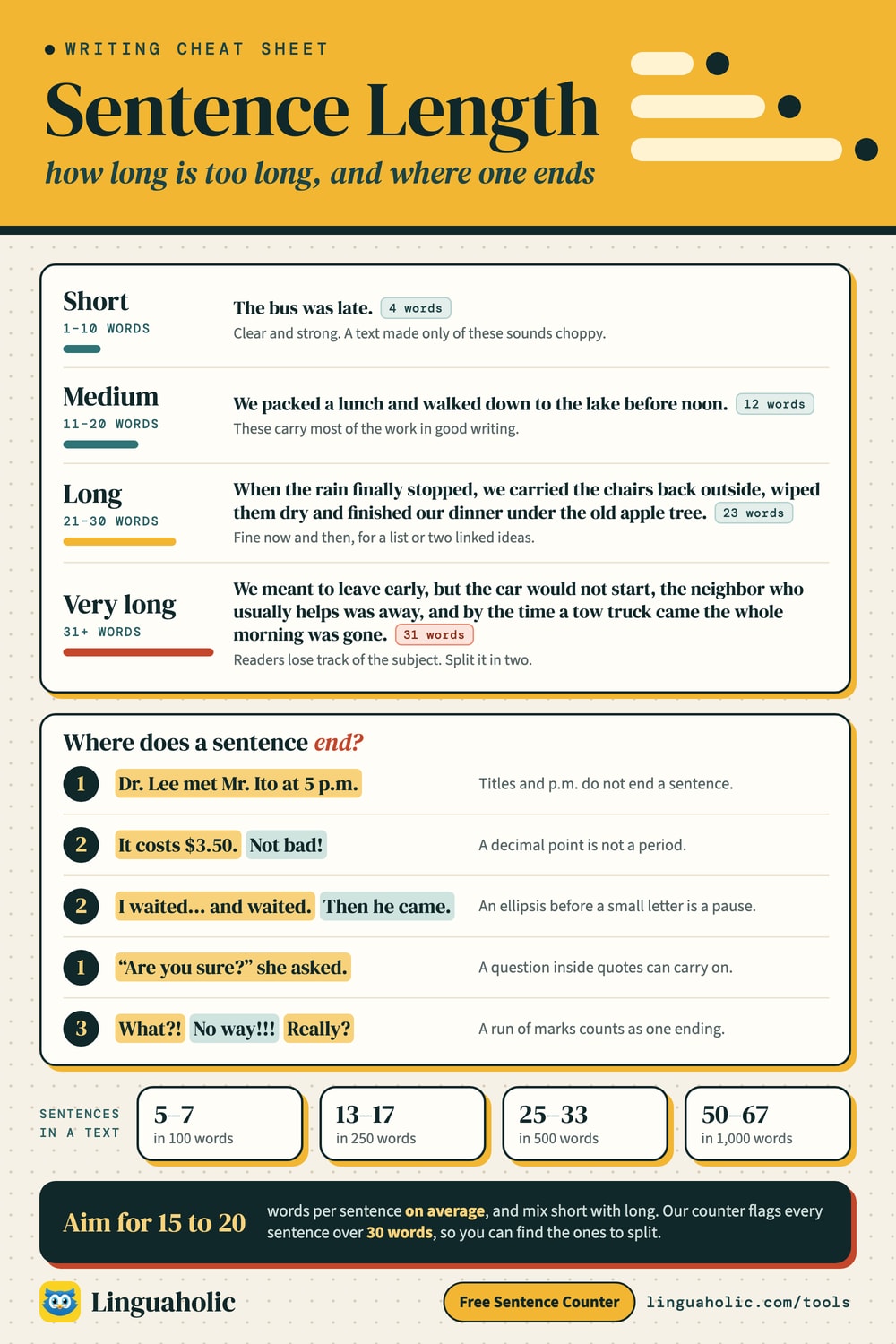
A simple counter treats every period as the end of a sentence, so “Dr. Lee met Mr. Ito at 5 p.m.” comes out as four sentences. This one reads the punctuation in context. It looks at the word before the period and the word after it, and only ends the sentence when a new one really starts. Here is how it counts some tricky cases:
| Text | Sentences | Why |
|---|---|---|
| Dr. Lee arrived at 5 p.m. on Jan. 3. She was late. | 2 | Titles, a.m./p.m. and a month before a number are abbreviations, not endings. |
| Bring snacks, e.g. chips or fruit. Then come in. | 2 | Latin shorthands such as e.g., i.e. and vs. never end a sentence. |
| The ticket costs $4.99. That is cheap! | 2 | A period inside a number is a decimal point. |
| Visit example.com today. It is free. | 2 | A period with no space after it belongs to a web address or file name. |
| I waited... and waited. Then he came. | 2 | An ellipsis followed by a lowercase word is a pause. |
| "Are you sure?" she asked. "Yes!" he said. | 2 | A question mark inside quotes followed by “she asked” stays in one sentence. |
| J. R. Smith wrote it. Read it. | 2 | Single capital letters with periods are initials. |
| I live in the U.S. It is big. | 2 | A dotted abbreviation ends a sentence when a typical sentence opener follows. |
| What?! No way!!! Really? | 3 | Runs of ?, ! and ?! count as one ending. |
No rule-based counter is perfect, because English punctuation is ambiguous. “Plan B. Then we leave.” looks exactly like the initial in “J. Smith”, and a sentence that ends with an abbreviation shares its period with the abbreviation. If a count looks off by one, switch to Highlighted: the small numbers show where each sentence starts, so you can find the place that confused it.
How long should a sentence be?
There is no single correct length, but readers find text easier when most sentences are short and the length varies. Many plain-writing guides suggest an average of about 15 to 20 words per sentence, and they treat sentences over 25 to 30 words as worth a second look. News writing and instructions often aim shorter; academic writing tends to run longer.
- Short sentences (1–10 words) are clear and strong. A text made only of them sounds choppy.
- Medium sentences (11–20 words) carry most of the work in good prose.
- Long sentences (21–30 words) are fine now and then, especially when they list things or build to a point.
- Very long sentences (over 30 words) are where readers lose track of the subject. They are the ones the tool flags by default.
Variety matters as much as the average. A paragraph of five 18-word sentences reads flatter than one that mixes a 6-word sentence, a 25-word one and a 12-word one. The length chart shows that mix at a glance.
How to fix a long sentence: a worked example
The example text has one sentence of 46 words, flagged in red: “The bus ride takes about 2.5 hours, so bring a snack, a book and maybe a small pillow, because the road through the hills is slow and winding and there is not much to see until we reach the coast, where the view finally opens up.” It is not wrong, but it asks the reader to hold a lot at once. Split it where the ideas change:
“The bus ride takes about 2.5 hours, so bring a snack, a book and maybe a small pillow. The road through the hills is slow and winding. There is not much to see until we reach the coast, where the view finally opens up.”
That gives 3 sentences of 18, 9, 17 words. Nothing was lost, and each sentence now has one job. Some reliable ways to shorten sentences:
- Break at “because”, “which” and “so”. These words often join two complete thoughts that can stand alone.
- Turn a list into bullet points when a sentence names more than three or four items.
- Cut warm-up phrases such as “it is important to note that” or “due to the fact that” (“because”).
- Put the subject and verb early. A sentence that opens with a long clause makes the reader wait for the point.
- Read it aloud. If you need a breath in the middle, the sentence probably needs a period there.
How many sentences are in a paragraph?
There is no fixed number. A paragraph is one idea, and it is as long as that idea needs. Still, some habits are common:
- School essays: many teachers ask for about three to five sentences per body paragraph, and some teach five to eight: a topic sentence, supporting sentences with evidence, and a closing sentence.
- Writing for screens: web articles, emails and posts use shorter paragraphs, often one to three sentences, because long blocks are hard to read on a phone.
- Academic and professional writing: paragraphs are often longer, since each one develops an argument in detail.
The sentences per paragraph number under the main boxes gives your average. If it is above eight, look for a place where the topic shifts and start a new paragraph there.
How many sentences are in an essay, a summary or a conclusion?
These depend on the assignment, so check the instructions first. As a rough guide, a thesis statement is usually one or two sentences, an introduction or conclusion paragraph is often three to five, and a summary is as short as it can be while still covering the main points: a one-paragraph summary is often around five sentences. A five-paragraph essay at three to five sentences per paragraph lands at roughly 15 to 25 sentences.
How many sentences is 100, 250 or 500 words?
At an average of 15 to 20 words per sentence, which is typical for clear writing, a word count converts to sentences like this:
| Words | Sentences (about) | Paragraphs (about) |
|---|---|---|
| 50 words | 3 | 1 |
| 100 words | 5–7 | 1 |
| 150 words | 8–10 | 1–2 |
| 200 words | 10–13 | 1–2 |
| 250 words | 13–17 | 2–3 |
| 300 words | 15–20 | 2–3 |
| 500 words | 25–33 | 3–5 |
| 750 words | 38–50 | 5–8 |
| 1,000 words | 50–67 | 7–10 |
The paragraph column assumes 100 to 150 words per paragraph. Your own numbers will differ: paste a draft into the counter to see your real average, then use it to plan the rest.
Questions, exclamations and statements
Grammar books name four kinds of sentence: declarative (a statement), interrogative (a question), exclamatory (an exclamation) and imperative (a command or request). The counter recognizes the first three by their end mark: a question mark makes a question, an exclamation mark an exclamation. Commands usually end in a period or an exclamation mark, so “Close the door.” is counted with the statements; no tool can tell them apart by punctuation alone.
A count of questions is handy when you write a quiz or an interview, and a count of exclamation marks keeps an email or a cover letter from sounding too excited. One or two per page is usually plenty.
Related tools
For characters, reading time and readability scores, use the Word Counter. To count the syllables in each word, try the Syllable Counter. Text pasted from a PDF often has a line break in the middle of every sentence; the Remove Line Breaks tool joins it back into paragraphs before you count. And to fix capital letters at the start of each sentence, use the Case Converter.
Is my text private?
Yes. The sentence counter runs entirely in your browser. Your text is never sent anywhere or stored, and the tool keeps working if you go offline after the page has loaded.
For teachers, bloggers & clubs
Put the Sentence Counter on your website
Give your readers this tool right on your page. Copy the code, paste it into your site, done: no sign-up, no account.
- Free for any website
- No ads, no cookies
- Fits phones and sidebars
- Always up to date
Please keep the small credit line under the tool; you may add rel="nofollow" to its link. How it works & the rules

› Show the code
Frequently asked questions
- How does the sentence counter work?
- Paste or type your text and the count updates as you type. A sentence ends at a period, question mark, exclamation mark or ellipsis when a new sentence starts after it, and at the end of every paragraph.
- Does it count abbreviations like Dr. or e.g. as the end of a sentence?
- No. Titles such as Dr. and Mrs., shorthands such as e.g., i.e. and vs., a.m. and p.m., initials, decimals like 3.14 and web addresses are recognized, so they don't split a sentence. Switch to Highlighted to see exactly where each sentence starts.
- What is a good average sentence length?
- Many plain-writing guides suggest an average of about 15 to 20 words per sentence, with a mix of short and longer ones. Sentences over 25 to 30 words are worth a second look; the tool flags them for you.
- How many sentences are in a paragraph?
- There is no fixed rule. School essays often use three to five sentences per paragraph (some teachers ask for five to eight), while web writing and emails use shorter paragraphs of one to three sentences.
- How many sentences is 100 words?
- About 5 to 7 sentences, at a typical 15 to 20 words per sentence. 250 words is about 13 to 17 sentences and 500 words about 25 to 33.
- What counts as a long sentence?
- The tool flags sentences over 30 words by default, and you can set the limit to 20, 25, 35 or 40 words. Flagged sentences are marked in red in the text and listed by number.
- How are paragraphs counted?
- Blocks separated by a blank line are paragraphs. If your text has no blank lines at all, each line counts as a paragraph, which matches text pasted from most editors and chat apps.
- Can I count each line as a sentence?
- Yes. Tick Each line is a sentence for lists, poems or headings without periods. Lines that start with a bullet or a number, such as - item or 1. item, always start a new sentence.
- Can I copy the results or the list of sentences?
- Yes. Copy results copies a short report with every number, and Copy sentences copies a numbered list of your sentences with the word count of each.
- Is my text private?
- Yes. The sentence counter runs entirely in your browser, so your text is never uploaded or stored.
About this page
The Sentence Counter is a free tool from Linguaholic, made by Marcel Iseli. It runs in your browser, with no sign-up. Last updated .
Keep exploring
More free tools
 Word CounterCount words, characters, sentences, and paragraphs as you type.
 Syllable CounterCount syllables in any word, sentence, or poem, with a haiku checker.
 Remove Line BreaksRemove or add line breaks, keep paragraphs, and fix text pasted from PDFs and emails.
 Case ConverterTitle case by APA, MLA, Chicago or AP, sentence case, upper, lower and code cases.
 Invisible CharacterCopy blank text and invisible characters, or find and remove hidden ones.
 Discord Text FormatterDiscord markdown with a live preview, plus a timestamp generator and colored text.