
Text tools
Case Converter
Change text to Title Case (APA, MLA, Chicago or AP), Sentence case, UPPERCASE, lowercase, camelCase, snake_case and more, then copy or download it.
Updated · Free, no sign-up
0 characters · 0 words · 0 sentences · 0 lines
Titles & sentences
Capitals
Fun
Code
Style guide (APA Style (7th edition))
Result · Title Case
Everything happens in your browser: your text is never uploaded or saved.
Share this tool
Know someone who’d love it?
How to use the case converter
Paste or type your text in the box, then pick a case. The case converter changes it as you type, so you can try 14 different cases on the same text and keep the one you like. Each line is converted on its own, so a list of headings, names or variable names works line by line.
- Choose a case. The buttons are grouped: titles and sentences, capitals, fun cases, and cases for code.
- For Title Case, pick a style guide: APA, MLA, Chicago or AP. Under the result, the tool lists the words it kept lowercase and why (article, preposition, conjunction), so you can check the result against your assignment or house style.
- Tidy up if you need to. Trim extra spaces removes spaces at the start and end of each line and turns double spaces into single ones. Remove extra blank lines closes up gaps of several empty lines, which is handy for text copied from a PDF or an email.
- Copy, download or keep going. Copy puts the result on your clipboard, Download .txt saves it as a text file, and Use as input moves the result into the box so you can convert it again.
Below the input you see live counts of characters, words, sentences and lines. For a deeper look at your text, such as reading time and keyword density, use the word counter. Open See your text in every case to compare all 14 versions at once and copy any of them. Your text stays in your browser the whole time; nothing is uploaded.
Title case converter: how to capitalize a title
Title case means the important words of a title start with a capital letter and the small words in between stay lowercase. Everyone agrees on the big picture: capitalize the first word, and capitalize nouns, verbs, adjectives, adverbs and pronouns. Style guides disagree on the small words, mostly prepositions and conjunctions. That is why “capitalize my title” has more than one right answer, and why the tool asks which guide you follow.
The same titles in all four styles:
| APA | MLA | Chicago | AP |
|---|---|---|---|
| Notes From a Year Without Sugar | Notes from a Year without Sugar | Notes from a Year without Sugar | Notes From a Year Without Sugar |
| The House Between the Hills | The House between the Hills | The House between the Hills | The House Between the Hills |
| Living With Less: A Guide to Small Homes | Living with Less: A Guide to Small Homes | Living with Less: A Guide to Small Homes | Living With Less: A Guide to Small Homes |
| What if the Rain Comes Early | What If the Rain Comes Early | What If the Rain Comes Early | What if the Rain Comes Early |
| Small yet Mighty: A Guide to Tiny Gardens | Small yet Mighty: A Guide to Tiny Gardens | Small Yet Mighty: A Guide to Tiny Gardens | Small yet Mighty: A Guide to Tiny Gardens |
| A Cause Worth Fighting for | A Cause Worth Fighting For | A Cause Worth Fighting For | A Cause Worth Fighting For |
| An Up-to-Date List of Anti-Inflammatory Foods | An Up-to-Date List of Anti-Inflammatory Foods | An Up-to-Date List of Anti-inflammatory Foods | An Up-to-Date List of Anti-Inflammatory Foods |
| Setting Up a Garden From Scratch | Setting Up a Garden from Scratch | Setting Up a Garden from Scratch | Setting Up a Garden From Scratch |
The pattern is easy to see. APA and AP decide by length: prepositions and conjunctions of four letters or more get a capital (From, Between, With). MLA and Chicago decide by part of speech: a preposition stays lowercase however long it is (from, between, without).
APA title case
APA Style is used for papers in psychology, education, nursing and the social sciences. APA uses title case for the title of your paper, for its headings and for the titles of works you mention in your text. The titles of articles and books in the reference list use sentence case instead.
Capitalize:
- The first word of the title and of any subtitle, and the first word after a colon, em dash or end punctuation
- Nouns, verbs (including short ones like Is and Be), adjectives, adverbs and pronouns
- Every word of four letters or more, so With, From, Between and That are capitalized
- Both parts of a hyphenated major word (Self-Report)
Keep lowercase (unless it is the first word):
- Articles: a, an, the
- Short conjunctions: and, as, but, for, if, nor, or, so, yet
- Short prepositions of three letters or fewer: as, at, by, for, in, of, off, on, out, per, to, up, via
- These short words stay lowercase at the end of a title too, because APA names only the first word
Example: Living With Less: A Guide to Small Homes. Note With (four letters) and A (the first word after the colon).
MLA title case
MLA style is common in literature, languages and the humanities, and it is the style many high school English classes teach. MLA uses title case for the titles of the works you cite, both in your text and in the works-cited list.
Capitalize:
- The first and last word of the title and of any subtitle
- All principal words: nouns, pronouns, verbs, adjectives, adverbs
- Subordinating conjunctions such as because, if, than, that, when, although
- Words after a hyphen in a compound, unless they are minor words (Self-Portrait)
Keep lowercase (unless it is the first word or the last word):
- Articles: a, an, the
- Prepositions of any length: against, between, of, through, with
- Coordinating conjunctions: and, but, for, nor, or, so, yet
- The to in infinitives (How to Write)
Example: Notes from a Year without Sugar. Both from and without are prepositions, so both stay lowercase, while the last word always gets a capital.
Chicago title case
The Chicago Manual of Style is the standard in book publishing and in history, and many magazines and websites follow it as well. Its title rules (sometimes called headline style) are close to MLA’s, with a few differences: Chicago capitalizes so, yet and if, keeps as lowercase in every use, and has its own rule for hyphenated words.
Capitalize:
- The first and last word of the title and of any subtitle
- Nouns, pronouns, verbs, adjectives, adverbs, and conjunctions other than and, but, for, or, nor (so If, Yet and So are capitalized)
- The first part of a hyphenated word, and later parts unless they are articles, prepositions or conjunctions
Keep lowercase (unless it is the first word or the last word):
- Articles: a, an, the
- Prepositions of any length: from, with, between, through
- The conjunctions and, but, for, or, nor
- The word to (as a preposition or in an infinitive) and the word as (in any use)
- After a prefix such as anti-, pre- or non-, the second part of a hyphenated word (Anti-intellectual)
Example: Small Yet Mighty: A Guide to Tiny Gardens and An Up-to-Date List of Anti-inflammatory Foods.
AP title case
The AP Stylebook is the guide for news writing. AP uses title case for the titles of books, films, songs, shows and other works; for headlines, AP uses sentence case, so for a news headline choose Sentence case instead.
Capitalize:
- The first and last word, even when it is an article or a short word
- All principal words: nouns, pronouns, verbs, adjectives, adverbs
- Prepositions and conjunctions of four letters or more: With, From, Into, That, Than
Keep lowercase (unless it is the first word or the last word):
- Articles: a, an, the
- Conjunctions of three letters or fewer: and, as, but, for, if, nor, or, so, yet
- Prepositions of three letters or fewer: at, by, for, in, of, off, on, out, per, to, up, via
AP and APA lowercase the same short words, so they agree on most titles. The difference is at the end: AP always capitalizes the last word (A Cause Worth Fighting For), while APA keeps a short preposition there lowercase (A Cause Worth Fighting for).
What words are not capitalized in a title?
Here is how each guide treats the small words people ask about most, when the word sits in the middle of a title. In every style, the first word gets a capital, and in MLA, Chicago and AP the last word does too.
| Word | APA | MLA | Chicago | AP |
|---|---|---|---|---|
| a | a | a | a | a |
| an | an | an | an | an |
| the | the | the | the | the |
| and | and | and | and | and |
| but | but | but | but | but |
| or | or | or | or | or |
| for | for | for | for | for |
| nor | nor | nor | nor | nor |
| so | so | so | So | so |
| yet | yet | yet | Yet | yet |
| if | if | If | If | if |
| as | as | as | as | as |
| at | at | at | at | at |
| by | by | by | by | by |
| in | in | in | in | in |
| of | of | of | of | of |
| on | on | on | on | on |
| to | to | to | to | to |
| up | up | up | up | up |
| with | With | with | with | With |
| from | From | from | from | From |
| into | Into | into | into | Into |
| about | About | about | about | About |
| between | Between | between | between | Between |
| through | Through | through | through | Through |
| is | Is | Is | Is | Is |
| are | Are | Are | Are | Are |
| it | It | It | It | It |
| you | You | You | You | You |
| that | That | That | That | That |
Short verbs and pronouns such as is, are, be, it and you are always capitalized in a title. They are short, but they are not minor words: a verb is one of the main parts of a sentence.
Colons, hyphens, acronyms and other tricky spots
- After a colon: the first word of a subtitle gets a capital in every style (Cooking for One: A Guide for Busy Weeks). The tool treats a question mark, an exclamation mark and a dash between spaces the same way.
- Hyphenated words: the first part always gets a capital. The parts after the hyphen follow the same rules as separate words (Chicago adds its prefix rule, above), so State-of-the-Art keeps of and the lowercase.
- Phrasal verbs: in Setting Up a Garden from Scratch, the word up is part of the verb, not a preposition, so every guide capitalizes it. The tool recognizes common ones such as set up, log in, sign up, shut down and figure out.
- Acronyms and names with inner capitals are kept as you typed them: Why the USA Needs More PhD Nurses. If your whole title is in capitals, the tool lowercases it first and then restores common acronyms such as FAQ, NASA and USB.
- Web addresses and email addresses are left exactly as they are, and Roman numerals become capitals (World War II: The Home Front).
One limit no tool can fully get around: some words change their part of speech with meaning. In “Walking up the Hill” the word is a preposition, but in “Picking Up the Pieces” it belongs to the verb. If a result looks off, read the word list under the result and fix that one word by hand.
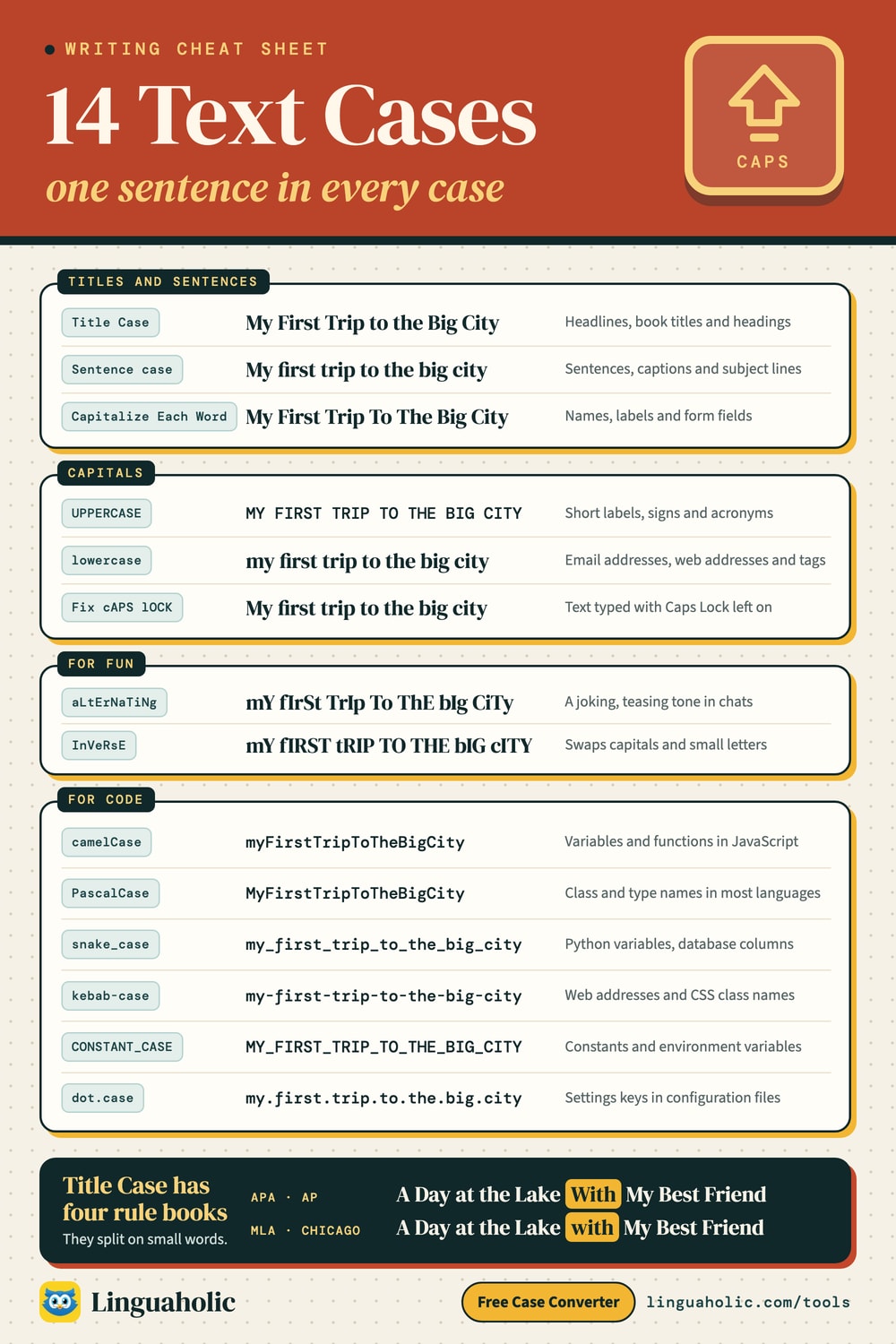
Text case chart

Sentence case converter
Sentence case writes text the way you would write a normal sentence: a capital letter at the start, then lowercase, except for names and the pronoun I. Many websites, apps and news sites use it for headlines and buttons because it reads more naturally, and APA uses it for article and book titles in a reference list.
The tool’s sentence case does more than lowercase everything:
- It capitalizes the first letter after a period, question mark or exclamation mark, and at the start of each line.
- It keeps I, I’m, I’ll and I’ve as capitals, and it keeps acronyms like FAQ and words like PhD as typed.
- It knows that e.g., i.e., vs. and Dr. don’t end a sentence, so the next word stays lowercase.
- It notices when a long line was simply wrapped in the middle of a sentence (as in text copied from a PDF) and doesn’t add a capital at the start of the next line.
Names are the one thing it cannot guess. If you paste text that has no capitals at all, names stay lowercase, so give the result a quick read.
Title case vs. sentence case
Both are correct; they are just different house styles. Title case looks more formal and is traditional for book titles, essays and many blogs. Sentence case is easier to read and is common for news headlines, website headings and reference lists. Pick one and use it the same way throughout.
| Title case (Chicago) | Sentence case |
|---|---|
| How to Write a Cover Letter That Gets Read | How to write a cover letter that gets read |
| The Best Time of Year to Visit the Coast | The best time of year to visit the coast |
| Why the FAQ Page Matters More Than You Think | Why the FAQ page matters more than you think |
Uppercase to lowercase (and lowercase to uppercase)
To change uppercase to lowercase, paste your text and choose lowercase. Every letter becomes small, including accented letters such as É and Ü. To go the other way, choose UPPERCASE.
Plain lowercase is rarely what you want for text that was written in capitals, though, because it also lowercases the start of each sentence and the word I. For a message or paragraph, choose Sentence case instead:
| Case | Result |
|---|---|
| Your text | PLEASE READ THE FAQ BEFORE YOU EMAIL US. I WILL REPLY SOON. |
| lowercase | please read the faq before you email us. i will reply soon. |
| Sentence case | Please read the FAQ before you email us. I will reply soon. |
All capitals online reads as shouting, and long stretches of capitals are slower to read than normal text. Save UPPERCASE for short labels, warnings and acronyms.
Fix text typed with Caps Lock on
With Caps Lock on, holding Shift for a capital gives you a small letter instead, so you end up with text like hELLO! i JUST GOT BACK FROM pARIS. Fix cAPS lOCK spots this pattern and flips every letter back: Hello! I just got back from Paris. Because it flips rather than guesses, the capitals you meant to type, like the P in a place name, come back exactly. If the text is simply all capitals, it falls back to sentence case and keeps common acronyms. If only a word or two is flipped, only those words change.
Capitalize Each Word, aLtErNaTiNg and InVeRsE
Capitalize Each Word gives every word a capital, small words included: The House Between The Hills. Use it for names, places, product lists and spreadsheet columns, where every word should start with a capital. For the title of a work, use Title Case, which follows a style guide. Acronyms and words such as PhD keep their capitals.
aLtErNaTiNg case switches between small and capital letters: tHiS iS fInE. It is the classic mocking tone in memes and chats. The tool counts only letters, so spaces and punctuation don’t break the rhythm. InVeRsE swaps every letter: capitals become small and small letters become capitals (hELLO wORLD). For other looks, such as tiny letters or bold letters that work in social media bios, try the small text generator or the fancy text generator.
camelCase, snake_case and other programming cases
Code can’t have spaces in names, so programmers join words in fixed patterns called naming conventions. The tool turns any phrase into the six most common ones. It splits words at spaces, punctuation and existing capitals, so it can also convert one convention into another: parseHTMLResponse becomes parse_html_response. Apostrophes are dropped rather than turned into a break (user’s name becomes usersName), and Remove accents turns café into cafe for names that must be plain ASCII.
| Case | “number of items in cart” | Where you see it |
|---|---|---|
| camelCase | numberOfItemsInCart | Variables and functions in JavaScript; JSON keys in many web APIs |
| PascalCase | NumberOfItemsInCart | Class and type names in most languages, including Python classes |
| snake_case | number_of_items_in_cart | Variables and functions in Python and Ruby; database column names |
| kebab-case | number-of-items-in-cart | Web addresses (URL slugs), CSS class names and file names |
| CONSTANT_CASE | NUMBER_OF_ITEMS_IN_CART | Constants and environment variables (MAX_SIZE, API_KEY) |
| dot.case | number.of.items.in.cart | Settings keys in configuration files (server.port) |
These are conventions, not laws: what matters most is to match the code around you. In Python, the official style guide (PEP 8) asks for snake_case functions and variables, CapWords (PascalCase) classes and capitals with underscores for constants. In JavaScript, camelCase variables and PascalCase classes are the norm. CSS property names are already kebab-case (font-size), which is why class names often follow suit. Paste one name per line to convert a whole list at once.
Tips for changing case
- Check names after converting. Lowercase and sentence case cannot know that a word is a name. Title Case and Capitalize Each Word will capitalize it anyway.
- Watch out for simple “title” functions. Spreadsheet and programming shortcuts that capitalize every word (such as the PROPER function in spreadsheets or
str.title()in Python) ignore style rules and can produce oddities like They’Re. Use a style guide when the title will be published. - Be consistent. If your headings use title case, use it for every heading of the same level. Mixing title case and sentence case at the same level looks like a mistake.
- Clean pasted text first. Text from PDFs often has broken lines; join them with remove line breaks, then fix the case here.
- Mind the length. Converting case never changes the number of characters, except for a few letters such as the German ß, which becomes SS in capitals. To check a character limit, see the sentence counter or the word counter.
For teachers, bloggers & clubs
Put the Case Converter on your website
Give your readers this tool right on your page. Copy the code, paste it into your site, done: no sign-up, no account.
- Free for any website
- No ads, no cookies
- Fits phones and sidebars
- Always up to date
Please keep the small credit line under the tool; you may add rel="nofollow" to its link. How it works & the rules

› Show the code
Frequently asked questions
- How do I convert uppercase to lowercase?
- Paste your text into the case converter and choose lowercase. For normal sentences, choose Sentence case instead: it lowercases the text but keeps capitals at the start of each sentence, on the word I and on acronyms.
- What is title case?
- Title case is a way of writing titles in which the first word and all major words (nouns, verbs, adjectives, adverbs and pronouns) start with a capital letter, while small words such as a, the, and and of stay lowercase. Style guides differ on which small words stay lowercase.
- What words should not be capitalized in a title?
- Articles (a, an, the), short conjunctions (and, but, or, nor, for) and prepositions stay lowercase unless they are the first word. APA and AP lowercase only prepositions of three letters or fewer, while MLA and Chicago lowercase prepositions of any length.
- Do you capitalize with, from and is in a title?
- Is is a verb, so it is capitalized in every style. With and from are prepositions of four letters: APA and AP capitalize them, while MLA and Chicago keep them lowercase.
- Should I use APA, MLA, Chicago or AP title case?
- Use the style your teacher, publisher or workplace asks for. APA is common for papers in psychology, education and the social sciences, MLA for literature and the humanities, Chicago for books and many websites, and AP for news writing.
- Do you capitalize the first word after a colon in a title?
- Yes. The word after a colon starts the subtitle, and APA, MLA, Chicago and AP all capitalize the first word of a subtitle, even a small word such as a or the.
- What is the difference between title case and sentence case?
- Title case capitalizes every major word (How to Write a Great Cover Letter). Sentence case capitalizes only the first word and names, like a normal sentence (How to write a great cover letter). Both are correct; pick one and use it consistently.
- How do I fix text I typed with Caps Lock on?
- Paste it and choose Fix Caps Lock. Text like hELLO wORLD is flipped back to Hello World, and text written entirely in capitals is turned into sentence case that keeps common acronyms.
- What are camelCase and snake_case?
- They are naming conventions for code, where spaces are not allowed. camelCase joins words and capitalizes each word after the first (userName), while snake_case writes them in lowercase joined by underscores (user_name). The converter also makes PascalCase, kebab-case, CONSTANT_CASE and dot.case.
- Is my text private?
- Yes. The case converter runs entirely in your browser. Nothing you type is uploaded or stored.
About this page
The Case Converter is a free tool from Linguaholic, made by Marcel Iseli. It runs in your browser, with no sign-up. Last updated .
Keep exploring
More free tools
 Word CounterCount words, characters, sentences, and paragraphs as you type.
 Sentence CounterCount sentences and words per sentence, and spot sentences that run too long.
 Remove Line BreaksRemove or add line breaks, keep paragraphs, and fix text pasted from PDFs and emails.
 Small Text GeneratorTiny small-caps letters to copy and paste into Instagram, TikTok, and Discord.
 Fancy Text GeneratorCopy-and-paste fonts for Instagram, TikTok, and Discord bios.
 Invisible CharacterCopy blank text and invisible characters, or find and remove hidden ones.