
Language learning
Syllable Counter
Count the syllables in any word, sentence, or poem using a pronouncing dictionary — with syllable division, word stress, a haiku and poem-form checker, meter scansion, reading level, and a words-by-syllables finder.
Updated · Free, no sign-up
Readability: Easy — Flesch reading ease 90, about US grade 2.4 (2 sentences).
Haiku (5-7-5) check✓ Every line fits
- Line 1 — An old silent pond5 / 5 ✓
- Line 2 — A frog jumps into the pond7 / 7 ✓
- Line 3 — Splash! Silence again5 / 5 ✓
Line by line — stressed syllables in bold
- An old silent pond5
- A frog jumps into the pond7iambic trimeter
- Splash Silence again5
Syllables per word — main stress in bold
Loading the dictionary… counts shown meanwhile are estimates.
Dictionary data: CMU Pronouncing Dictionary, WordNet 3.1, SCOWL and ENABLE — sources & licenses.
Share this tool
Know someone who’d love it?
What is a syllable?
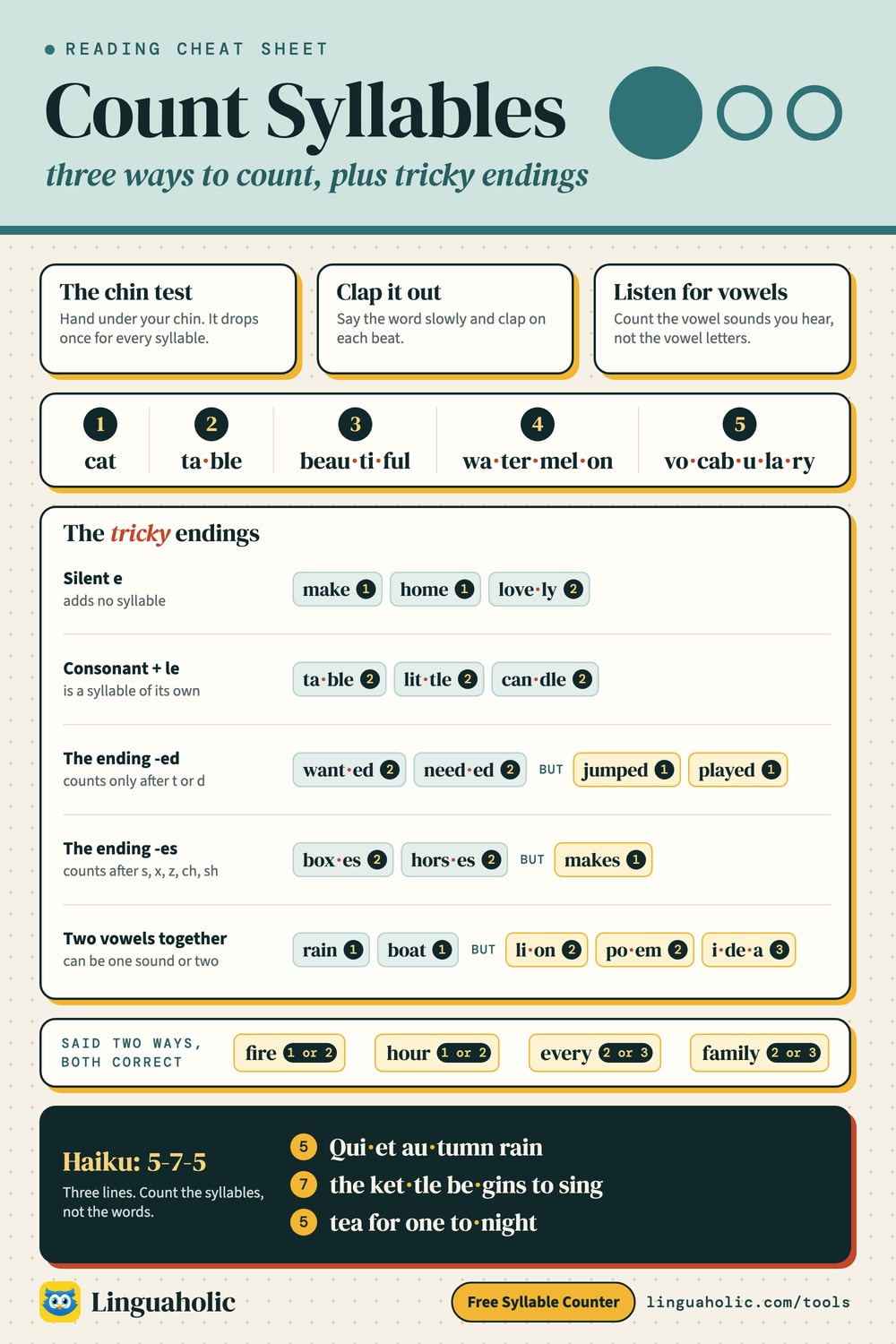
A syllable is a single beat of spoken sound, built around one vowel sound. “Cat” has one syllable, “ta·ble” has two, and “beau·ti·ful” has three. Each syllable usually has a vowel sound at its center, with consonants around it: the vowel sound matters, not the number of vowel letters. That is why “bread” (two vowels, one sound) has one syllable and “i·de·a” (three vowels, three sounds) has three.
This syllable counter looks up every word in a pronouncing dictionary of more than 50,000 English words (plus names), so it counts the way words are actually said — not just by counting vowel letters. It shows where each word breaks into syllables, which syllable is stressed, and which words can be said more than one way.
How to use the syllable counter
- Type or paste a word, sentence, poem, or song lyrics. The total, words, lines, average syllables per word, and reading grade update as you type.
- Type a single word to see its syllable count, how it divides (ev·er·y), and where the stress falls.
- Paste a poem on separate lines to count the syllables in each line. Pick a form — haiku, tanka, cinquain, limerick, sonnet, or your own pattern — to check every line against it.
- Read the rhythm: stressed syllables are shown in bold, and lines that follow a regular meter are labeled, like “iambic pentameter”.
- Find words with a given number of syllables in the second tab — filter by part of speech, topic, stress, and letters, then copy the list.
Words the dictionary doesn’t know (brand names, made-up words, typos) are estimated from their spelling and marked with a ~. Everything runs in your browser: nothing you type is uploaded or stored.
Syllable counting rules chart

How many syllables are in…?
These are the words people most often ask about. Stressed syllables are in bold. Where two counts are given, both pronunciations are common — use the one that matches how you say the word.
| Word | Syllables | Divided | Note |
|---|---|---|---|
| many | 2 | man·y | |
| syllable | 3 | syl·la·ble | |
| and | 1 | and | |
| haiku | 2 | hai·ku | Hai-ku: two syllables in English. |
| fire | 1 or 2 | fire | Said as one beat (fire) or two (fi-er). |
| beautiful | 3 | beau·ti·ful | |
| every | 2 or 3 | ev·er·y | Usually “ev-ry” (2), carefully “ev-er-y” (3). |
| orange | 2 | o·range | “Or-ange” (2); some accents say “ornj” (1). |
| firefighter | 3 | fire·fight·er | |
| family | 2 or 3 | fam·i·ly | Usually “fam-ly” (2), carefully “fam-i-ly” (3). |
| friends | 1 | friends | |
| very | 2 | ver·y | |
| leaves | 1 | leaves | |
| flowers | 2 | flow·ers | |
| elephant | 3 | el·e·phant | |
| smile | 1 | smile | |
| apple | 2 | ap·ple | |
| word | 1 | word | |
| everything | 3 | ev·ery·thing | |
| bright | 1 | bright | |
| squirrel | 2 | squir·rel | American “squirl” (1) or British “squir-rel” (2). |
| umbrella | 3 | um·brel·la | |
| favorite | 2 or 3 | fa·vor·ite | |
| friendship | 2 | friend·ship | |
| chocolate | 2 | chocolate | Usually “choc-lit” (2), carefully “choc-o-late” (3). |
| flower | 2 | flow·er | Often blended into one beat in fast speech, like “flour”. |
| different | 2 or 3 | dif·fer·ent | Usually “diff-rent” (2), carefully “dif-fer-ent” (3). |
| our | 1 or 2 | our | Often one syllable (“are”), or two (“ow-er”). |
| lion | 2 | li·on | Two syllables: li-on. |
| world | 1 | world | |
| there | 1 | there | |
| owl | 1 | owl | |
| everywhere | 3 | ev·ery·where | |
| love | 1 | love | |
| wild | 1 | wild | |
| hours | 1 or 2 | hours | “Hour” rhymes with “our”: one beat or two. |
| butterfly | 3 | but·ter·fly | |
| really | 2 | real·ly | |
| water | 2 | wa·ter | |
| around | 2 | a·round | |
| heart | 1 | heart | |
| people | 2 | peo·ple | |
| idea | 3 | i·de·a | Three syllables: i-de-a. |
| watermelon | 4 | wa·ter·mel·on | |
| everyone | 3 | ev·ery·one | |
| difference | 2 or 3 | dif·fer·ence | |
| tired | 2 | tired | “Tired” can be one beat or two (ti-erd). |
| crocodile | 3 | croc·o·dile | |
| limerick | 3 | lim·er·ick | |
| poem | 2 | po·em | “Po-em” (2) or, in some accents, “pome” (1). |
| alligator | 4 | al·li·ga·tor | |
| pumpkin | 2 | pump·kin | |
| wednesday | 2 | wednes·day | The first d is silent: “Wenz-day”. |
| everybody | 4 | ev·ery·bod·y | |
| strawberry | 3 | straw·ber·ry | |
| banana | 3 | ba·nan·a | |
| vegetable | 3 | vegetable | Usually “veg-ta-ble” (3), carefully “veg-e-ta-ble” (4). |
| usually | 3 or 4 | u·su·al·ly | Usually “use-ya-lee” (3) or “u-su-al-ly” (4). |
| question | 2 | ques·tion | |
| caterpillar | 4 | cat·er·pil·lar | |
| quiet | 2 | qui·et | Two syllables: qui-et (not “quite”). |
| ladybug | 3 | la·dy·bug | |
| supercalifragilisticexpialidocious | 14 | su·per·cal·i·frag·il·is·tic·ex·pi·al·i·do·cious | The Mary Poppins word — 34 letters, 14 syllables. |
Fun fact: “syllable” has three syllables (syl·la·ble), and “haiku” has two.
How to count syllables yourself
Three quick methods work for most words:
- The chin method. Put your hand flat under your chin and say the word slowly. Your jaw drops once for each syllable.
- Clap it out. Say the word and clap on every beat: “but-ter-fly” gets three claps.
- Count vowel sounds. Each vowel sound you hear is one syllable. Count sounds, not letters: “boat” has two vowel letters but one sound.
Tricky cases
- Silent e adds no syllable: “make”, “home”, “love·ly”, “care·ful”.
- Consonant + le at the end is its own syllable: “ta·ble”, “lit·tle”, “can·dle”.
- The -ed ending is only a syllable after t or d: “want·ed” (2) but “jumped” (1).
- The -es ending adds a syllable after s, z, x, ch, sh, or a soft g/c: “box·es”, “hors·es”, “pric·es”, but not “makes”.
- Two vowels side by side can be one sound (“rain”, “boat”) or two (“li·on”, “po·em”, “qui·et”, “i·de·a”).
- Words said two ways — “fire”, “hour”, “every”, “family”, “chocolate” — have two correct counts. Poets and songwriters use whichever fits the rhythm.
How to divide words into syllables
When you split a written word into syllables, a few classic rules cover most words. The counter shows each word divided with a dot (·), following these rules and the word’s pronunciation.
| Pattern | Rule | Examples |
|---|---|---|
| VC/CV | Two consonants between vowels: split between them. | rab·bit, nap·kin, pic·nic, win·ter |
| V/CV | One consonant after a long vowel: the consonant starts the next syllable. | ba·by, ro·bot, ti·ger, mu·sic |
| VC/V | One consonant after a short, stressed vowel: it stays with the first syllable. | riv·er, lem·on, cab·in, stud·y |
| Consonant + le | The consonant before “-le” goes with it. | ta·ble, lit·tle, pur·ple, can·dle |
| Digraphs | ch, sh, th, ph, wh, ck never split. | moth·er, fa·ther, chick·en, el·e·phant |
| Compound words | Split between the two words first. | base·ball, some·one, home·work, but·ter·fly |
| Prefixes and suffixes | Keep them as their own syllables. | re·play, un·hap·py, jump·ing, care·ful |
Dictionaries don’t always agree on where breaks fall in writing (is it “pi·lot” or “pil·ot”?), but they do agree on the number of syllables. For hyphenating words at the end of a line, follow your dictionary or style guide.
Stressed syllables (word stress)
In English words with two or more syllables, one syllable is said louder and longer than the others — the stressed syllable. “PHO·to·graph”, “pho·TOG·ra·pher” and “pho·to·GRAPH·ic” show how stress can move as a word grows. Stress can even change a word’s meaning: a REC·ord (noun) versus to re·CORD (verb), a PRES·ent versus to pre·SENT.
The counter shows the main stress in bold for every word it knows. In the word finder, you can list words by stress position — handy for pronunciation practice, ESL lessons, and writing lyrics that land on the beat.
Open and closed syllables: the six syllable types
Reading teachers sort syllables into six types. Knowing the type tells you how the vowel sounds, which makes it easier to read and spell new words.
| Type | What it looks like | Vowel sound | Examples |
|---|---|---|---|
| Closed | Ends in a consonant after one vowel | Short | cat, rab·bit, nap·kin |
| Open | Ends in a single vowel | Long | go, me, ba·by, ro·bot |
| Silent e (VCe) | Vowel, consonant, silent e | Long | cake, hope, in·vite |
| Vowel team | Two letters making one vowel sound | Varies | rain, boat, teach·er |
| R-controlled | Vowel followed by r | Changed by the r | car, her, bird, cor·ner |
| Consonant-le | Consonant + le at the end of a word | Schwa + l | ta·ble, lit·tle, bub·ble |
An open syllable ends with its vowel, so the vowel “says its name” (the long sound): “me”, “ba” in “ba·by”. A closed syllable is closed off by a consonant, so the vowel is short: “met”, “rab” in “rab·bit”.
Words by number of syllables
Here are common English words sorted by syllable count, with the stressed syllable in bold. Open the Find words by syllables tab above for thousands more — filter them by part of speech, topic (animals, food, feelings…), first letter, or stress, and copy the list.
One-syllable words
- act
- best
- break
- chain
- clue
- deem
- ease
- feel
- fly
- gap
- guide
- hint
- kept
- lend
- loss
- mess
- news
- parts
- plea
- put
- road
- scan
- shelf
- solve
- start
- suit
- there
- track
- vast
- whole
Two-syllable words
- a·ble
- a·larm
- a·side
- be·hind
- cap·tain
- com·bine
- con·tract
- da·ta
- de·tailed
- du·ty
- ex·plain
- fin·ger
- giv·ing
- hid·ing
- in·stall
- lay·out
- low·er
- mi·nor
- nor·mal
- ow·ner
- po·lice
- prom·ise
- re·duced
- res·ponse
- send·ing
- soon·er
- stu·dent
- ta·ken
- twen·ty
- warn·ing
Three-syllable words
- ab·so·lute
- a·gree·ment
- ar·e·a
- at·trac·tive
- can·did·ate
- com·mit·tee
- con·fus·ing
- cop·y·ing
- de·fin·ing
- dig·i·tal
- dis·turb·ing
- el·e·ments
- es·sen·tial
- ex·pect·ed
- gas·o·line
- im·prove·ment
- in·struc·tions
- jus·ti·fied
- me·chan·ics
- now·a·days
- or·gan·ize
- pos·i·tive
- prom·is·ing
- re·a·lize
- re·gard·less
- re·peat·ed
- se·lec·tion
- stud·y·ing
- te·di·ous
- un·like·ly
Four-syllable words
- ab·bre·vi·ate
- al·le·vi·ate
- ap·prox·i·mate
- cal·cu·la·tor
- com·pet·i·tive
- con·so·la·tion
- cu·mu·la·tive
- di·a·gnos·tics
- doc·u·ment·ed
- en·gine·er·ing
- ex·pen·di·ture
- hon·or·a·ry
- in·ci·den·tal
- in·hab·it·ed
- in·ter·fer·ing
- leg·en·da·ry
- mon·i·tor·ing
- op·po·si·tion
- pho·to·cop·y
- pub·li·ci·zing
- re·pet·i·tive
- sim·plic·i·ty
- sym·pa·thet·ic
- u·ni·fy·ing
Five-syllable words
- ab·bre·vi·at·ed
- a·li·e·na·tion
- ar·chae·ol·o·gist
- bi·o·log·i·cal
- com·pre·hen·si·ble
- cre·a·tiv·i·ty
- dis·ci·pli·na·ry
- ed·i·to·ri·al
- ex·a·mi·na·tion
- gen·er·os·i·ty
- il·lu·mi·na·ting
- in·ap·pli·ca·ble
- in·di·vis·i·ble
- in·hu·man·i·ty
- in·tim·i·dat·ed
- jux·ta·po·si·tion
- mis·cel·la·ne·ous
- op·por·tu·ni·ty
- po·la·ri·za·tion
- punc·tu·al·i·ty
- re·mu·ner·a·tion
- so·phis·ti·cat·ed
- ul·tra·vi·o·let
- un·for·giv·a·ble
Haiku syllable counter (5-7-5)
A traditional English haiku has three lines of 5, 7, and 5 syllables — 17 in total — and usually captures a single moment in nature or a season. Paste your three lines and the counter checks each one, tells you how many syllables to add or cut, and flags lines that fit only if a word like “fire” is said the shorter or longer way. Here is a haiku written for this page:
Morning syllables
counted softly on my hand —
five, then seven, five
Japanese haiku actually count on (sound units), which are shorter than English syllables, so many modern English haiku poets write fewer than 17 syllables. For school assignments and contests, 5-7-5 is the rule to follow.
Syllable patterns of popular poem forms
| Form | Lines | Syllables per line |
|---|---|---|
| Haiku | 3 | 5 – 7 – 5 |
| Tanka | 5 | 5 – 7 – 5 – 7 – 7 |
| Cinquain (Crapsey) | 5 | 2 – 4 – 6 – 8 – 2 |
| Limerick | 5 (rhymes AABBA) | about 8 – 8 – 5 – 5 – 8 |
| Sonnet | 14 | 10 each (iambic pentameter) |
| Ballad / common meter | 4-line stanzas | 8 – 6 – 8 – 6 |
| Villanelle | 19 | usually 10 each |
The counter checks haiku, tanka, cinquain, limerick, and sonnet directly. For anything else — ballad stanzas, a song verse, a rap bar — choose Custom pattern and type the syllables you want per line, such as “8, 6, 8, 6”.
Meter and iambic pentameter
Meter is the pattern of stressed and unstressed syllables in a line of poetry. It is measured in feet:
- Iamb (da-DUM): a·bout, to·day
- Trochee (DUM-da): gar·den, hap·py
- Anapest (da-da-DUM): un·der·stand
- Dactyl (DUM-da-da): beau·ti·ful
The number of feet names the line length: trimeter (3), tetrameter (4), pentameter (5), hexameter (6). So iambic pentameter is five iambs — ten syllables going da-DUM five times, as in Shakespeare’s “Shall I compare thee to a summer’s day?”
The counter scans each line using dictionary stress for longer words and treats one-syllable words flexibly (small words like “the” and “of” lean unstressed), then names the closest meter. Poets bend the rules on purpose, so treat it as a helpful first reading — your ear has the final say.
Syllables and reading level
Longer words make text harder to read, so readability formulas count syllables. The counter shows the Flesch reading ease (higher is easier; 60–70 is plain English) and the Flesch–Kincaid grade level (the US school grade that can read the text comfortably). Both use average sentence length and average syllables per word, so they are most reliable for a paragraph or more. For a full breakdown of your writing, also try the Word Counter.
Why syllable counts can differ
Syllables depend on pronunciation, and pronunciation varies by accent and speed. “Every” and “family” often lose a middle syllable in everyday speech, “fire” and “hour” can be one beat or two, and British and American speakers say some words differently. When a word has two common pronunciations, the counter shows both counts, and the poem checker accepts a line that works either way. The counts come from the CMU Pronouncing Dictionary, a widely used open pronunciation dictionary of American English, extended by Linguaholic with syllable breaks and word information.
Related tools
Counting words or characters instead? Use the Word Counter or Sentence Counter. Looking for inspiration? The Random Word Generator gives writing prompts, and the Fill-in-the-Blank Stories are a fun way to practice parts of speech.
For teachers, bloggers & clubs
Put the Syllable Counter on your website
Give your readers this tool right on your page. Copy the code, paste it into your site, done: no sign-up, no account.
- Free for any website
- No ads, no cookies
- Fits phones and sidebars
- Always up to date
Please keep the small credit line under the tool; you may add rel="nofollow" to its link. How it works & the rules

› Show the code
Frequently asked questions
- How does the syllable counter work?
- It looks up every word in a pronouncing dictionary of more than 50,000 English words (based on the CMU Pronouncing Dictionary, plus names), so the count reflects how words are actually said. It also shows where each word divides into syllables and which syllable is stressed. Words that aren't in the dictionary, such as brand names or made-up words, are estimated from their spelling and marked with a ~.
- How many syllables are in a word like fire, every, or family?
- Some words have two common pronunciations. Fire and hour can be said with 1 or 2 syllables, every and family with 2 or 3, and chocolate and different are usually 2 in everyday speech but 3 when said carefully. The counter shows both counts for these words, and either is correct — use the one that matches how you say it.
- How do I check a haiku?
- Paste your haiku as three lines. The counter checks the 5-7-5 pattern line by line, shows how many syllables to add or cut, and marks a line that fits only with an alternate pronunciation. You can also check tanka (5-7-5-7-7), cinquain (2-4-6-8-2), limericks, sonnets (10 syllables per line), or any custom pattern.
- Can it tell me which syllable is stressed?
- Yes. For every word in the dictionary, the main stressed syllable is shown in bold, for example beau·ti·ful or ba·nan·a. Type a single word to see its stress spelled out, and use the word finder to list words by stress position.
- Does it check iambic pentameter and meter?
- Yes. Each line of a poem is scanned: stressed syllables are shown in bold and the closest meter is named, such as iambic pentameter or trochaic tetrameter. It uses dictionary stress for longer words and treats one-syllable words flexibly, the way a reader scans by ear, so treat it as a helpful first reading.
- How do I divide a word into syllables?
- Split between two consonants (rab·bit), before a single consonant after a long vowel (ba·by), after a single consonant after a short stressed vowel (riv·er), and keep consonant + le together (ta·ble). Keep digraphs like ch, sh and th together, and split compound words and prefixes or suffixes first (base·ball, re·play). The counter shows the division of every word it knows.
- Can I find words with a certain number of syllables?
- Yes. Open the Find words by syllables tab, choose 1 to 7+ syllables, and filter by part of speech, topic, how common the word is, stress position, and starting or ending letters. Tap a word for a short definition, or copy the whole list.
- What are open and closed syllables?
- An open syllable ends in a vowel, which usually makes the vowel long, as in go or ba·by. A closed syllable ends in a consonant, which usually makes the vowel short, as in cat or rab·bit. They are two of the six syllable types taught in reading: closed, open, silent e, vowel team, r-controlled, and consonant-le.
- What reading level does it show?
- For texts of 10 words or more it shows the Flesch reading ease score (higher is easier; 60–70 is plain English) and the Flesch–Kincaid grade level, both calculated from sentence length and syllables per word.
- Is it free and private?
- Yes. It is free with no sign-up, and it runs entirely in your browser — nothing you type is uploaded or stored.
About this page
The Syllable Counter is a free tool from Linguaholic, made by Marcel Iseli. It runs in your browser, with no sign-up. Last updated .
Word data: Linguaholic’s English dictionary, built from the open ENABLE and SCOWL word lists, the CMU Pronouncing Dictionary (pronunciation and syllables) and Princeton WordNet (meanings). Licenses and notices.
Keep exploring
More free tools
 Word CounterCount words, characters, sentences, and paragraphs as you type.
 Morse Code TranslatorTranslate text to Morse code and back, hear it as sound at any speed, and see the full Morse alphabet chart.
 Roman Numeral ConverterNumbers to Roman numerals and back — plus dates, a chart, and a calculator.
 Binary TranslatorConvert text to binary code and binary back to text.
 Binary ConverterConvert between binary, decimal, hex, and octal as you type.
 Binary CalculatorAdd, subtract, multiply and divide binary with every carry, borrow and two's complement shown.