
Converters & translators
Hieroglyphics Translator
Write any name or word in Egyptian hieroglyphs, spelled by sound with the signs Egyptologists use, in a cartouche or without. Copy the Unicode signs, save a PNG or SVG, read signs back, type with a hieroglyph keyboard and print the alphabet chart. No sign-up.
Updated · Free, no sign-up
𓎡𓃭𓇋𓅱𓊪𓄿𓏏𓂋𓄿
𓍹𓎡𓃭𓇋𓅱𓊪𓄿𓏏𓂋𓄿𓍺
Each letter and its sign
- C𓎡basket with a handle (V31), khard c sounds like k
- l𓃭lying lion (E23), rw (l)l: the lion, as in the Greek names Ptolemy and Cleopatra
- e𓇋flowering reed (M17), i
- o𓅱quail chick (G43), wo: the quail chick (w), the nearest sound
- p𓊪stool (Q3), p
- a𓄿Egyptian vulture (G1), ꜣ
- t𓏏loaf of bread (X1), t
- r𓂋mouth (D21), r
- a𓄿Egyptian vulture (G1), ꜣ
✓ No sign-up✓ Free✓ Nothing uploaded
Share this tool
Know someone who’d love it?
A hieroglyphics translator that spells by sound
This hieroglyphics translator writes English names and words in Egyptian hieroglyphs. It spells them the way Egyptologists write modern names: by their sounds, with the signs that stood for single sounds in ancient Egypt. Cleopatra becomes 𓎡𓃭𓇋𓅱𓊪𓄿𓏏𓂋𓄿, drawn in a cartouche like a pharaoh's name. Every sign is a real Unicode character, so you can copy and paste it, and you can save the picture as a PNG or SVG.
One honest note before you start: this is a transliteration, not a translation. The tool writes the sounds of your words with Egyptian signs. It does not turn English sentences into the ancient Egyptian language, and no online tool can do that letter by letter. No sign-up, no app: it is free and everything happens in your browser.
How to use the hieroglyphics translator
- Translate: type a name or a word. The hieroglyphs appear as you type, with a list of which sign stands for each sound. Choose a cartouche or plain signs, a row or a column, and the reading direction. Right to left turns every sign around, as Egyptian scribes did.
- Spelling: By sound (the default) writes sh, ch, kh and th as one sound, drops a silent e and writes a double letter once. Letter by letter gives one sign per letter, as many simple charts do.
- Sign after the name: add the seated man, seated woman or seated god that Egyptians wrote after names.
- Copy and download: Copy hieroglyphs copies the Unicode signs. Download PNG and Download SVG save the picture with your name under it, for cards, posters and school projects.
- Read signs: paste hieroglyphs to see each sign's number, picture and sound. Keyboard lets you type with signs, including the famous ones like the ankh. Numbers writes any number from 1 to 9,999,999 in Egyptian numerals. Chart prints the alphabet with a classroom worksheet.
Hieroglyphic alphabet chart

The hieroglyphic alphabet
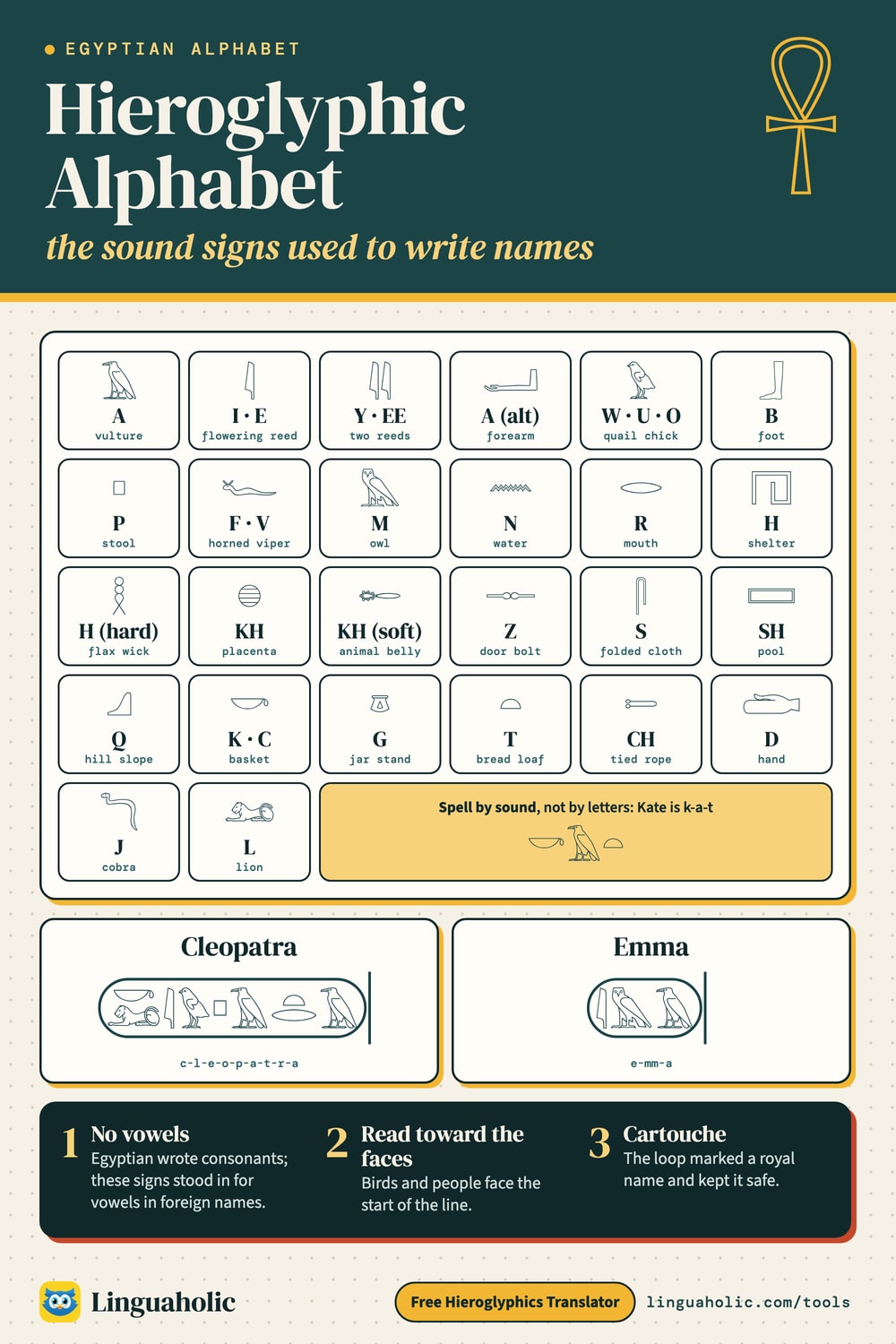
Egyptian hieroglyphs are not an alphabet like ours. The script had hundreds of signs of three kinds: signs for sounds, signs for whole words, and signs that showed what a word was about. But about 25 signs stood for a single sound (Egyptologists call them uniliterals), and these work like an alphabet. They are what people mean by the hieroglyphic alphabet or the Egyptian alphabet, and they are the signs this translator uses.
Egyptian, like Arabic and Hebrew, wrote only its consonants. Signs such as the vulture, the reed and the quail chick were consonants too, but when Egyptians wrote foreign names they used them for vowels. That is how names are written in hieroglyphs today. The letters column shows which English letters each sign is used for.
| Sign | Letters | Picture | Sound | Code |
|---|---|---|---|---|
| 𓄿 | A | Egyptian vulture | ꜣ: a consonant whose exact sound is debated (aleph); said “ah” today | G1 |
| 𓇋 | I, E | flowering reed | i: a weak “y” sound (yod); said “ee” or “i” today | M17 |
| 𓇌 | Y, EE | two flowering reeds | y: y as in yes; said “ee” | M17A |
| 𓂝 | A (some charts) | forearm | ꜥ: a deep throat sound (ayin), as in Arabic; said “ah” | D36 |
| 𓅱 | W, U, O | quail chick | w: w; said “oo” between consonants | G43 |
| 𓃀 | B | foot | b: b | D58 |
| 𓊪 | P | stool | p: p | Q3 |
| 𓆑 | F, V, PH | horned viper | f: f | I9 |
| 𓅓 | M | owl | m: m | G17 |
| 𓈖 | N | ripple of water | n: n | N35 |
| 𓂋 | R | mouth | r: r | D21 |
| 𓉔 | H | reed shelter | h: h as in hat | O4 |
| 𓎛 | H (strong) | twisted flax wick | ḥ: a strong h, breathed from the throat | V28 |
| 𓐍 | KH | placenta (or sieve) | ḫ: kh, like ch in Scottish loch | Aa1 |
| 𓄡 | KH (light) | belly of an animal with teats | ẖ: a lighter kh, like ch in German ich | F32 |
| 𓊃 | Z | door bolt | z: z (later the same sound as s) | O34 |
| 𓋴 | S, soft C | folded cloth | s: s | S29 |
| 𓈙 | SH | pool | š: sh | N37 |
| 𓈎 | Q | sandy hill slope | q: q, a k made further back in the throat | N29 |
| 𓎡 | K, hard C | basket with a handle | k: k | V31 |
| 𓎼 | G | jar stand | g: g as in go | W11 |
| 𓏏 | T, TH | loaf of bread | t: t | X1 |
| 𓍿 | CH | tethering rope | ṯ: tj, like ch in church | V13 |
| 𓂧 | D | hand | d: d | D46 |
| 𓆓 | J | cobra | ḏ: dj, like j in jam | I10 |
| 𓃭 | L | lying lion | rw (l): rw; Egyptian had no separate l, so scribes used the lion for L in Greek names | E23 |
The code is the sign's number in Sir Alan Gardiner's sign list, the standard list Egyptologists still use (G1 is the first sign in group G, birds). The transliteration letters with dots and hooks, such as ḥ and ḫ, are how Egyptologists write the sounds English has no letters for.
How to write your name in hieroglyphs
- Say your name slowly and listen to its sounds, not its spelling: Kate is k-a-t, Phil is f-i-l, Shawn is sh-o-n.
- Find a sign for each sound in the alphabet above. Sounds like sh, ch and kh have one sign each.
- Write the signs in a row or a column. Small flat signs can sit on top of each other in one square, as the translator does.
- Draw a cartouche around the name: an oval with a short bar across one end. Or skip it and add the seated man or woman after the name.
Tap a name to open it in the translator. The last column shows each sound and the sign the translator chose.
| Name | Hieroglyphs | Sounds |
|---|---|---|
| Emma | 𓇋𓅓𓄿 | e → i, mm → m, a → ꜣ |
| Liam | 𓃭𓇋𓄿𓅓 | l → rw (l), i → i, a → ꜣ, m → m |
| Olivia | 𓅱𓃭𓇋𓆑𓇋𓄿 | o → w, l → rw (l), i → i, v → f, i → i, a → ꜣ |
| Noah | 𓈖𓅱𓄿𓉔 | n → n, o → w, a → ꜣ, h → h |
| Sophia | 𓋴𓅱𓆑𓇋𓄿 | s → s, o → w, ph → f, i → i, a → ꜣ |
| James | 𓆓𓄿𓅓𓇋𓋴 | j → ḏ, a → ꜣ, m → m, e → i, s → s |
| Mia | 𓅓𓇋𓄿 | m → m, i → i, a → ꜣ |
| Lucas | 𓃭𓅱𓎡𓄿𓋴 | l → rw (l), u → w, c → k, a → ꜣ, s → s |
| Chloe | 𓎡𓃭𓅱𓇋 | ch → k, l → rw (l), o → w, e → i |
| Ethan | 𓇋𓏏𓄿𓈖 | e → i, th → t, a → ꜣ, n → n |
| Grace | 𓎼𓂋𓄿𓋴 | g → g, r → r, a → ꜣ, c → s |
| Jack | 𓆓𓄿𓎡 | j → ḏ, a → ꜣ, ck → k |
English letters with no Egyptian sign
Some English sounds did not exist in Egyptian. The translator picks the nearest sign, as Egyptologists do, and says so in its list:
| Letters | Written with | Example |
|---|---|---|
| L | the lying lion (rw), used for L in Greek names | Lily 𓃭𓇋𓃭𓇌 |
| E, I | the flowering reed (i) | Eli 𓇋𓃭𓇋 |
| O, U, W | the quail chick (w) | Owen 𓅱𓅱𓇋𓈖 |
| V | the horned viper (f), the nearest sound | Vera 𓆑𓇋𓂋𓄿 |
| C | the basket (k), or the folded cloth (s) before e, i and y | Cecil 𓋴𓇋𓋴𓇋𓃭 |
| X | the basket and the folded cloth (k + s) | Max 𓅓𓄿𓎡𓋴 |
| TH | the bread loaf (t): Egyptian had no th sound | Ruth 𓂋𓅱𓏏 |
| SH, CH, KH | one sign each: the pool, the tethering rope, the placenta | Sasha 𓋴𓄿𓈙𓄿 |
Different charts make different choices. Some use the forearm (ꜥ) for A instead of the vulture, or the lasso sign for O, although that sign really stands for the pair of sounds wꜣ. There is no single correct spelling of an English name in hieroglyphs, so if you are copying a design from a book or a museum, use its choices.
What is a cartouche?
A cartouche is the oval loop drawn around a royal name, with a straight bar at one end where the rope is tied. It grew out of the shen ring, a circle of rope that stood for eternity and protection, stretched long enough to hold a name. A pharaoh had five names, and the two most important, the throne name and the birth name, were written in cartouches. The Egyptian word was shenu; French soldiers in Egypt called it a cartouche because it reminded them of the paper cartridges of their guns.
Cartouches were what made the decipherment possible: scholars knew that the signs inside them were names of rulers. Today a name in a cartouche is a favorite for jewelry, pendants and birthday cards. The translator draws the tie bar at the end of the name, which is the left end when you write right to left and the bottom when you write in a column.
Which way do you read hieroglyphs?
Hieroglyphs could run right to left (the most common), left to right, or in columns from top to bottom. To find the direction, look at the people, birds and animals: they face the beginning of the line, so you read toward their faces. Scribes chose the direction to fit the space, so on a doorway the two sides often face each other.
Signs were also grouped into neat squares instead of being strung out in a line. Tall signs stand alone; small flat signs such as the water ripple 𓈖, the mouth 𓂋 and the bread loaf 𓏏 are stacked on top of each other. A group is read from top to bottom. The translator stacks flat signs this way unless you turn off Stack signs into blocks.
Sound signs, word signs and determinatives
Real Egyptian texts mix three kinds of signs, and the same sign can work in more than one way:
- Sound signs (phonograms) stand for one, two or three consonants. The 25 one-sound signs are the alphabet above; there are also about 100 signs for two sounds and many for three.
- Word signs (logograms) stand for a whole word, often what they show: the sun 𓇳 for sun or day, the house 𓉐 for house. A single stroke under a sign marks it as a word sign.
- Determinatives were written at the end of a word and not read aloud. They showed its meaning: a seated man 𓀀 after a man's name, a seated woman 𓁐 after a woman's, legs walking after verbs of movement.
Famous hieroglyphs and their meanings
These signs appear again and again on temple walls, jewelry and amulets. All of them are on the translator's keyboard.
| Sign | Picture | Meaning | Code |
|---|---|---|---|
| 𓋹 | ankh (sandal strap) | lifeꜥnḫ | S34 |
| 𓊽 | djed pillar | stability, lastingḏd | R11 |
| 𓌀 | was scepter | power, rulewꜣs | S40 |
| 𓂀 | eye of Horus (wedjat) | the healed eye of Horus; wholeness, protectionwḏꜣt | D10 |
| 𓆣 | scarab beetle | to come into being, to changeḫpr | L1 |
| 𓇳 | sun | sun, day; the sun god Rarꜥ | N5 |
| 𓄤 | heart and windpipe | good, beautifulnfr | F35 |
| 𓄣 | heart | heartib | F34 |
| 𓂓 | two raised arms | ka, the life force of a personkꜣ | D28 |
| 𓅽 | bird with a human head | ba, the soul or personalitybꜣ | G53 |
| 𓊹 | cloth on a pole | godnṯr | R8 |
| 𓇓 | sedge plant | part of nswt, king (of Upper Egypt)sw | M23 |
| 𓆤 | bee | part of bity, king (of Lower Egypt)bit | L2 |
| 𓅭 | pintail duck | sonzꜣ | G39 |
| 𓅐 | vulture | mothermwt | G14 |
| 𓅃 | falcon | the god Horusḥr | G5 |
| 𓈌 | sun rising between two hills | horizonꜣḫt | N27 |
| 𓇯 | sky | skypt | N1 |
| 𓇼 | star | starsbꜣ | N14 |
| 𓈍 | hill with rays of the rising sun | to appear, to shine (like the sun)ḫꜥ | N28 |
| 𓉐 | house | housepr | O1 |
| 𓊖 | village with crossroads | town, cityniwt | O49 |
| 𓁹 | eye | to do, to makeir | D4 |
| 𓎟 | basket | lord; every, allnb | V30 |
| 𓊵 | loaf on a reed mat | offering; peace, to be contentḥtp | R4 |
| 𓄥 | lungs and windpipe | to unitesmꜣ | F36 |
| 𓇅 | papyrus stem | green, fresh, to flourishwꜣḏ | M13 |
| 𓆗 | rearing cobra | cobra goddess; written after names of goddesses | I12 |
| 𓁦 | goddess Maat with a feather | Maat, the goddess of truth and order | C10 |
| 𓃒 | bull | bullkꜣ | E1 |
| 𓆳 | palm rib | yearrnpt | M4 |
| 𓇹 | crescent moon | moon, monthiꜥḥ | N11 |
| 𓏙 | cone-shaped loaf | to givedi | X8 |
| 𓂡 | arm holding a stick | strength, effort; written after verbs of action | D40 |
| 𓍷 | cartouche | name; written after the word for namern | V10 |
| 𓀀 | seated man | Determinative: a man; written after men's names and words for people | A1 |
| 𓁐 | seated woman | Determinative: a woman; written after women's names | B1 |
| 𓀭 | seated god | Determinative: a god; written after the names of gods | A40 |
| 𓀔 | child with a finger to the mouth | Determinative: a child; young | A17 |
The ankh 𓋹 is the sign for life and the best known of all. It is a word sign, but it also writes the three sounds ꜥnḫ inside other words. That is the key to reading hieroglyphs: a sign can be a picture, a sound or a hint, depending on the word.
Egyptian numbers in hieroglyphs
Egyptian numbers were written with one sign for each power of ten, repeated as often as needed and grouped neatly in rows. There was no zero and no place value: the signs are simply added up. Open the Numbers tab to write any number.
| Sign | Value | Picture |
|---|---|---|
| 𓏤 | 1 | single stroke |
| 𓎆 | 10 | cattle hobble |
| 𓍢 | 100 | coil of rope |
| 𓆼 | 1,000 | lotus plant |
| 𓂭 | 10,000 | finger |
| 𓆐 | 100,000 | tadpole |
| 𓁨 | 1,000,000 | god Heh with raised arms |
For example, 2026 is two lotus plants, two cattle hobbles and six strokes: 𓆼𓆼𓎆𓎆𓏤𓏤𓏤𓏤𓏤𓏤. The figure of the god Heh, with his arms raised, also meant "millions" in the sense of countless, and appears in wishes for millions of years of life.
Words about Egypt in hieroglyphs
Handy for a class display on ancient Egypt. They are spelled by sound with the alphabet signs, as a name would be:
| Word | Hieroglyphs |
|---|---|
| Egypt | 𓇋𓎼𓇌𓊪𓏏 |
| Nile | 𓈖𓇋𓃭 |
| pharaoh | 𓆑𓄿𓂋𓄿𓅱𓉔 |
| mummy | 𓅓𓅱𓅓𓇌 |
| pyramid | 𓊪𓇌𓂋𓄿𓅓𓇋𓂧 |
| sphinx | 𓋴𓆑𓇋𓈖𓎡𓋴 |
| scarab | 𓋴𓎡𓄿𓂋𓄿𓃀 |
| papyrus | 𓊪𓄿𓊪𓇌𓂋𓅱𓋴 |
These are English words in Egyptian signs. The Egyptians had their own words: the Nile was simply iteru, the river, and Egypt was Kemet, the black land, after its dark river soil.
How hieroglyphs were deciphered
After the last hieroglyphs were carved, at the temple of Philae in AD 394, the knowledge of how to read them was lost for more than 1,400 years. Scholars long believed the signs were pure symbols with hidden meanings. The breakthrough came from the Rosetta Stone, found by French soldiers near the town of Rosetta (Rashid) in 1799. It carries the same decree of 196 BC three times: in hieroglyphs, in Demotic (the everyday Egyptian script) and in Ancient Greek, which scholars could read.
The English scientist Thomas Young worked out some of the sounds in the cartouche of King Ptolemy. In 1822 the French scholar Jean-François Champollion showed that hieroglyphs were mostly a writing of sounds, mixed with word signs, and could read the names of Ptolemy, Cleopatra and Ramesses. The Rosetta Stone has been in the British Museum since 1802.
A short history of hieroglyphs
The oldest hieroglyphs, on small labels from a tomb at Abydos, date to around 3200 BC, which makes Egyptian writing one of the two oldest in the world, with Mesopotamian cuneiform. The word hieroglyph comes from the Greek for "sacred carving". In the classic period scribes used about 750 signs; in the last centuries of Egyptian writing, under Greek and Roman rule, priests added thousands more.
Hieroglyphs were the formal script of monuments, tombs and temples. For letters, accounts and stories, scribes wrote with a reed brush on papyrus in hieratic, a fast joined-up form of the same signs, and later in Demotic. Egyptian itself lived on as Coptic, written with Greek letters, and Coptic helped Champollion recognize the sounds of the old words.
Gardiner's sign list
In his Egyptian Grammar (first published in 1927), Alan Gardiner sorted the signs into groups by what they show, each group with a letter. The sign codes in this tool and in Unicode come from his list:
| Group | Signs showing |
|---|---|
| A | men and their activities |
| B | women |
| C | gods in human form |
| D | parts of the human body |
| E | mammals |
| F | parts of mammals |
| G | birds |
| H | parts of birds |
| I | reptiles, amphibians |
| K | fish |
| L | insects and small animals |
| M | trees and plants |
| N | sky, earth and water |
| O | buildings |
| P | ships |
| Q | furniture |
| R | temple furniture and sacred emblems |
| S | crowns, clothing, staffs |
| T | weapons, hunting |
| U | farming, crafts |
| V | rope, baskets |
| W | vessels of stone and clay |
| X | loaves and cakes |
| Y | writing, games, music |
| Z | strokes and geometric shapes |
| Aa | signs of unclear meaning |
Copy and paste hieroglyphs
Since 2009 hieroglyphs have been part of Unicode, the standard that gives every character on computers a number: the Egyptian Hieroglyphs block, U+13000 to U+1342F, holds 1,071 signs from Gardiner's list. Text you copy here is made of these characters, so it pastes into messages, documents and social media bios.
- Windows shows them with the font Segoe UI Historic, Android and recent Macs and iPhones with Noto Sans Egyptian Hieroglyphs.
- On a device without a hieroglyph font, people see empty boxes. If you are not sure, share the PNG picture instead.
- The cartouche in copied text is made of two characters, 𓍹 and 𓍺, the start and end of a cartouche. Use Copy without cartouche if you only want the signs.
Hieroglyphs in the classroom
Writing names in hieroglyphs is a classic part of a unit on ancient Egypt, and it teaches something real: that writing can record sounds, and that the same sound can be spelled in different ways. Some ideas for teachers and parents:
- Print the chart with the worksheet page. Students read the words, write their own names and swap secret words with a partner. Type your own words for the reading exercise; the answers are printed upside down at the bottom.
- Ask students to say their names slowly and count the sounds before they look up any signs. Kate and Cate both come out as k-a-t, which starts a good talk about spelling.
- Make cartouche name tags or bookmarks: save each name as a PNG and print it, or draw it by hand from the breakdown list.
- Compare scripts: the same name in our rune translator and ogham translator shows three ancient ways to write sounds.
For young children, the Letter by letter spelling is easier to follow; older students can use By sound and try leaving out the vowels.
Is my text private?
Yes. The translator runs entirely in your browser. Your text is not uploaded or stored, and the pictures are made on your device. Links that open the tool with a name filled in (like this one) only read the name from the address; the tool never writes what you type into it.
More codes and ancient scripts
Write your name in Viking runes with the rune translator, or in the strokes of the early Irish alphabet with the ogham translator. For codes you can use today, try the braille translator, the Morse code translator and the Roman numeral converter, which, like Egyptian numbers, adds up its signs.
Credits
Hieroglyphs are drawn from Noto Sans Egyptian Hieroglyphs (Copyright 2022 The Noto Project Authors, github.com/notofonts/egyptian-hieroglyphs), used under the SIL Open Font License 1.1. Sign numbers and names: the Unicode Character Database (Unicode License).
For teachers, bloggers & clubs
Put the Hieroglyphics Translator on your website
Give your readers this tool right on your page. Copy the code, paste it into your site, done: no sign-up, no account.
- Free for any website
- No ads, no cookies
- Fits phones and sidebars
- Always up to date
Please keep the small credit line under the tool; you may add rel="nofollow" to its link. How it works & the rules

› Show the code
Frequently asked questions
- How do I write my name in hieroglyphs?
- Type your name in the translator. It spells the name by its sounds with the sound signs Egyptologists use, puts it in a cartouche and shows which sign stands for each sound. Copy the signs as text or save the picture as a PNG or SVG.
- Is there a hieroglyphic alphabet?
- Not in the way English has one. Egyptian writing mixed sound signs, word signs and signs that showed the meaning. About 25 signs stood for single sounds, and Egyptologists use these as an alphabet to write modern names, which is what this translator does.
- Can this tool translate English into ancient Egyptian?
- No. It writes the sounds of English words with Egyptian signs, which is how names are written. Translating a sentence would mean using Egyptian words and grammar, which no letter-by-letter tool can do.
- What is a cartouche?
- A cartouche is the oval loop of rope drawn around the name of a pharaoh, tied at one end. It marked the name as royal and was thought to protect it. The name comes from French soldiers in Egypt, who thought it looked like a gun cartridge (cartouche).
- Which way do you read hieroglyphs?
- Hieroglyphs could be written from right to left, from left to right, or in columns from top to bottom. The people and animals in a line face its beginning, so you read toward their faces. Right to left was the most common direction.
- Is there an L in hieroglyphs?
- Egyptian had no separate L sound. For Greek names such as Ptolemy and Cleopatra, scribes used the lying lion, a sign for r or rw, so the translator uses the lion for L.
- How did the Egyptians write numbers?
- With one sign for each power of ten, repeated as often as needed: a stroke for 1, a cattle hobble for 10, a coil of rope for 100, a lotus for 1,000, a finger for 10,000, a tadpole for 100,000 and the god Heh for 1,000,000. There was no zero.
- How do I copy and paste hieroglyphs?
- Press Copy hieroglyphs. The signs are Unicode characters, so they paste into messages and documents. Windows, Android and recent Macs and iPhones have a font for them; where a device has none, people see empty boxes, so share the PNG picture instead.
- Who deciphered hieroglyphs?
- Jean-François Champollion announced the decipherment in 1822. He compared the Greek and Egyptian texts of the Rosetta Stone and the royal names in cartouches, building on earlier work by Thomas Young, and showed that most signs stood for sounds.
- Is there a helicopter in Egyptian hieroglyphs?
- No. The carving at the temple of Seti I at Abydos that looks like a helicopter was made when the titles of one king were filled in with plaster and carved over with new ones. The plaster fell out, and the two sets of signs overlap into odd shapes.
- Do I need to sign up or download an app?
- No. The translator is free and runs in your browser on a phone, tablet or computer. Nothing you type is uploaded or saved.
About this page
The Hieroglyphics Translator is a free tool from Linguaholic, made by Marcel Iseli. It runs in your browser, with no sign-up. Last updated .
Keep exploring
More free tools
 Rune TranslatorEnglish to Elder Futhark, Viking or Anglo-Saxon runes, with rune names, bind runes and a printable chart.
 Ogham TranslatorNames in the Irish ogham alphabet, up like a standing stone or across, with letter names and trees.
 Braille TranslatorText to braille and back (UEB grade 1), with dot numbers, name cards and a printable chart.
 Morse Code TranslatorTranslate text to Morse code and back, hear it as sound at any speed, and see the full Morse alphabet chart.
 Roman Numeral ConverterNumbers to Roman numerals and back — plus dates, a chart, and a calculator.
 Substitution CipherEncode with any alphabet or keyword, or crack a cryptogram and fix letters yourself.