
Converters & translators
Rune Translator
Turn English into runes of the Elder Futhark, the Viking-Age Younger Futhark or the Anglo-Saxon Futhorc, spelled by sound, with each rune's name and meaning. Copy the runes, save a PNG or SVG, make a bind rune, read runes back and print the rune alphabet. No sign-up.
Updated · Free, no sign-up
- ansuza
- sōwilōs
- tīwazt
- raidōr
- īsazi
- dagazd
ᚨᛊᛏᚱᛁᛞ
24 runes, used from about AD 150 to 750 across Scandinavia and wherever Germanic peoples lived; the oldest row of runes.
Each letter and its rune
- Aansuz (a god), a
- ssōwilō (sun), s
- ttīwaz (the god Tyr), t
- rraidō (ride, journey), r
- iīsaz (ice), i
- ddagaz (day), d
✓ No sign-up✓ Free✓ Nothing uploaded
Share this tool
Know someone who’d love it?
A rune translator for three rows of runes
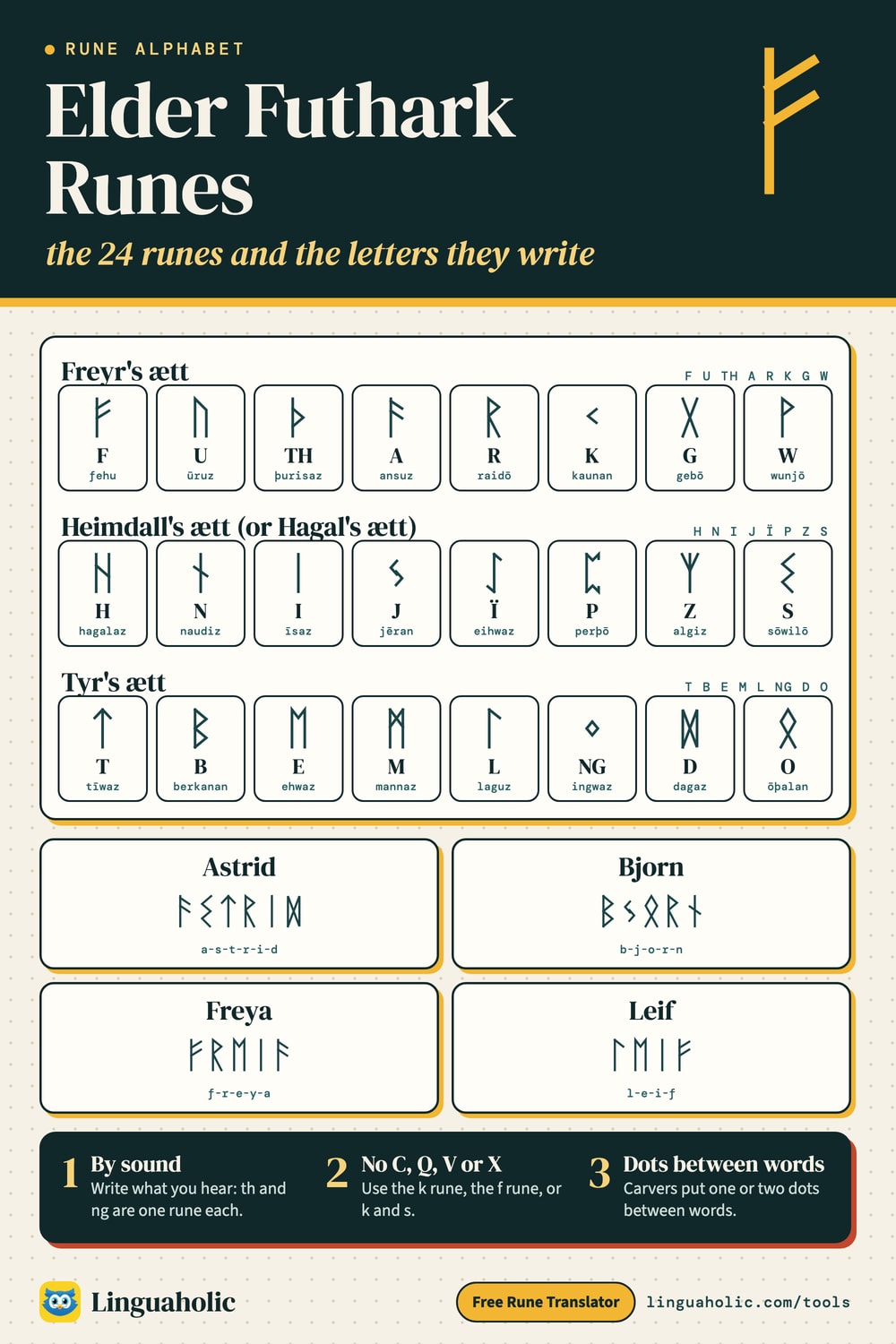
This rune translator writes English names and words in runes, the letters of the early Germanic peoples and the Vikings. Choose the Elder Futhark, the oldest row of 24 runes; the Younger Futhark of the Viking Age, with only 16; or the Anglo-Saxon Futhorc, used in England. Astrid in the Elder Futhark is ᚨᛊᛏᚱᛁᛞ. You see the name of every rune, can copy the runes as text, and can save the picture as a PNG or SVG.
Like every rune converter, this one transliterates: it writes the sounds of your English words with runes. It does not translate English into Old Norse. The runes were made for Germanic languages, so some English sounds have no rune of their own; the translator picks the nearest one and says why. No sign-up, no app: it is free and runs in your browser.
How to use the rune translator
- Translate: type a name or a short text and choose the row of runes. The runes appear as you type, drawn large, with each rune's name under it. Pick a word divider: a space, or the dots and crosses carvers put between words.
- Spelling: By sound (the default) writes th and ng with one rune, drops a silent e and writes a double letter once. Letter by letter gives one rune per letter.
- Copy and download: Copy runes copies Unicode runes for messages and documents. Download PNG and Download SVG save the drawing with your text under it, sharp enough for printing, wood burning or engraving.
- Read runes turns runes back into letters and names every rune. Bind rune joins the runes of initials into one sign. Rune chart prints the alphabet with a classroom worksheet.
Rune alphabet chart

The Elder Futhark rune alphabet
The Elder Futhark is the rune alphabet most people mean when they say runes. It was used from about AD 150 to 750 from Scandinavia to the Black Sea, and is named, like the word alphabet, after its first letters: f, u, þ, a, r, k. Its 24 runes come in three groups of eight called ætts (families): Freyr's ætt, Heimdall's or Hagal's ætt, and Tyr's ætt, named after the first rune of each group in later tradition.
| Rune | Letters | Name | Meaning | Sound |
|---|---|---|---|---|
| ᚠ | F, V, PH | fehu | cattle, wealth | f |
| ᚢ | U, OO | ūruz | aurochs (wild ox) | u |
| ᚦ | TH | þurisaz | giant | þ |
| ᚨ | A | ansuz | a god | a |
| ᚱ | R | raidō | ride, journey | r |
| ᚲ | K, C, Q | kaunan | sore, or torch (uncertain) | k |
| ᚷ | G | gebō | gift | g |
| ᚹ | W | wunjō | joy | w |
| ᚺ | H | hagalaz | hail | h |
| ᚾ | N | naudiz | need | n |
| ᛁ | I, E, EE | īsaz | ice | i |
| ᛃ | J, Y | jēran | year, good harvest | j |
| ᛇ | (a rare vowel; not used for English) | eihwaz | yew tree | ï |
| ᛈ | P | perþō | unknown | p |
| ᛉ | Z | algiz | elk (uncertain) | z |
| ᛊ | S, soft C | sōwilō | sun | s |
| ᛏ | T | tīwaz | the god Tyr | t |
| ᛒ | B | berkanan | birch | b |
| ᛖ | E | ehwaz | horse | e |
| ᛗ | M | mannaz | man, human being | m |
| ᛚ | L | laguz | water, lake | l |
| ᛜ | NG | ingwaz | the god Ing | ŋ |
| ᛞ | D | dagaz | day | d |
| ᛟ | O | ōþalan | inherited land, home | o |
The names are reconstructed: no text from the time lists them, so scholars worked them out from the later rune poems and from the languages that grew out of Proto-Germanic. That is why some meanings are marked as uncertain.
How to write your name in runes
- Say your name slowly and listen to its sounds: Phil starts with an f sound, Kate is k-a-t.
- Pick a row of runes. The Elder Futhark has a rune for almost every sound; the Viking-Age Younger Futhark often uses one rune for two sounds.
- Write one rune for each sound, using th and ng as single runes.
- Put a dot or two dots between words, as rune carvers did.
Here are common names in all three rows. Tap one to open it in the translator.
| Name | Elder Futhark | Younger Futhark | Anglo-Saxon |
|---|---|---|---|
| Astrid | ᚨᛊᛏᚱᛁᛞ | ᛅᛋᛏᚱᛁᛏ | ᚪᛋᛏᚱᛁᛞ |
| Bjorn | ᛒᛃᛟᚱᚾ | ᛒᛁᚬᚱᚾ | ᛒᛄᚩᚱᚾ |
| Erik | ᛖᚱᛁᚲ | ᛁᚱᛁᚴ | ᛖᚱᛁᚳ |
| Freya | ᚠᚱᛖᛁᚨ | ᚠᚱᛁᛁᛅ | ᚠᚱᛖᚣᚪ |
| Ingrid | ᛁᛜᚱᛁᛞ | ᛁᚾᚴᚱᛁᛏ | ᛁᛝᚱᛁᛞ |
| Leif | ᛚᛖᛁᚠ | ᛚᛁᛁᚠ | ᛚᛖᛁᚠ |
| Emma | ᛖᛗᚨ | ᛁᛘᛅ | ᛖᛗᚪ |
| Jack | ᛃᚨᚲ | ᛁᛅᚴ | ᛄᚪᚳ |
| Sophia | ᛊᛟᚠᛁᚨ | ᛋᚬᚠᛁᛅ | ᛋᚩᚠᛁᚪ |
| Noah | ᚾᛟᚨᚺ | ᚾᚬᛅᚼ | ᚾᚩᚪᚻ |
| Ethan | ᛖᚦᚨᚾ | ᛁᚦᛅᚾ | ᛖᚦᚪᚾ |
| Grace | ᚷᚱᚨᛊ | ᚴᚱᛅᛋ | ᚷᚱᚪᛋ |
English letters with no rune
| Letters | Written with (Elder Futhark) | Example |
|---|---|---|
| C | the k rune; before e, i and y the s rune | Cecilia ᛊᛖᛊᛁᛚᛁᚨ |
| Q | the k rune (qu: k and w) | Quinn ᚲᚹᛁᚾ |
| V | fehu, which also stood for the v sound | Viktor ᚠᛁᚲᛏᛟᚱ |
| X | two runes: k and s | Alex ᚨᛚᛖᚲᛊ |
| J, Y | jēran, the rune of the y sound | Jonas ᛃᛟᚾᚨᛊ |
| TH | one rune, the thorn (þurisaz) | Thea ᚦᛖᚨ |
| NG | one rune, ingwaz | Inga ᛁᛜᚨ |
| SH, CH | s and h, or k and h: there are no runes for these sounds | Sasha ᛊᚨᛊᚺᚨ |
Charts on the web disagree on some of these (some use the w rune for V, or invent a rune for C). There is no official way to write English in runes, so when you copy a design, keep to one set of choices.
The Younger Futhark: the runes of the Vikings
Around AD 800, at the start of the Viking Age, Scandinavians cut the row down to 16 runes, even though their language had more sounds than before. One rune now wrote several sounds: ᚴ for k and g, ᛏ for t and d, ᛒ for b and p, ᛁ for i and e. The runestones of Denmark, Norway and Sweden are written in this row. It came in two styles: the long-branch runes shown here, common in Denmark, and the simpler short-twig runes of Sweden and Norway.
| Rune | Letters | Name | Meaning | Sound |
|---|---|---|---|---|
| ᚠ | F, V | fé | wealth | f |
| ᚢ | U, O, W, V | úr | drizzle, or slag (iron dross) | u |
| ᚦ | TH | þurs | giant | þ |
| ᚬ | O | óss | a god (or river mouth) | ą |
| ᚱ | R | reið | ride | r |
| ᚴ | K, G, C, Q | kaun | sore | k |
| ᚼ | H | hagall | hail | h |
| ᚾ | N | nauðr | need | n |
| ᛁ | I, E, J, Y | íss | ice | i |
| ᛅ | A | ár | year, plenty | a |
| ᛋ | S, Z | sól | sun | s |
| ᛏ | T, D | Týr | the god Tyr | t |
| ᛒ | B, P | bjarkan | birch | b |
| ᛘ | M | maðr | man, human being | m |
| ᛚ | L | lǫgr | water, sea | l |
| ᛦ | (an r sound at the end of words) | ýr | yew | ʀ |
So Ragnar becomes ᚱᛅᚴᚾᛅᚱ, with the same rune for its g and its k-sound. The last rune, ýr ᛦ, wrote an r sound that grew out of an older z, mostly at the end of words; English names do not need it.
The Anglo-Saxon Futhorc
In England and Frisia the runes went the other way: Old English had more vowels, so new runes were added, up to 29 in the south and 33 in Northumbria. The row is called the futhorc because its fourth rune changed from a to o. Anglo-Saxon runes appear on coins, combs, crosses and the Franks Casket, and they were used until the 11th century.
| Rune | Letters | Name | Meaning | Sound |
|---|---|---|---|---|
| ᚠ | F, V | feoh | wealth | f |
| ᚢ | U, OO | ūr | aurochs (wild ox) | u |
| ᚦ | TH | þorn | thorn | þ |
| ᚩ | O | ōs | a god, or mouth | o |
| ᚱ | R | rād | riding | r |
| ᚳ | C, K, CH | cēn | torch | c |
| ᚷ | G | gyfu | gift | g |
| ᚹ | W | wynn | joy | w |
| ᚻ | H | hægl | hail | h |
| ᚾ | N | nȳd | need | n |
| ᛁ | I, EE | īs | ice | i |
| ᛄ | J, Y (as in yes) | gēr | year | j |
| ᛇ | (a rare vowel) | ēoh | yew tree | ēo |
| ᛈ | P | peorð | unknown | p |
| ᛉ | X | eolhx | elk-sedge | x |
| ᛋ | S, Z, soft C | sigel | sun | s |
| ᛏ | T | tīr | a guiding star, or the god Tiw | t |
| ᛒ | B | beorc | birch | b |
| ᛖ | E | eh | horse | e |
| ᛗ | M | mann | man, human being | m |
| ᛚ | L | lagu | lake, sea | l |
| ᛝ | NG | ing | the hero Ing | ŋ |
| ᛟ | OE | ēþel | inherited land, home | œ |
| ᛞ | D | dæg | day | d |
| ᚪ | A | āc | oak | a |
| ᚫ | AE | æsc | ash tree | æ |
| ᚣ | Y (as in gym) | ȳr | bow (uncertain) | y |
| ᛡ | IO | īor | a water creature, perhaps an eel or a beaver | io |
| ᛠ | EA | ēar | earth, the grave | ea |
This row writes modern English best, because Old English is its ancestor. It has runes for sh (written sc, as in Old English scip, ship), for y as a vowel and for x, and ᚳ cēn stood for both k and ch.
Where the rune meanings come from
Each rune had a name that was also an ordinary word: fehu is cattle and wealth, sōwilō the sun, īsaz ice. The names helped people learn the row, the way children learn "A is for apple". Three medieval rune poems, from England, Norway and Iceland, give a short verse for each rune, and they are the oldest source for the names.
Many websites give runes meanings such as protection, love or luck, and use them for fortune telling. These meanings come from 20th-century books, not from the Viking Age or earlier; algiz ᛉ, often called the protection rune, has a reconstructed name that probably meant elk. The meanings in this tool are the names' word meanings, as scholars give them.
Bind runes
A bind rune joins two or more runes into one sign, usually by letting them share a stave, the upright line. Carvers used bind runes now and then, mostly to save space or to decorate a name; a few early inscriptions are made of them. Today they are popular as monograms, logos and tattoos. The Bind rune tab joins each rune of a word once, on one stave, and can mirror every second rune so the sign stays balanced.
Because bind runes are drawings, Unicode has no characters for them. Save the picture as an SVG to keep a sharp outline you can resize. If you plan a tattoo, ask someone who reads runes to check it first: a joined sign can be read in more than one way.
How runes were written
Runes are made of straight lines and have almost no curves or horizontal strokes. They were made for carving into wood, where a cut along the grain disappears, and into stone, bone and metal. Most inscriptions run from left to right, but some run right to left, and some turn back and forth like a plowed field. Words were often run together or separated with one or more dots. Carvers rarely wrote a double letter twice, even across two words.
Most surviving runes are short and practical: a name on a brooch, the maker of a comb, a label on a bag, a message on a stick. The famous runestones, about 3,000 of them in Sweden alone, are mostly memorials from the Viking Age, raised by families for a relative, often painted in bright colors.
A short history of runes
The oldest certain rune inscription is on a comb found at Vimose in Denmark, from around AD 160, with the word harja. The runes probably grew out of an alphabet of northern Italy, borrowed by Germanic peoples who had contact with the Roman world. The Kylver stone from Gotland, carved around AD 400, carries the oldest list of the whole Elder Futhark.
After the Viking Age, Scandinavians kept writing in medieval runes, with dots added to tell sounds apart, alongside the Latin alphabet. In parts of Sweden runes were carved on calendars and houses into the 1800s and later. In English, rune letters lived on in the Latin alphabet: the letter thorn (þ) and wynn (ƿ) came from runes and were used in Old English manuscripts.
Words from the Viking world in runes
| Word | Elder Futhark | Younger Futhark |
|---|---|---|
| Viking | ᚠᛁᚲᛁᛜ | ᚠᛁᚴᛁᚾᚴ |
| Valhalla | ᚠᚨᛚᚺᚨᛚᚨ | ᚠᛅᛚᚼᛅᛚᛅ |
| Odin | ᛟᛞᛁᚾ | ᚬᛏᛁᚾ |
| longship | ᛚᛟᛜᛊᚺᛁᛈ | ᛚᚬᚾᚴᛋᚼᛁᛒ |
| saga | ᛊᚨᚷᚨ | ᛋᛅᚴᛅ |
| raven | ᚱᚨᚠᛖᚾ | ᚱᛅᚠᛁᚾ |
| warrior | ᚹᚨᚱᛁᛟᚱ | ᚢᛅᚱᛁᚬᚱ |
| shield | ᛊᚺᛁᛖᛚᛞ | ᛋᚼᛁᛁᛚᛏ |
These are English spellings written in runes. A Viking would have written Old Norse words: Odin was Óðinn, a saga a saga (a telling).
Copy and paste runes
Runes have been part of Unicode since 1999. The Runic block, U+16A0 to U+16FF, holds the runes of all three rows plus many variant forms and the word dividers ᛫ ᛬ ᛭. Text you copy here is made of these characters, so it pastes into messages, games, documents and bios. Windows shows them with Segoe UI Historic, Macs with Apple Symbols or Noto Sans Runic, and Android with Noto. If someone sees boxes, their device lacks a rune font; send the PNG instead.
Runes in the classroom
- Print the chart with the worksheet page for a unit on the Vikings or Anglo-Saxons. Students read the runic words, write their names and send a partner a secret message. Type your own words for the reading exercise; the answers are printed upside down.
- Write the same name in all three rows and ask why the Younger Futhark needs fewer runes: it is a good way into how alphabets change.
- Compare runes with the Latin letters they resemble (ᚱ and R, ᛒ and B, ᛏ and T) and with those that look alike but mean something else (ᚠ is f, ᚺ is h, ᛗ is m).
- Try the same name in ogham, the alphabet of early Ireland, and in Egyptian hieroglyphs.
Is my text private?
Yes. The translator runs entirely in your browser. Nothing you type is uploaded or stored, and the pictures are drawn on your device. A link like this one opens the tool with a name filled in; the tool only reads such links and never writes what you type into the address.
More scripts and codes
For more old ways of writing, try the ogham translator and the hieroglyphics translator. The Old English text generator gives you medieval blackletter in the Latin alphabet, and the Morse code translator and substitution cipher turn messages into codes of their own.
Credits
The large runes are Linguaholic's own drawings. Runes as text use Noto Sans Runic (Copyright 2022 The Noto Project Authors, github.com/notofonts/runic) under the SIL Open Font License 1.1. Rune names follow the standard reconstructed (Elder Futhark), Old Norse (Younger Futhark) and Old English Rune Poem (Futhorc) forms.
For teachers, bloggers & clubs
Put the Rune Translator on your website
Give your readers this tool right on your page. Copy the code, paste it into your site, done: no sign-up, no account.
- Free for any website
- No ads, no cookies
- Fits phones and sidebars
- Always up to date
Please keep the small credit line under the tool; you may add rel="nofollow" to its link. How it works & the rules

› Show the code
Frequently asked questions
- How do I translate English into runes?
- Type your text and choose a row of runes: Elder Futhark, Younger Futhark or Anglo-Saxon Futhorc. The translator writes it by sound (th becomes the thorn rune, ng the ing rune) and shows the name of every rune it used.
- What is the Elder Futhark?
- The oldest row of runes, with 24 runes, used from about AD 150 to 750 by Germanic peoples in Scandinavia and beyond. Its name comes from its first six runes: f, u, th, a, r, k. It is the row most people mean by the rune alphabet.
- Which runes did the Vikings use?
- The Younger Futhark, a row of only 16 runes used in the Viking Age, from about AD 800 to 1100. Because it had so few runes, one rune stood for several sounds: the same rune wrote k and g, another t and d.
- Does this translate English words into Old Norse?
- No. It writes the sounds of English with runes, which is how names are put into runes today. Translating into Old Norse would mean using Old Norse words and grammar, which a letter tool cannot do.
- Why are there no runes for C, Q, V or X?
- The runes were made for Germanic languages, which used different sounds. C and Q are written with the k rune, X with k and s, and V with the f rune, which also stood for the v sound. The translator notes every such choice.
- What do the runes mean?
- Each rune had a name that was also a word, such as fehu (cattle, wealth), sowilo (sun) and tiwaz (the god Tyr). The names helped people remember the runes. Several names are reconstructed and their meanings uncertain, which the chart notes.
- What is a bind rune?
- Two or more runes joined into one sign, usually by sharing a stave (the upright line). Carvers used them to save space, and today they are popular as monograms and designs. The Bind rune tab joins the runes of a name or initials.
- Were runes used for magic?
- Some inscriptions contain charms or formulas, but most runes were everyday writing: names on memorial stones, owners' marks, letters on sticks and messages. Modern meanings such as protection runes come from 20th-century books, not from the Viking Age.
- How do I copy and paste runes?
- Press Copy runes. Runes are Unicode characters and paste into messages and documents. Most phones and computers show them; if a device shows boxes, share the PNG picture instead.
- Do I need to sign up or download an app?
- No. The translator is free and runs in your browser on any phone, tablet or computer. Nothing you type is uploaded or saved.
About this page
The Rune Translator is a free tool from Linguaholic, made by Marcel Iseli. It runs in your browser, with no sign-up. Last updated .
Keep exploring
More free tools
 Ogham TranslatorNames in the Irish ogham alphabet, up like a standing stone or across, with letter names and trees.
 Hieroglyphics TranslatorYour name in Egyptian hieroglyphs, in a cartouche: copy the signs, save a picture, print the alphabet.
 Old English Font GeneratorWrite in real blackletter fonts and download your text as a PNG.
 Morse Code TranslatorTranslate text to Morse code and back, hear it as sound at any speed, and see the full Morse alphabet chart.
 Braille TranslatorText to braille and back (UEB grade 1), with dot numbers, name cards and a printable chart.
 Substitution CipherEncode with any alphabet or keyword, or crack a cryptogram and fix letters yourself.