
Converters & translators
Scytale Cipher Decoder & Encoder
Encode and decode the scytale, the rod cipher of ancient Sparta: see the strip wind around the rod, choose how many letters fit around it, crack a message without the key and print strip templates for the classroom.
Updated · Free, no sign-up
The thickness of the rod is the key: both sides need the same one.
The strip, unwound (your code)
Srsheetansordhtbmihooper
On the rod
6 turns of the strip, 4 letters around the rod. Turn the rod to read each row; tap a letter on the strip below to find it on the rod.
The strip, unwound
The rod, unrolled flat
| Row 1 | S | e | n | d | m | o |
|---|---|---|---|---|---|---|
| Row 2 | r | e | s | h | i | p |
| Row 3 | s | t | o | t | h | e |
| Row 4 | h | a | r | b | o | r |
Share this tool
Know someone who’d love it?
What is a scytale?
A scytale (pronounced SKIT-uh-lee; Greek skytalē, “staff” or “baton”) is a rod used to read a message written on a long, narrow strip of leather or parchment. Wind the strip around the rod and the letters line up along it, so the message can be read. Unwind it, and the same letters run down the strip in a jumbled order. Only someone with a rod of the same thickness can wind it back so the letters line up again.
That makes the scytale one of the oldest known transposition ciphers: it does not change any letter, it only changes their order. It is often called the Spartan scytale, because ancient writers connect it with the generals of Sparta. (Scytale is also the name of a character in the Dune novels and films; this page is about the ancient cipher tool.)
How to use the scytale cipher tool
- Choose Encode to hide a message or Decode to read a strip.
- Set the letters around the rod: that is the rod’s thickness and the key. Both sides must use the same number.
- Type the message. The tool winds the strip for you: turn the rod with the arrows to read each row, and tap a letter on the unwound strip to see where it sits on the rod.
- Lost the rod? In Decode, open Crack it: the tool tries every rod size and puts the one that reads as English first.
- Tap Print strip template for paper strips with your message on them, blank strips and a measuring band for the rod.
The tool is free, there is no sign-up, and it runs in your browser: nothing is uploaded. Not sure the message is a scytale at all? Paste it into the Cipher Decoder, which tries every cipher at once.
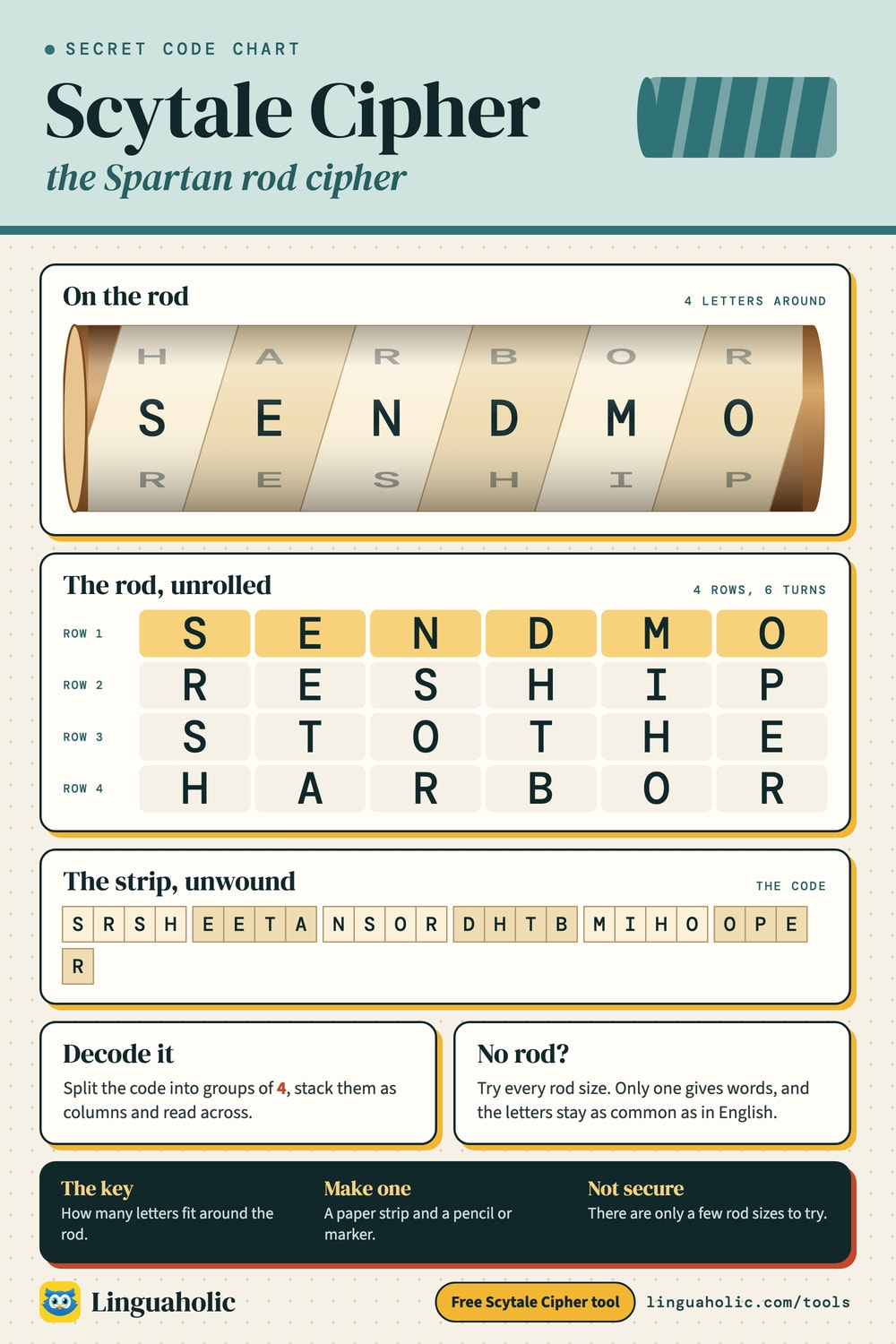
Scytale cipher chart

How the scytale cipher works
Picture a rod with a strip wound around it, edge to edge, like the stripe on a candy cane. Write the message along the rod, one letter on each turn of the strip. When the row is full, turn the rod a little and write the next row below it. With room for 4 letters around the rod, MEET AT THE OLD BRIDGE AT DAWN (written without spaces, as was usual) fills 4 rows of 6 letters:
| Around | 1 | 2 | 3 | 4 | 5 | 6 |
|---|---|---|---|---|---|---|
| Row 1 | M | E | E | T | A | T |
| Row 2 | T | H | E | O | L | D |
| Row 3 | B | R | I | D | G | E |
| Row 4 | A | T | D | A | W | N |
Each numbered column is one turn of the strip. Unwind it, and the strip carries the columns one after another, top to bottom: MTBA EHRT EEID TODA ALGW TDEN. Joined up, that is the code MTBAEHRTEEIDTODAALGWTDEN. Anyone who finds the strip sees letter salad; the general with the matching rod sees the order.
How to decode a scytale by hand
Without a rod, decoding is a matter of grouping. If the rod held 4 letters around, the strip is made of turns of 4 letters:
- Split the code into groups of 4: MTBA EHRT EEID TODA ALGW TDEN.
- Write the groups as columns, side by side.
- Read across the top row, then the second row, and so on: MEETATTHEOLDBRIDGEATDAWN.
Put the spaces back where the words are, and you have the message. When the message does not fill the last row, the last turns of the strip are shorter: the tool handles that by leaving the missing places at the end of the last row empty, exactly as on a real rod.
How to crack a scytale without the rod
The scytale has very few keys: only the rods that fit a message of that length, and short messages almost always use two to ten letters around. So try them all. Here is MTBAEHRTEEIDTODAALGWTDEN read with every rod size from 2 to 8:
| Letters around | Reading |
|---|---|
| 2 | MBEREITDAGTETAHTEDOALWDN |
| 3 | MARETAGDTETIOAWEBHEDDLTN |
| 4 | MEETATTHEOLDBRIDGEATDAWN |
| 5 | MHIATTRDADBTTLEAEOGNEEDW |
| 6 | MRTGTTOWBEDTAEADEIAEHDLN |
| 7 | MRTGTTOWBEDTAEADEIAEHDLN |
| 8 | MEATELBIGADWETTHODRDETAN |
Only 4 gives words. The tool’s Crack it section does the same and ranks the readings by how much of each is real English. A quick check before you start: a scytale code has normal English letter counts (plenty of E, T, A and O), because no letter was replaced. If the letters look English but the words do not, think transposition: a scytale or a rail fence cipher.
The scytale in Sparta: what the sources say
The word skytalē appears in Greek writing from early on, often for an official message from Sparta: commanders abroad received orders and recall notices “by skytale”. The clearest description of how it hid a message is much later. Plutarch, writing around 100 AD about the Spartan admiral Lysander, explains that the authorities kept one rod and gave its exact twin to the general; a strip of leather wound round one rod was written on, unwound and sent, and could only be read on the other. The Roman author Aulus Gellius describes the same method in the second century AD.
That gap of several centuries matters. Some modern historians doubt that the Spartans used the scytale to keep messages secret at all. They suggest it may rather have been a way to prove that a message was genuine (only the matching rod made sense of it), or simply the name of an official dispatch. What is certain is that by Roman times the rod and strip were understood as a cipher, and that is how cryptography books have taught it ever since.
How to make a scytale
A classroom scytale takes five minutes. The rod’s thickness has to suit the width of the strip, or the letters drift out of line as you wind. With squares of 1.5 cm (about 0.6 in), these rods give a neat number of letters around:
| Letters around | Rod circumference | Rod thickness | Roughly the size of |
|---|---|---|---|
| 2 | 2.1 cm (0.8 in) | 0.7 cm (0.27 in) | a pencil |
| 3 | 4.2 cm (1.7 in) | 1.3 cm (0.53 in) | a thick marker |
| 4 | 5.8 cm (2.3 in) | 1.8 cm (0.73 in) | a glue stick |
| 5 | 7.3 cm (2.9 in) | 2.3 cm (0.92 in) | a rolled paper tube |
| 6 | 8.9 cm (3.5 in) | 2.8 cm (1.11 in) | a rolled paper tube |
| 8 | 11.9 cm (4.7 in) | 3.8 cm (1.49 in) | a cardboard paper towel tube (a little thinner) |
| 10 | 14.9 cm (5.9 in) | 4.8 cm (1.87 in) | a cardboard paper towel tube |
- Cut a long strip of paper, 1.5 cm wide. Glue pieces end to end for long messages.
- Find a rod of the right size, or roll a sheet of paper into a tube until the measuring band from the printable template fits around it once, and tape it.
- Tape one end of the strip to the rod and wind it edge to edge, with no gaps and no overlaps.
- Write the message along the rod, one letter on each turn. When the row is full, turn the rod and start the next row.
- Unwind the strip and give it to your partner, who needs a rod of the same thickness to read it.
The template from the tool has your encoded message already on strips, blank strips for writing your own, and the measuring band for the rod size you chose. Print it at 100% so the squares come out the right size.
Scytale, rail fence and columnar transposition
| Cipher | How the letters move | Key | MEETATTHEOLD becomes |
|---|---|---|---|
| Scytale | Rows along a rod, read off turn by turn (columns) | letters around the rod | MAEETOETLTHD (3 around) |
| Rail fence | A zigzag across rails, read rail by rail | number of rails | MAEETTHODETL (3 rails) |
| Columnar transposition | Rows under a keyword, columns read in the keyword’s alphabetical order | a keyword | depends on the keyword |
A scytale is a columnar transposition without the keyword: the columns are read in their natural order. That is why it is so easy to crack, and why later transposition ciphers added a keyword to scramble the column order as well.
Is the scytale secure?
No. With only a handful of possible rod sizes, anyone can try them all in a few minutes, and the normal English letter counts give the method away. It is still a great teaching cipher: it shows the idea of a key you can hold in your hand, and the difference between moving letters (transposition) and replacing them (substitution, as in the Caesar cipher).
Scytale practice puzzles
Three strips to decode, with the spaces removed. Try them by hand first, then check with the decoder.
Puzzle 1 (Easy)
3 letters around the rod.
BGCRSKINSNA
Show the answer
BRING SNACKS
Puzzle 2 (Medium)
4 letters around the rod.
TAOSHSROESDWPWIL
Show the answer
THE PASSWORD IS OWL
Puzzle 3 (Hard)
The rod size is up to you to find.
LETOWOHHCEOIEKRKNCTBDLO
Show the answer
LOOK BEHIND THE CLOCK TOWER (5 letters around the rod)
Scytale ideas for classrooms and escape rooms
- History lessons: give each pair two rods of the same size and one of a different size. The pairs discover the key by experiment, then read the Plutarch description together.
- Escape rooms: leave the strip on a table and hide the rod (a painted dowel, a rolling pin, a bottle) somewhere else in the room. The rod is the key.
- Belt messages: a ribbon or a paper “belt” with letters on it looks like decoration; wound on the right rod it becomes the next clue.
- Maths: ask why a message of 24 letters works with 2, 3, 4, 6, 8 or 12 letters around the rod without empty places, and what happens with 5 or 7.
Free and private
This scytale cipher tool runs entirely in your browser. It is free, needs no sign-up, and nothing you type is uploaded or stored.
For teachers, bloggers & clubs
Put the Scytale Cipher on your website
Give your readers this tool right on your page. Copy the code, paste it into your site, done: no sign-up, no account.
- Free for any website
- No ads, no cookies
- Fits phones and sidebars
- Always up to date
Please keep the small credit line under the tool; you may add rel="nofollow" to its link. How it works & the rules

› Show the code
Frequently asked questions
- What is a scytale?
- A scytale (Greek skytalē, 'staff') is a rod used to read a message written on a strip of leather or parchment. Wound around the rod, the strip shows the message along the rod; unwound, the letters are mixed up. It is a transposition cipher.
- How do you pronounce scytale?
- Usually SKIT-uh-lee, with the stress on the first syllable. The Greek word is skytalē.
- How does the scytale cipher work?
- Wind a strip around a rod and write the message along the rod, one letter on each turn of the strip, row after row. Unwind it, and the letters are out of order. Only a rod of the same thickness lines them up again.
- What is the key of a scytale?
- The thickness of the rod, which decides how many letters fit around it. In the tool this is 'letters around the rod'. The same message on a thicker or thinner rod gives a different code.
- How do you decode a scytale without the rod?
- Try every rod size: write the code in groups of that size and read the first letter of each group, then the second, and so on. Only one size gives words. The tool's crack option tries them all.
- Did the Spartans really use the scytale?
- Greek writers say Spartan commanders carried scytales, but the detailed description of it as a cipher comes from Plutarch, who wrote centuries later. Some historians think it was mainly a way to prove a message was genuine rather than to hide it.
- How do you make a scytale?
- Cut a long paper strip about a finger wide, wind it edge to edge around a pencil, marker or cardboard tube, and tape the ends. Write along the rod, one letter per turn, then unwind it. The tool's printable template has strips and a guide for the rod size.
- Is the scytale the same as the rail fence cipher?
- Both are transposition ciphers that only change the order of the letters. The scytale reads the message in columns of a grid; the rail fence writes it in a zigzag. Both have few keys, so both are easy to crack.
- Is this scytale tool free?
- Yes. It is free, needs no sign-up and runs entirely in your browser; nothing you type is uploaded.
About this page
The Scytale Cipher is a free tool from Linguaholic, made by Marcel Iseli. It runs in your browser, with no sign-up. Last updated .
The code breaker's English letter frequencies and word checks come from Linguaholic’s English dictionary, built from the open ENABLE and SCOWL word lists. Licenses and notices.
Keep exploring
More free tools
 Rail Fence CipherZigzag a message across 2 to 10 rails, decode it, or crack it without knowing the key.
 Cipher DecoderPaste any coded message: every cipher is tried at once and the best English reading comes first.
 Caesar CipherShift letters to encode or decode, or crack a Caesar message without knowing the key.
 Polybius SquareTurn letters into row-column number pairs on the 5×5 grid and back, with keyword squares.
 Pigpen CipherWrite in the pigpen (Masonic) cipher, decode with a symbol keyboard, print the key or save a PNG.
 Morse Code TranslatorTranslate text to Morse code and back, hear it as sound at any speed, and see the full Morse alphabet chart.