
Converters & translators
Cipher Decoder & Identifier
Paste any coded message: the decoder tries every cipher and code we have, from Caesar and Vigenère to Morse and binary, ranks the readings by how English they look and tells you which cipher it probably is.
Updated · Free, no sign-up
Try an example
Trying every cipher…
Symbol ciphers such as pigpen cannot be pasted as text: use the symbol keyboard on the Pigpen Cipher page.
Share this tool
Know someone who’d love it?
What is a cipher decoder?
A cipher decoder turns a secret message back into plain words. Most decoders handle one cipher and need the key. This one does not ask which cipher you have: paste the message and it tries every cipher and code we have at once, with every key that can be tried, then puts the readings that look most like English at the top. Each reading names the cipher and the key, and one tap opens that cipher’s own page with your message already filled in, where you can see every step.
It works for the codes people actually meet: puzzle books, escape rooms, geocaches, scout and classroom activities, secret notes and homework on classical cryptography. It also answers the first question everybody has about a strange message: which cipher is this?
How to use the cipher decoder
- Paste or type the coded message into the box. Letters, numbers, dots and dashes, 0s and 1s, braille: anything goes.
- Wait a moment. The quick ciphers come back almost at once; the Vigenère cracker and the cryptogram solver keep working in the background and add their readings when they finish.
- Read the top result. A green Reads as English label means most of its words are real English words.
- Tap Open in the … decoder to see the cipher worked out step by step, change the key, or encode a reply.
- No luck? Open Clues: which cipher is this? to see what the characters and letter counts point to.
It is free, there is no sign-up, and everything runs on your own device: the message is never uploaded. You can try the buttons under the box for an example of each cipher.
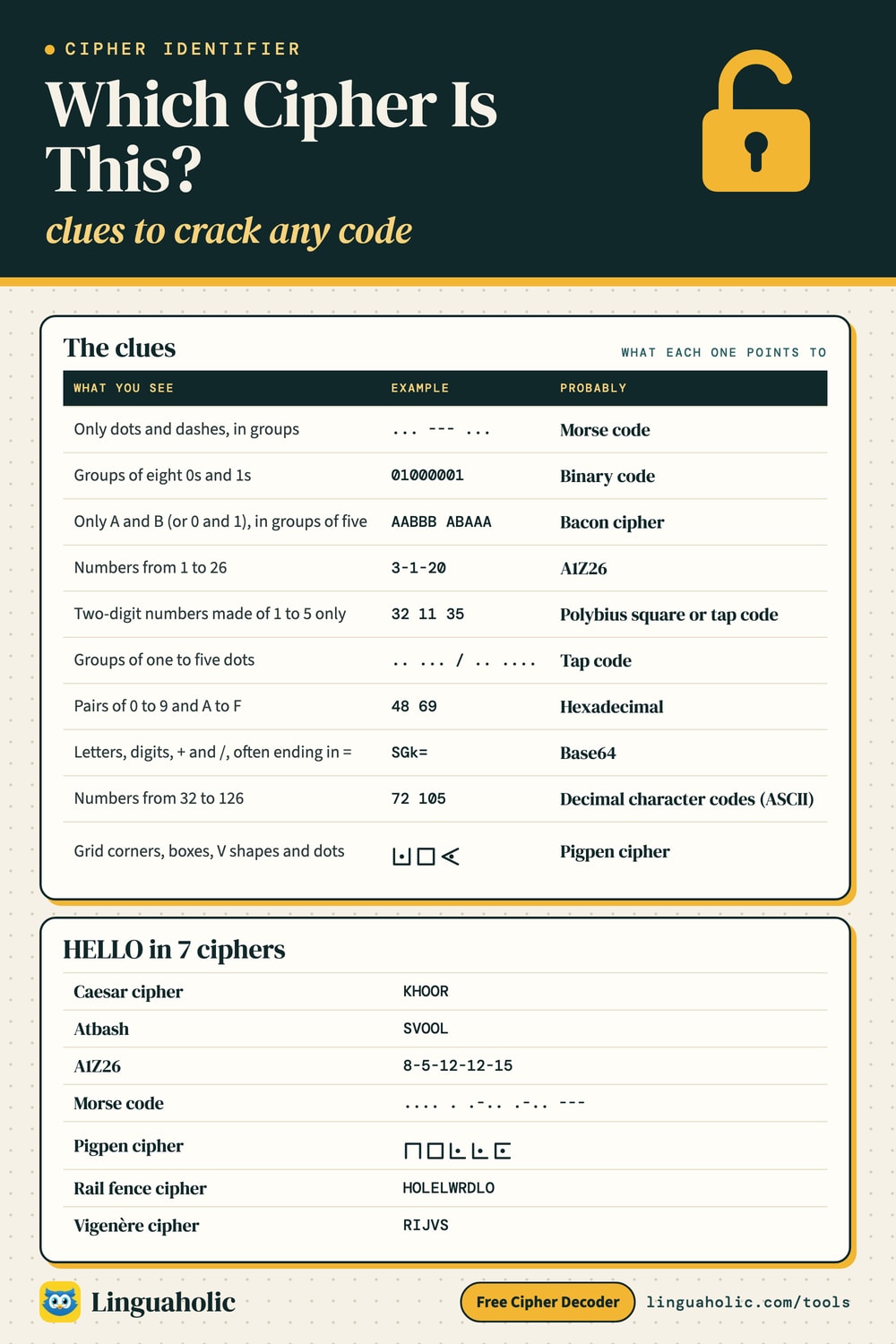
Which cipher is this? A cipher identifier chart

How the decoder finds the right cipher
Most classical ciphers have few enough keys to try them all. A Caesar cipher has 25 shifts, an affine cipher 312 key pairs, a rail fence cipher a handful of rail counts, a scytale a handful of rod sizes. The decoder decodes the message with every one of them and scores each result for how English it looks: how common its groups of three letters are in English (“the”, “ing”, “and” score high, “qzx” very low) and how many of its words are in our English dictionary. For text without spaces it first puts the spaces back, the way you would read meetmeatnoon as meet me at noon.
Codes such as Morse, binary, hex, Base64 and braille are recognized from their characters and decoded directly. The keyword ciphers take more work: for Vigenère, Beaufort and autokey the decoder works out the length of the keyword from repeated letter patterns and then each letter of the key, and for a cryptogram (a fully mixed alphabet) it climbs towards the alphabet that gives the most real words.
Here is how it ranks the first example, Tlla tl ha aol vsk vhr ayll hmaly zjovvs, a message of 32 letters:
| Rank | Cipher and key | Reading | Real words |
|---|---|---|---|
| 1 | Caesar cipher, shift 7 | Meet me at the old oak tree after school | 100% (reads as English) |
| 2 | Affine cipher, a = 21, b = 3 | Cool co ul ldo mxj mus lboo utlob gedmmx | 13% (unlikely) |
| 3 | Rail fence cipher, 3 rails, spaces ignored | T a loll yvlszk a vjhtro a lyvlhlv hams a | 11% (unlikely) |
| 4 | Affine cipher, a = 25, b = 15 | Weep we ip pbe uxf uiy pree idper qgbuux | 19% (unlikely) |
| 5 | Scytale, 8 letters around the rod, spaces ignored | Tar llo a yllyz a vljtslolkhvhvmv a has | 8% (unlikely) |
| 6 | Caesar cipher, shift 19 | Assh as oh hvs czr coy hfss othsf gqvccz | 22% (unlikely) |
Only the first reading is made of real words, so the decoder puts it on top with a clear margin. That margin is the useful part: when two readings are close, the message is probably too short to be sure, and you should check both.
How to identify a cipher (cipher identifier)
Before you can decode a message you need to know what kind of cipher it is. The characters give most codes away at a glance, and the letter counts tell the letter ciphers apart. The decoder checks all of these clues for you (they are under Clues in the tool), but they are easy to learn:
| What you see | Example | Probably |
|---|---|---|
| Only dots and dashes, in groups | ... --- ... | Morse code |
| Groups of eight 0s and 1s | 01000001 | Binary code |
| Only A and B (or 0 and 1), in groups of five | AABBB ABAAA | Bacon cipher |
| Numbers from 1 to 26 | 3-1-20 | A1Z26 |
| Two-digit numbers made of 1 to 5 only | 32 11 35 | Polybius square or tap code |
| Groups of one to five dots | .. ... / .. .... | Tap code |
| Pairs of 0 to 9 and A to F | 48 69 | Hexadecimal |
| Letters, digits, + and /, often ending in = | SGk= | Base64 |
| Numbers from 32 to 126 | 72 105 | Decimal character codes (ASCII) |
| Grid corners, boxes, V shapes and dots | (symbols) | Pigpen cipher |
| Cells of raised dots | ⠓⠊ | Braille |
| Normal letters, E, T and A common, but no words | ACDTAKTANTAW | A transposition: rail fence or scytale |
| Word lengths look real, the common letters are wrong | VHH BRX VRRQ | Caesar, Atbash, affine or substitution |
| Letters spread out evenly, few repeats | LXFOPV EF RNHR | A keyword cipher such as Vigenère |
The index of coincidence
For letter ciphers, cryptographers use one number above all: the index of coincidence, the chance that two letters picked at random from the message are the same. English text scores about 0.067, random letters about 0.038. A substitution cipher such as Caesar, Atbash or a cryptogram only swaps letters, so the score stays near 0.067; a transposition such as the rail fence keeps the letters themselves, so even the most common letters stay the same (E, T, A, O). A keyword cipher such as Vigenère spreads every letter over several others and pulls the score down towards 0.04. The example above scores 0.089.
Every cipher and code we have
A directory of the ciphers this decoder tries, from the easiest to the hardest to break by hand. The examples show what the word HELLO (or a short phrase) turns into, worked out by each cipher’s own page. Teachers and escape room makers: the difficulty column is a good guide for choosing one.
| Cipher | How it works | Example | Key | Difficulty |
|---|---|---|---|---|
| Caesar cipher Substitution | Every letter moves the same number of places along the alphabet. | KHOOR | a shift, 1 to 25 (here 3) | Easy |
| ROT13 Substitution | A Caesar shift of 13; doing it twice gives the message back. | URYYB | none | Easy |
| Atbash Substitution | The alphabet backwards: A becomes Z, B becomes Y. | SVOOL | none | Easy |
| A1Z26 Letter numbers | Each letter becomes its place in the alphabet. | 8-5-12-12-15 | none | Easy |
| Pigpen cipher Symbols | Each letter becomes the shape of its pen in two grids and two X shapes. | the grid layout | Easy | |
| Tap code Grid code | Row taps and column taps in a 5 × 5 grid; K is tapped as C. | .. ... / . ..... / ... . / ... . / ... .... | none | Easy |
| Polybius square Grid code | Each letter becomes its row and column in a 5 × 5 grid. | 23 15 31 31 34 | none, or a keyword grid | Easy |
| Morse code Signal code | Dots and dashes for every letter and digit. | .... . .-.. .-.. --- | none | Easy |
| Braille Touch code | Raised dots in cells of six; here as Unicode braille. | ⠓⠑⠇⠇⠕ | none | Easy |
| Bacon cipher Two-letter code | Every letter is a group of five A and B symbols; can hide inside normal text. | AABBB AABAA ABABB ABABB ABBBA | none | Medium |
| Binary code Computer code | Each character as eight 0s and 1s (its byte). | 01001000 01000101 01001100 01001100 01001111 | none | Easy |
| Hexadecimal Computer code | Each byte as two hex digits, 0 to 9 and A to F. | 48 45 4C 4C 4F | none | Easy |
| Affine cipher Substitution | Multiply each letter's number by a, add b, take mod 26. | RCLLA | two numbers (here 5 and 8) | Medium |
| Rail fence cipher Transposition | Write in a zigzag across rails, read each rail in turn. | HOLELWRDLO | the number of rails (here 3) | Medium |
| Scytale Transposition | Write along a strip wound around a rod; unwound, the letters are mixed. | HOLEWDLOLR | letters around the rod (here 3) | Medium |
| Substitution cipher Substitution | Any mixed-up alphabet: each letter has its own stand-in. | ITSSG | a 26-letter alphabet | Medium |
| Vigenère cipher Keyword cipher | A keyword shifts each letter by a different amount. | RIJVS | a keyword (here KEY) | Hard |
Rail fence and scytale examples use HELLOWORLD, written without the space, because a transposition cipher only moves letters around. Easy means you can decode it with the chart alone, Medium needs the key or a little trial and error, and Hard needs the keyword or a computer.
Code or cipher: what is the difference?
People use the words interchangeably, but there is a difference. A cipher works on letters: it swaps or moves each letter by a rule and a key, so any message can be enciphered, even one nobody thought of before. A code replaces whole words or phrases with code words or numbers from a code book (“EAGLE” for “the meeting is on”). Morse code, binary and braille are called codes, but strictly they are encodings: open, public ways to write letters as signals, with no secret key at all.
Types of ciphers
- Substitution ciphers replace each letter with another letter, number or symbol. With one alphabet (monoalphabetic): Caesar, ROT13, Atbash, affine, pigpen, A1Z26 and the general substitution cipher behind newspaper cryptograms.
- Polyalphabetic ciphers switch between several alphabets, usually by a keyword: Vigenère, Beaufort, autokey and Gronsfeld. The same letter turns into different letters, which defeats simple letter counting.
- Transposition ciphers keep every letter and change the order: the rail fence, the Spartan scytale and columnar transposition.
- Grid and signal codes write letters as coordinates or signals: the Polybius square, tap code, Morse code.
- Hidden messages (steganography) hide the fact that there is a message at all, like the Bacon cipher written in two typefaces inside an innocent sentence.
Choosing a cipher for escape rooms, classrooms and parties
| For | Good choices | Why |
|---|---|---|
| Young children (with a parent or teacher) | A1Z26, Pigpen cipher | Numbers and pictures they can look up on a chart, no key to remember. |
| Classrooms, ages 8 to 12 | Caesar cipher, Scytale, Morse code | A cipher wheel or a paper rod makes the idea visible; good for maths and history lessons. |
| Escape rooms and treasure hunts | Pigpen cipher, Rail fence cipher, Tap code, Polybius square | The key can be hidden in the room as a clue (a drawn grid, a fence, a number). |
| Teens and puzzle fans | Substitution cipher, Affine cipher, Bacon cipher | They need real code breaking: letter counts, guessing short words, algebra. |
| A real challenge | Vigenère cipher | Hard to break by hand; a short message with a long key cannot be broken at all. |
For a daily puzzle to solve rather than a message to decode, try our Cryptogram Puzzles.
What a cipher decoder cannot do
- Modern encryption (the kind that protects passwords, banking and messaging apps) cannot be broken by trying keys, by this tool or anyone else. This decoder is for classical, pen-and-paper ciphers.
- Book ciphers point to words in a particular book or text by page and line number. Without that book, the numbers mean nothing.
- A one-time pad, a random key as long as the message and used once, gives every possible message the same chance. Nothing can tell the right one apart.
- Very short messages fit several readings. Five letters can decode to two different real words with two different keys.
- Ciphers we do not have yet, such as Playfair, Enigma or homophonic ciphers with numbers for each letter, and messages put through two ciphers in a row.
When no reading looks like English
- Check that you copied the whole message, with its spaces and line breaks.
- Look for a hint in the puzzle: a number (a Caesar shift, rails, a rod size), a word (a keyword) or a drawing (a pigpen key, a fence).
- Try reading the message backwards, or each word backwards: puzzle makers love that twist.
- If it uses symbols, find the chart they come from. Pigpen symbols can be typed with the keyboard on the Pigpen Cipher page.
- If the message is not in English, the ranking does not help: the decoder scores readings against English. The codes (Morse, binary, braille and so on) still decode correctly.
Free and private
The cipher decoder runs entirely in your browser, in a background worker that keeps the page responsive even with long messages. It is free to use, needs no sign-up, and nothing you paste is uploaded or stored.
For teachers, bloggers & clubs
Put the Cipher Decoder on your website
Give your readers this tool right on your page. Copy the code, paste it into your site, done: no sign-up, no account.
- Free for any website
- No ads, no cookies
- Fits phones and sidebars
- Always up to date
Please keep the small credit line under the tool; you may add rel="nofollow" to its link. How it works & the rules

› Show the code
Frequently asked questions
- What is a cipher decoder?
- A tool that turns a coded message back into plain text. This one does not need to know the cipher: it tries every cipher and code it has, with every key that can be tried, and ranks the readings by how English they look.
- Which ciphers can this decoder decode?
- Caesar and ROT13, Atbash, affine, rail fence, scytale, reversed text, ROT47, Vigenère, Beaufort and autokey without the key, simple substitution (cryptograms), A1Z26, Polybius square, tap code, Bacon, Morse code, binary, hexadecimal, Base64, decimal character codes and braille.
- How does it know which cipher was used?
- It decodes the message with every cipher and key and scores each result: how common its letter groups are in English and how many of its words are real English words. Codes such as Morse or binary are also recognized from their characters alone.
- How do I identify a cipher?
- Look at the characters first: dots and dashes are Morse code, groups of eight 0s and 1s are binary, numbers from 1 to 26 are A1Z26, pairs of the digits 1 to 5 are a Polybius square. For letters, count them: English-like counts mean a transposition such as the rail fence, the wrong common letters mean a substitution, and very even counts mean a keyword cipher such as Vigenère.
- Can it decode a Vigenère cipher without the key?
- Usually, if the message has a few sentences. It finds the keyword length from repeated patterns, then each key letter from the letter counts. Short messages with long keywords cannot be cracked reliably by anyone.
- What is the difference between a code and a cipher?
- A cipher changes letters by a rule and a key, so it works on any message. A code replaces whole words or phrases with code words from a code book. Morse code, binary and braille are open encodings with no secret key.
- Why does no reading look like English?
- The message may be very short, use a cipher we do not have (such as Playfair or a book cipher), be put through two ciphers, or not be in English. Open the Clues section to see what its characters suggest.
- Can it break modern encryption?
- No. Modern encryption such as the kind used for passwords and messaging apps cannot be broken by trying keys. This decoder is for classical, pen-and-paper ciphers and codes.
- Can I decode pigpen or other symbol ciphers here?
- Symbols cannot be pasted as text. Use the symbol keyboard on our Pigpen Cipher page: tap each symbol and the letters appear.
- Is the cipher decoder free and private?
- Yes. It is free, needs no sign-up, and runs entirely in your browser: nothing you paste is uploaded or stored.
About this page
The Cipher Decoder is a free tool from Linguaholic, made by Marcel Iseli. It runs in your browser, with no sign-up. Last updated .
The code breaker's English letter frequencies and word checks come from Linguaholic’s English dictionary, built from the open ENABLE and SCOWL word lists. Licenses and notices.
Keep exploring
More free tools
 Caesar CipherShift letters to encode or decode, or crack a Caesar message without knowing the key.
 Vigenère CipherEncode or decode with a keyword, or crack a Vigenère message without the key.
 Substitution CipherEncode with any alphabet or keyword, or crack a cryptogram and fix letters yourself.
 Atbash CipherMirror the alphabet (A↔Z, B↔Y) to encode or decode, with the full Atbash chart.
 Morse Code TranslatorTranslate text to Morse code and back, hear it as sound at any speed, and see the full Morse alphabet chart.
 Pigpen CipherWrite in the pigpen (Masonic) cipher, decode with a symbol keyboard, print the key or save a PNG.