
Word games & fun
Spelling Bee Solver
Solve any seven-letter hive puzzle: every valid word with the pangrams, points and maximum score, a hints grid that does not spoil the answers, and a play mode with random hives.
Updated · Free, no sign-up
Type the seven letters. The yellow cell is the centre letter.
Enter the seven letters of your hive to see every word, the pangrams and the maximum score.
Try one:
Share this tool
Know someone who’d love it?
How the spelling bee solver works
The spelling bee solver finds every word in a seven-letter hive puzzle. Type the seven letters, mark the centre letter, and it lists all the valid words, with the pangrams first, the points for each word and the maximum score. It works from the letters alone, so it solves any hive: one from an app, a newspaper or a puzzle book, or one you made up yourself.
- Type the centre letter into the yellow cell, then the six letters around it. The cursor moves on by itself, and pasting seven letters works too.
- Pick a mode. Solve shows every word. Hints shows only how many words there are. Play lets you find them yourself and keeps score.
- Tap a word to see what it means. If the wrong letter is in the centre, tap the right one under the hive.
Rules and points of the hive puzzle
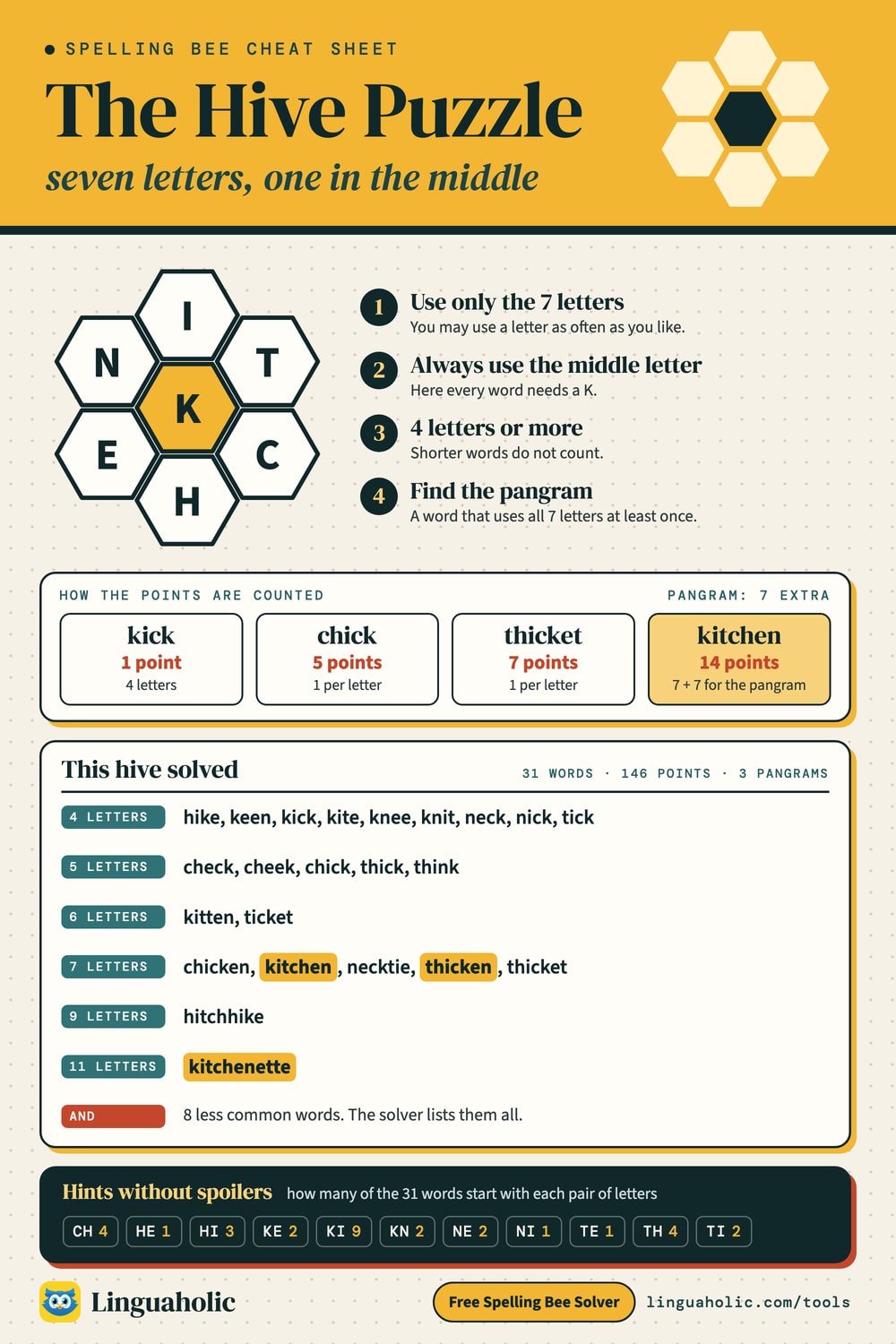
A word counts when it has at least four letters, uses only the seven letters of the hive and contains the centre letter. Letters may be used more than once. The points depend on the length:
| Word | Points | Example (centre letter K) |
|---|---|---|
| 4 letters | 1 | KICK = 1 |
| 5 letters or more | 1 per letter | CHICK = 5, THICKET = 7 |
| Pangram (uses all seven letters) | 1 per letter, plus 7 | KITCHENETTE = 11 + 7 = 18 |
Hive puzzle rules and a solved hive

A worked example: K with I, T, C, H, E, N
For this hive the solver finds 31 words worth 146 points, plus 17 rare words that are listed separately. 3 of the words are pangrams: kitchen, kitchenette, thicken. In hints mode the same hive looks like this, with first letters down the side and word lengths across the top:
| First letter | 4 | 5 | 6 | 7 | 9 | 11 | Total |
|---|---|---|---|---|---|---|---|
| C | – | 3 | – | 1 | – | – | 4 |
| H | 3 | – | – | – | 1 | – | 4 |
| K | 8 | 1 | 1 | 2 | – | 1 | 13 |
| N | 2 | – | – | 1 | – | – | 3 |
| T | 1 | 2 | 1 | 3 | – | – | 7 |
| Total | 14 | 6 | 2 | 7 | 1 | 1 | 31 |
Spelling bee hints without spoilers
Hints mode is for when you are stuck but do not want the answers. The grid tells you where the missing words are: in the example, row K and column 4 say that 8 four-letter words start with K. Below the grid, the two-letter list goes one step further: CH 4, HE 1, HI 3, KE 2, KI 9, KN 2, NE 2, NI 1, TE 1, TH 4, TI 2. So 4 words start with CH. Tap any number to see the pattern of those words, such as CH•••, and reveal them only if you want to. The pangram hint works the same way: first letter and length first, the word on request.
What is a pangram?
In the hive puzzle, a pangram is a word that uses all seven letters at least once. It earns 7 extra points, so it is usually the most valuable word in the hive. A perfect pangram is exactly seven letters long and uses each letter once: kitchen, thicken in the example. Some letter sets hide several of them:
| Seven letters | Perfect pangrams |
|---|---|
| A D E G I L N | aligned, dealing, leading |
| A B G I L M N | ambling, blaming, lambing |
| A C G I N R T | carting, crating, tracing |
| A C D E I L M | claimed, decimal, medical |
| C E N O R T U | counter, recount, trounce |
| D E G I L N U | dueling, eluding, indulge |
| D E G I N O R | eroding, ignored, redoing |
| F G I L N O W | flowing, fowling, wolfing |
To find a pangram, look for common endings first (-ING, -ED, -TION, -MENT), then see which of the remaining letters fit in front of them.
Play a spelling bee game with any letters
Play mode turns your seven letters, or a random hive, into a game. Tap the cells or type, and each word you find adds to your score. Random hives always contain at least one pangram and never use the letter S, so the list is not flooded with plurals. They are drawn from 3,801 everyday words that use exactly seven different letters and no S (2,670 different letter sets), so you can play as many as you like. Your rank is a share of the maximum score. For the example hive:
| Rank | Share of the maximum | Points needed (of 146) |
|---|---|---|
| Egg | 0% | 0 |
| Larva | 2% | 3 |
| Nurse bee | 5% | 7 |
| Builder | 8% | 12 |
| Guard | 15% | 22 |
| Forager | 25% | 37 |
| Scout | 40% | 58 |
| Dancer | 50% | 73 |
| Royal court | 70% | 102 |
| Queen | 100% | 146 |
Tips for finding more words
- Reuse letters. A letter can appear as often as you like, so check doubles and repeats: kick, kitten, hitchhike.
- Build on what you have. Try each found word with a new beginning or ending (thick, thicken, thicket).
- Shuffle. Seeing the letters in a new order is often enough to spot a new word.
- Use the grid. If a row or column still has words left, you know the first letter and the length to look for.
Which words count?
Every hive puzzle has its own word list, chosen by its own editor, so no solver can match all of them exactly. This one uses the public-domain ENABLE word list and the SCOWL English word lists, without slurs and crude words: about 50,000 everyday and less common words that fit a hive. Words that are valid in the big word-game lists but unusual, like chickee, keck, keek, are shown apart as rare words and are not counted unless you ask. If your puzzle rejects a word shown here, or accepts one we call rare, that is why. We do not publish the daily answers of any puzzle; the solver only works with the letters you type.
Looking for a real spelling bee?
A spelling bee is also the contest in which spellers stand up and spell words aloud, letter by letter. This page is about the letter puzzle named after it. If you are practicing for a contest, the Random Word Generator gives you words with definitions at several difficulty levels, and the Syllable Counter breaks a hard word into syllables.
Is it private?
Yes. The word list is downloaded once and everything else happens in your browser. Your letters are never sent anywhere, and your progress in play mode is saved only on your own device.
More word tools: the Word Unscrambler finds words from any set of letters, the Word Search Maker builds printable puzzles, and you can play Hangman with the same dictionary.
For teachers, bloggers & clubs
Put the Spelling Bee Solver on your website
Give your readers this tool right on your page. Copy the code, paste it into your site, done: no sign-up, no account.
- Free for any website
- No ads, no cookies
- Fits phones and sidebars
- Always up to date
Please keep the small credit line under the tool; you may add rel="nofollow" to its link. How it works & the rules

› Show the code
Frequently asked questions
- How does the spelling bee solver work?
- Type the seven letters of your hive, with the centre letter in the yellow cell. The solver lists every word of four or more letters that uses only those letters and contains the centre letter, with the pangrams first, the points for each word and the maximum score.
- What is a pangram in the spelling bee puzzle?
- A pangram is a word that uses all seven letters of the hive at least once. It scores one point per letter plus 7 extra points, so a seven-letter pangram is worth 14.
- What is a perfect pangram?
- A perfect pangram is exactly seven letters long, so it uses each letter of the hive once. With K in the centre of K, I, T, C, H, E, N, both 'kitchen' and 'thicken' are perfect pangrams.
- Can I get spelling bee hints without seeing the answers?
- Yes. Hints mode shows only numbers: how many words start with each letter at each length, and how many start with each pair of letters. Words and pangrams stay hidden until you tap to reveal them.
- How are the points counted?
- A four-letter word is worth 1 point. Longer words are worth 1 point per letter, and a pangram gets 7 extra points. The maximum score is the total for every word in the hive.
- Does it show today's answers?
- No. We do not publish the daily answers of any puzzle. The solver works from the seven letters you type, so it works for any hive on any day.
- Why does the solver show words that my puzzle does not accept?
- Every hive puzzle has its own word list. The solver uses the open ENABLE and SCOWL word lists and shows unusual words separately as rare words, because many puzzles leave those out. A puzzle may also accept a recent word that the lists do not have yet.
- Can I play a spelling bee game here?
- Yes. Play mode lets you find words for your own seven letters or a random hive, with a score and ten ranks. Random hives always have at least one pangram, and you can play as many as you like for free.
- Is it free and private?
- Yes. It is free with no sign-up and runs in your browser. Your letters are never sent anywhere, and play progress is saved only on your own device.
About this page
The Spelling Bee Solver is a free tool from Linguaholic, made by Marcel Iseli. It runs in your browser, with no sign-up. Last updated .
Word data: Linguaholic’s English dictionary, built from the open ENABLE and SCOWL word lists, the CMU Pronouncing Dictionary (pronunciation and syllables) and Princeton WordNet (meanings). Licenses and notices.
Keep exploring
More free tools
 Word FinderFind words by length, known letters, and pattern, for 5-letter games and crosswords.
 Anagram SolverSolve anagrams of words, names, and phrases, with multi-word answers.
 Word UnscramblerUnscramble letters into every possible word, with definitions.
 HangmanThe classic word-guessing game, with 48 categories and a 2-player mode.
 Random Word GeneratorRandom English words with definitions for Pictionary, charades, and writing.
 Syllable CounterCount syllables in any word, sentence, or poem, with a haiku checker.