
Converters & translators
Ogham Translator
Write names and words in ogham, the early Irish alphabet of strokes on a line, read from the bottom up like a standing stone or across like a manuscript. See each letter's name and tree, copy the Unicode ogham, save a PNG or SVG, read ogham back and print the alphabet chart. No sign-up.
Updated · Free, no sign-up
Read from the bottom up, as on the standing stones.
᚛ᚐᚑᚔᚃᚓ᚜
Each letter, its name and its tree
- Aailm (pine (or fir)), A
- oonn (gorse (or ash)), O
- iidad (yew), I
- ffearn (alder), F
- eedad (aspen), E
✓ No sign-up✓ Free✓ Nothing uploaded
Share this tool
Know someone who’d love it?
An ogham translator for names and words
This ogham translator writes names and words in ogham, the alphabet of early Ireland: groups of strokes and notches along a line. See your text standing up, read from the bottom like an ogham stone, or written across like a medieval manuscript. Aoife is ᚛ᚐᚑᚔᚃᚓ᚜. Every letter comes with its Irish name and its tree, and you can copy the ogham as text or save the picture as a PNG or SVG.
The translator writes the letters you type in ogham; it does not translate English into Irish. To write an Irish word, type it in Irish, as in anam cara. No sign-up, no app: it is free and runs in your browser.
How to use the ogham translator
- Translate: type a name or a short text. Choose Up, like a stone to read it from the bottom up, or Across to read it from left to right. Letters can be shown beside the strokes, and feather marks at the start and end.
- Copy and download: Copy ogham copies the Unicode ogham letters. Download PNG and Download SVG save the stave, for cards, carving, wood burning or a design.
- Extra letters: turn on the forfeda to write ea, oi, ui, ia and ae with the extra letters of the manuscripts.
- Read ogham turns ogham back into letters. Chart prints the ogham alphabet with a classroom worksheet.
Ogham alphabet chart

The ogham alphabet
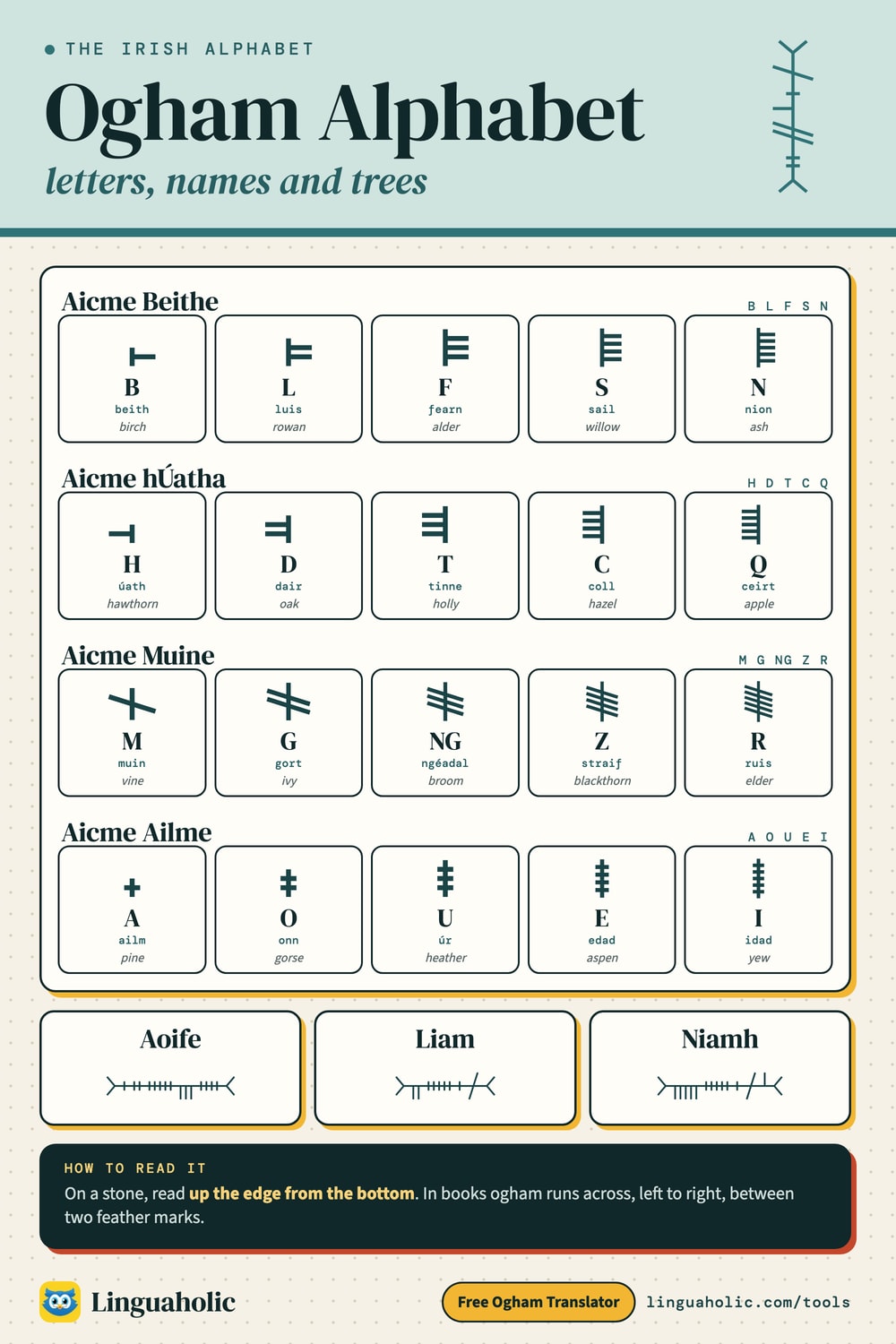
Ogham has 20 letters in four groups of five, called aicmí (families), each named after its first letter. The letters of a group are told apart by the number of strokes, from one to five, and the groups by where the strokes sit on the stem line (in Irish, the druim, the back or ridge):
- Aicme Beithe (the B group): 1 to 5 strokes on one side of the stem line (right of it on a standing stone, below it when written across).
- Aicme hÚatha (the H group): 1 to 5 strokes on the other side (left on a stone, above when written across).
- Aicme Muine (the M group): 1 to 5 slanting strokes that cross the stem line.
- Aicme Ailme (the vowels): 1 to 5 notches or short strokes on the stem line itself.
| Ogham | Letter | Name | Say it | Tree |
|---|---|---|---|---|
| ᚁ | B | beith | beh | birch |
| ᚂ | L | luisflame, or herb | lwish | rowan |
| ᚃ | F | fearnoriginally the sound w, later f and v | farn | alder |
| ᚄ | S | sail | sahl | willow |
| ᚅ | N | nionfork, or loft (uncertain) | nee-un | ash |
| ᚆ | H | úathfear, horror | oo-ah | hawthorn |
| ᚇ | D | dair | dar | oak |
| ᚈ | T | tinnebar of metal | chin-yeh | holly |
| ᚉ | C | colla hard c, like k | cull | hazel |
| ᚊ | Q | ceirtbush, or rag; the sound kw | kert | apple |
| ᚋ | M | muinneck, or trick (uncertain) | mwin | vine (or bramble) |
| ᚌ | G | gortfield | gurt | ivy |
| ᚍ | NG | ngéadaloriginally the sound gw | nyay-dal | broom (or reed) |
| ᚎ | Z | straifsulphur; read as z or st | strahf | blackthorn |
| ᚏ | R | ruisredness | rush | elder |
| ᚐ | A | ailm | al-um | pine (or fir) |
| ᚑ | O | onn | un | gorse (or ash) |
| ᚒ | U | úrearth, soil | oor | heather |
| ᚓ | E | edadmeaning unknown | eh-dah | aspen |
| ᚔ | I | idad | ee-dah | yew |
The order is not the order of the Latin alphabet: it begins B, L, F, S, N, which is why ogham is sometimes called the Beith-Luis-Nin. The sounds given are the classic values; a few letters first had other sounds (fearn was w, ngéadal gw).
How to write your name in ogham
- Draw a straight line: the stem. On a stone it runs up from the bottom; on paper you can also write across from left to right.
- For each letter, add its strokes: on one side for the B group, on the other side for the H group, across the line for the M group, and short notches on the line for the vowels.
- Leave a little space between letters, and a longer piece of plain line between words.
- If you like, add the feather marks ᚛ and ᚜ at the start and end, as in the manuscripts.
| Name | Ogham | Letters |
|---|---|---|
| Aoife | ᚛ᚐᚑᚔᚃᚓ᚜ | A-O-I-F-E |
| Niamh | ᚛ᚅᚔᚐᚋᚆ᚜ | N-I-A-M-H |
| Saoirse | ᚛ᚄᚐᚑᚔᚏᚄᚓ᚜ | S-A-O-I-R-S-E |
| Ciara | ᚛ᚉᚔᚐᚏᚐ᚜ | C-I-A-R-A |
| Siobhan | ᚛ᚄᚔᚑᚁᚆᚐᚅ᚜ | S-I-O-B-H-A-N |
| Liam | ᚛ᚂᚔᚐᚋ᚜ | L-I-A-M |
| Conor | ᚛ᚉᚑᚅᚑᚏ᚜ | C-O-N-O-R |
| Cian | ᚛ᚉᚔᚐᚅ᚜ | C-I-A-N |
| Oisin | ᚛ᚑᚔᚄᚔᚅ᚜ | O-I-S-I-N |
| Emma | ᚛ᚓᚋᚋᚐ᚜ | E-M-M-A |
| Jack | ᚛ᚔᚐᚉ᚜ | I-A-C |
| Olivia | ᚛ᚑᚂᚔᚃᚔᚐ᚜ | O-L-I-F-I-A |
English letters that ogham does not have
| Letters | Written with | Example |
|---|---|---|
| K | C (coll), the hard c | Kate ᚛ᚉᚐᚈᚓ᚜ |
| V, W | F (fearn), whose first sound was w | Will ᚛ᚃᚔᚂᚂ᚜ |
| J, Y | I (idad), as in Latin | Jay ᚛ᚔᚐᚔ᚜ |
| X | C and S | Max ᚛ᚋᚐᚉᚄ᚜ |
| P | peith, a letter added later | Peter ᚛ᚚᚓᚈᚓᚏ᚜ |
| Q | ceirt, the kw sound (qu is one letter) | Quinn ᚛ᚊᚔᚅᚅ᚜ |
| NG | one letter, ngéadal | Inga ᚛ᚔᚍᚐ᚜ |
Accents are left off (Siobhán is written with a plain a), and double letters stay double, as on the stones, where the common word for "son of" is written MAQQI.
The forfeda: five extra letters
Later scholars added a fifth group, the forfeda (extra letters), mostly for vowel pairs. They are rare on the stones and common in manuscripts, and their sounds changed over time.
| Ogham | Letters | Name | Tree |
|---|---|---|---|
| ᚕ | EA | éabhadhlater also read as k or ch | aspen (uncertain) |
| ᚖ | OI | órgold | spindle tree |
| ᚗ | UI | uilleannelbow | honeysuckle |
| ᚘ | IA | ifínlater also read as p | gooseberry |
| ᚙ | AE | eamhancholltwin of hazel; later read as x or ch | witch hazel |
| ᚚ | P | peitha later letter for the sound p, which early Irish lacked | (none: a late letter) |
Is ogham a tree alphabet?
In medieval Ireland, scholars taught that every ogham letter was named after a tree or plant: beith birch, dair oak, coll hazel, idad yew. That is why ogham is often called the Celtic tree alphabet. But several names first meant something else: úath means fear, tinne a bar of metal, gort a field and straif sulphur. The tree list is a real medieval tradition, written down long after the stones were carved, and the table above gives both.
The same scholars made lists of secret oghams: letters named after birds, colors, churches and more. One medieval book, the Book of Ballymote, describes about a hundred such variations, which shows how much ogham was loved as a puzzle as well as a script.
Ogham stones
About 400 ogham stones survive. Most are in southern Ireland, especially Kerry, Cork and Waterford; others are in Wales, Scotland, the Isle of Man and Cornwall. Most were carved between the 4th and 6th centuries AD and stand as memorials or boundary markers. The inscription runs up one edge of the stone, which serves as the stem line, and sometimes over the top and down the other side.
Nearly every stone carries a name, often in the form "of X, son of Y": a word like MAQQI (son of) or AVI (grandson of) appears again and again. The language is Primitive Irish, the oldest known form of Irish, so the stones are the earliest written Irish we have. In Wales many stones also repeat the name in Latin letters, which helped scholars read ogham again.
Which way is ogham read?
On stones, ogham is read from the bottom up. In manuscripts it is written across the page from left to right, often with a feather mark ᚛ at the start and ᚜ at the end. When you turn a stone inscription a quarter turn to write it across, the strokes of the B group end up below the line and those of the H group above it, which is how the translator's horizontal stave and the Unicode characters draw them.
Irish words in ogham
Popular for gifts, jewelry and tattoos. Tap one to open it in the translator:
| Irish | Meaning | Ogham |
|---|---|---|
| anam cara | soul friend | ᚛ᚐᚅᚐᚋ ᚉᚐᚏᚐ᚜ |
| grá | love | ᚛ᚌᚏᚐ᚜ |
| síocháin | peace | ᚛ᚄᚔᚑᚉᚆᚐᚔᚅ᚜ |
| neart | strength | ᚛ᚅᚓᚐᚏᚈ᚜ |
| clann | family | ᚛ᚉᚂᚐᚅᚅ᚜ |
| sláinte | health (a toast) | ᚛ᚄᚂᚐᚔᚅᚈᚓ᚜ |
| dóchas | hope | ᚛ᚇᚑᚉᚆᚐᚄ᚜ |
| Éire | Ireland | ᚛ᚓᚔᚏᚓ᚜ |
| misneach | courage | ᚛ᚋᚔᚄᚅᚓᚐᚉᚆ᚜ |
| saoirse | freedom | ᚛ᚄᚐᚑᚔᚏᚄᚓ᚜ |
| cairde | friends | ᚛ᚉᚐᚔᚏᚇᚓ᚜ |
| baile | home | ᚛ᚁᚐᚔᚂᚓ᚜ |
Irish words of love in ogham
| Irish | Meaning | Ogham |
|---|---|---|
| grá | love | ᚛ᚌᚏᚐ᚜ |
| a ghrá | my love (said to someone) | ᚛ᚐ ᚌᚆᚏᚐ᚜ |
| mo chroí | my heart | ᚛ᚋᚑ ᚉᚆᚏᚑᚔ᚜ |
| a stór | my darling (my treasure) | ᚛ᚐ ᚄᚈᚑᚏ᚜ |
| anam cara | soul friend | ᚛ᚐᚅᚐᚋ ᚉᚐᚏᚐ᚜ |
| grá go deo | love forever | ᚛ᚌᚏᚐ ᚌᚑ ᚇᚓᚑ᚜ |
These use the 20 main letters with accents left off. If you want a design for a tattoo or a ring, ask someone who reads Irish to check the spelling first.
A short history of ogham
Ogham was probably created in Ireland in the early centuries AD by someone who knew the Latin alphabet and its grammar: its letters follow the sounds of early Irish, and its groups look like a teacher's way of sorting them. Irish legend gives the invention to Ogma, a god of eloquence. The oldest stones date from the 4th century.
As the Latin alphabet took over for writing Irish, ogham stayed alive in the schools of poets and scholars. The Auraicept na nÉces (The Scholars' Primer) and the Ogam Tract in the Book of Ballymote, written down around 1390, explain the letters and their names, and they are the sources of the tree alphabet. Scholars learned to read the stones again in the 19th century.
Copy and paste ogham
Ogham has been part of Unicode since 1999. The Ogham block, U+1680 to U+169F, holds the 20 letters, the five forfeda, the letter peith, the two feather marks and the ogham space mark, a short piece of stem line used between words. Text you copy here is made of these characters, drawn across, the way computers write ogham. Windows shows them with Segoe UI Historic, Macs with Apple Symbols or Noto Sans Ogham, Android with Noto. To keep the standing-stone look, save the picture.
Ogham in the classroom
- Print the chart with the worksheet page for a unit on early Ireland or the Celts. Students read the ogham words, write their names on a stem line and swap messages. Type your own words for the reading exercise; the answers are printed upside down.
- Ogham is easy to carve and draw: try writing names along the edge of a cardboard "stone", a stick or a clay tile.
- Count the strokes: ogham is a good way to practice grouping, since every letter is one to five strokes in one of four places.
- Compare it with runes and braille, two other alphabets made of simple marks.
Is my text private?
Yes. The translator runs entirely in your browser. Nothing you type is uploaded or stored, and the pictures are drawn on your device. A link like this one opens it with a name filled in; the tool only reads such links and never writes what you type into the address.
More scripts and codes
For other ancient scripts, try the rune translator and the hieroglyphics translator. For codes made of marks and taps, see the Morse code translator, the tap code and the braille translator.
Credits
The ogham staves are Linguaholic's own drawings. Ogham as text uses Noto Sans Ogham (Copyright 2022 The Noto Project Authors, github.com/notofonts/ogham) under the SIL Open Font License 1.1. Letter names and sounds follow Damian McManus, A Guide to Ogam (1991).
For teachers, bloggers & clubs
Put the Ogham Translator on your website
Give your readers this tool right on your page. Copy the code, paste it into your site, done: no sign-up, no account.
- Free for any website
- No ads, no cookies
- Fits phones and sidebars
- Always up to date
Please keep the small credit line under the tool; you may add rel="nofollow" to its link. How it works & the rules

› Show the code
Frequently asked questions
- What is ogham?
- Ogham is an alphabet of strokes and notches on a line, made in Ireland in the early centuries AD. About 400 ogham stones survive, most in southern Ireland and some in Wales, Scotland and the Isle of Man. Most of them carry a person's name.
- How do you read ogham?
- On a standing stone, ogham runs up one edge from the bottom, sometimes over the top and down the other side. The edge is the stem line. In manuscripts it was written across the page from left to right. The translator draws both.
- How many letters does ogham have?
- Twenty main letters in four groups of five, plus five extra letters (forfeda) added later in manuscripts. Each group sits in its own place: strokes on one side of the line, on the other side, across it, or notches on it for the vowels.
- Which English letters are missing in ogham?
- Ogham has no J, K, P (at first), V, W, X or Y. The translator writes K with C, V and W with F (whose first sound was w), J and Y with I, and X with C and S. P uses the later letter peith. Every such choice is shown.
- Is ogham a tree alphabet?
- Medieval Irish scholars linked every letter to a tree or plant: beith is birch, dair is oak, coll is hazel. Several names first meant other things (úath means fear, tinne a bar of metal), so the tree list is a later tradition. The chart gives both.
- Can this translate English into Irish?
- No. It writes English letters in ogham, which is how names are put into ogham today. For an Irish word or phrase, type the Irish spelling, such as anam cara (soul friend), and the translator writes those letters.
- What do the arrows at the ends mean?
- They are feather marks, used in manuscripts to show where an ogham text begins and ends. Turn them on or off with the Feather marks option. Stones usually had none.
- How do I copy and paste ogham?
- Press Copy ogham. Ogham letters are Unicode characters, and the space between words is the ogham space mark, a short piece of stem line. If a device shows boxes, share the PNG picture instead.
- Do I need to sign up or download an app?
- No. The translator is free and runs in your browser on any phone, tablet or computer. Nothing you type is uploaded or saved.
About this page
The Ogham Translator is a free tool from Linguaholic, made by Marcel Iseli. It runs in your browser, with no sign-up. Last updated .
Keep exploring
More free tools
 Rune TranslatorEnglish to Elder Futhark, Viking or Anglo-Saxon runes, with rune names, bind runes and a printable chart.
 Hieroglyphics TranslatorYour name in Egyptian hieroglyphs, in a cartouche: copy the signs, save a picture, print the alphabet.
 Braille TranslatorText to braille and back (UEB grade 1), with dot numbers, name cards and a printable chart.
 Morse Code TranslatorTranslate text to Morse code and back, hear it as sound at any speed, and see the full Morse alphabet chart.
 Tap CodeTurn text into the 5×5 knock code prisoners tapped through walls, and decode taps back to text.
 Substitution CipherEncode with any alphabet or keyword, or crack a cryptogram and fix letters yourself.