
Name generators
Japanese Name Generator — Names with Kanji & Meanings
Generate real Japanese names in romaji and kanji — full names, first names, or last names, in popular, traditional, and nature styles, in either name order.
Updated · Free, no sign-up
Tap a name to copy it · ♥ saves it to your favorites · Generate again for new ideas (no repeats).
Share this tool
Know someone who’d love it?
How to use the Japanese name generator
- Choose what to generate: full names, first names, or last names.
- Pick a gender and a style. Popular today draws on names that are common among children and young adults in Japan now, Traditional on classic names from earlier generations (Keiko, Hiroshi, Ichiro), and Nature on names written with kanji for plants, seasons, weather, sea, and sky.
- Set the name order: given name first, as in most English text, or family name first, as in Japan.
- Tap a name to copy it, or tap the heart to keep it in your favorites.
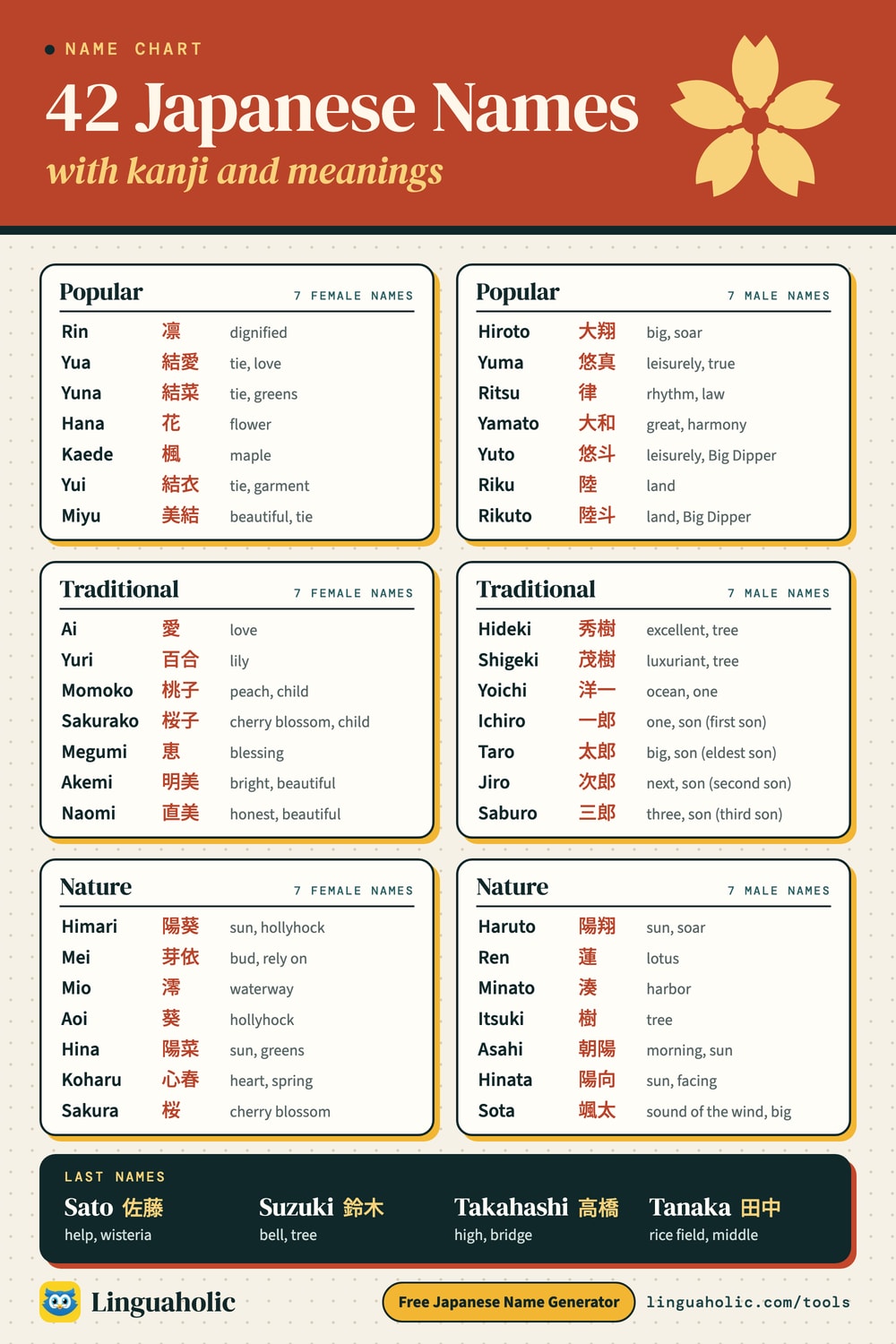
Every result from the Japanese name generator shows the name in Latin letters followed by its kanji, for example Haruto Sato · 佐藤 陽翔. The kanji always stand in Japanese order, family name first. The generator draws on 223 female given names, 217 male given names, and 225 family names, all of them real names in use in Japan, which gives more than 99,000 possible full names.
In full names, the style picks the given name. For last names, Popular today narrows the list to the most common surnames and Nature to surnames built from landscape and plant words; Traditional changes nothing there, because family names do not go in and out of fashion.
How the Japanese names are romanized
The names use Hepburn romanization, the system found on Japanese passports, written without macrons. In stricter Hepburn, long vowels carry a line: Yūto, Satō, Ōno. Here they appear as Yuto, Sato, and Ono. Vowel length changes the word: Yuki (雪, snow) has a short u and Yūki (勇気, courage) a long one, and 小野 (Ono, “small field”) and 大野 (Ōno, “big field”) are two different family names. The kanji next to each name removes the doubt. Strict Hepburn also puts an apostrophe in names such as Ken’ichi and Shin’ya to show where the syllable ends; like passports, the generator leaves it out.
Japanese names with kanji and meanings

Most common Japanese last names and meanings
Japan has well over 100,000 different family names, but a small group covers a large share of the population. The table lists 40 of the most common Japanese last names, roughly from most to least common, with the literal meaning of each kanji. Rankings differ a little from survey to survey, but Sato, Suzuki, Takahashi, and Tanaka lead all of them.
| Name | Kanji | Meaning of the kanji |
|---|---|---|
| Sato | 佐藤 | help, wisteria |
| Suzuki | 鈴木 | bell, tree |
| Takahashi | 高橋 | high, bridge |
| Tanaka | 田中 | rice field, middle |
| Ito | 伊藤 | Ise (old province), wisteria |
| Watanabe | 渡辺 | cross over, vicinity |
| Yamamoto | 山本 | mountain, base |
| Nakamura | 中村 | middle, village |
| Kobayashi | 小林 | small, woods |
| Kato | 加藤 | add (from Kaga province), wisteria |
| Yoshida | 吉田 | good luck, rice field |
| Yamada | 山田 | mountain, rice field |
| Sasaki | 佐々木 | help (repeated), tree |
| Yamaguchi | 山口 | mountain, mouth |
| Matsumoto | 松本 | pine, base |
| Inoue | 井上 | well, above |
| Kimura | 木村 | tree, village |
| Hayashi | 林 | woods |
| Saito | 斎藤 | purification, wisteria |
| Shimizu | 清水 | pure, water |
| Yamazaki | 山崎 | mountain, cape |
| Mori | 森 | forest |
| Ikeda | 池田 | pond, rice field |
| Hashimoto | 橋本 | bridge, base |
| Abe | 阿部 | nook, guild (an ancient clan name) |
| Ishikawa | 石川 | stone, river |
| Yamashita | 山下 | mountain, below |
| Nakajima | 中島 | middle, island |
| Ishii | 石井 | stone, well |
| Ogawa | 小川 | small, river |
| Maeda | 前田 | front, rice field |
| Okada | 岡田 | hill, rice field |
| Hasegawa | 長谷川 | long, valley, river |
| Fujita | 藤田 | wisteria, rice field |
| Goto | 後藤 | behind, wisteria |
| Kondo | 近藤 | near, wisteria |
| Murakami | 村上 | village, above |
| Endo | 遠藤 | far, wisteria |
| Aoki | 青木 | blue-green, tree |
| Sakamoto | 坂本 | slope, base |
Most Japanese last names describe a place. 田 (rice field), 山 (mountain), 川 (river), 木 (tree), 村 (village), and 本 (base) appear again and again: Yamamoto is “the foot of the mountain” and Tanaka “in the middle of the rice fields.” 口 (mouth) marks an entrance, so Yamaguchi is the way into the mountains.
The 藤 (wisteria) in Sato, Ito, Kato, Saito, Kondo, and Endo points back to the Fujiwara (藤原) clan, the leading family of the Heian court. The first kanji is traditionally explained as a province or an office: Ito is linked to Ise, Kato to Kaga, Kondo to Ōmi, and Endo to Tōtōmi. Commoners were only required to take a family name in 1875, during the Meiji era, and many families chose or formalized a name from the place where they lived.
More Japanese last names from the generator:
- Fukuda 福田
- Ota 太田
- Nishimura 西村
- Fujii 藤井
- Kaneko 金子
- Okamoto 岡本
- Fujiwara 藤原
- Miura 三浦
- Nakano 中野
- Nakagawa 中川
- Harada 原田
- Matsuda 松田
- Takeuchi 竹内
- Ono 小野
- Tamura 田村
- Nakayama 中山
- Wada 和田
- Ishida 石田
- Morita 森田
- Ueda 上田
- Hara 原
- Uchida 内田
- Shibata 柴田
- Miyazaki 宮崎
- Yokoyama 横山
- Takagi 高木
- Ando 安藤
- Miyamoto 宮本
- Kojima 小島
- Kudo 工藤
- Taniguchi 谷口
- Imai 今井
- Takada 高田
- Masuda 増田
- Maruyama 丸山
- Sugiyama 杉山
- Murata 村田
- Otsuka 大塚
- Arai 新井
- Koyama 小山
- Hirano 平野
- Fujimoto 藤本
- Ueno 上野
- Noguchi 野口
- Takeda 武田
- Matsui 松井
- Chiba 千葉
- Sugawara 菅原
- Iwasaki 岩崎
- Kubo 久保
- Sano 佐野
- Nomura 野村
- Matsuo 松尾
- Kikuchi 菊池
- Sugimoto 杉本
- Ichikawa 市川
- Furukawa 古川
- Onishi 大西
- Shimada 島田
- Mizuno 水野
- Sakurai 桜井
- Takano 高野
- Yoshikawa 吉川
- Yamauchi 山内
- Nishida 西田
- Iida 飯田
- Nishikawa 西川
- Komatsu 小松
- Kitamura 北村
- Yasuda 安田
- Igarashi 五十嵐
- Kawaguchi 川口
Japanese female names with meanings
The kanji shown for each given name is one common way to write it, not the only one. Parents choose the characters, so the same name can be written in several ways: Yui may be 結衣, 優衣, or 唯, and each spelling has its own meaning. The table gives 40 well-known Japanese female names, recent favorites first and classics after them.
| Name | Kanji | Meaning of the kanji |
|---|---|---|
| Himari | 陽葵 | sun, hollyhock |
| Rin | 凛 | dignified |
| Yua | 結愛 | tie, love |
| Tsumugi | 紬 | pongee (a soft silk cloth) |
| Mio | 澪 | waterway |
| Aoi | 葵 | hollyhock |
| Sakura | 桜 | cherry blossom |
| Hana | 花 | flower |
| Kaede | 楓 | maple |
| Yui | 結衣 | tie, garment |
| Misaki | 美咲 | beautiful, bloom |
| Nanami | 七海 | seven, sea |
| Akari | 明里 | bright, village |
| Chihiro | 千尋 | thousand, fathoms |
| Ai | 愛 | love |
| Shiori | 栞 | bookmark |
| Haruka | 遥 | far away |
| Akane | 茜 | madder (a plant that gives red dye) |
| Mai | 舞 | dance |
| Tsubaki | 椿 | camellia |
| Yuri | 百合 | lily |
| Megumi | 恵 | blessing |
| Naomi | 直美 | honest, beautiful |
| Yoko | 陽子 | sun, child |
| Keiko | 恵子 | blessing, child |
| Sachiko | 幸子 | happiness, child |
| Tomoko | 智子 | wisdom, child |
| Hanako | 花子 | flower, child |
| Yukiko | 雪子 | snow, child |
| Shizuka | 静香 | quiet, fragrance |
| Kaori | 香織 | fragrance, weave |
| Nagisa | 渚 | shore |
| Hotaru | 蛍 | firefly |
| Momo | 桃 | peach |
| Yuki | 雪 | snow |
| Mizuki | 美月 | beautiful, moon |
| Midori | 緑 | green |
| Hikari | 光 | light |
| Aiko | 愛子 | love, child |
| Chiyo | 千代 | thousand, generations |
More Japanese girl names from the generator:
- Yuna 結菜
- Mei 芽依
- Hina 陽菜
- Koharu 心春
- Miyu 美結
- Airi 愛莉
- Riko 莉子
- Sara 紗良
- Miu 美羽
- Rio 莉央
- Ayaka 彩花
- Kanon 花音
- Yuzuki 柚希
- Mao 真央
- Nozomi 希
- Moe 萌
- Aya 彩
- Chinatsu 千夏
- Natsumi 夏美
- Natsuki 夏希
- Momoko 桃子
- Sakurako 桜子
- Akemi 明美
- Yumi 由美
- Kumiko 久美子
- Kyoko 京子
- Kazuko 和子
- Yuko 優子
- Junko 純子
- Yumiko 由美子
- Michiko 美智子
- Fumiko 文子
- Haruko 春子
- Natsuko 夏子
- Akiko 明子
- Mika 美香
- Rie 理恵
- Emi 絵美
- Koto 琴
- Ume 梅
- Ran 蘭
- Sumire 菫
- Azusa 梓
- Izumi 泉
- Shizuku 雫
- Kiku 菊
- Chiaki 千秋
- Miyuki 美雪
- Koyuki 小雪
- Minami 美波
- Wakaba 若葉
- Futaba 双葉
- Aoba 青葉
- Hazuki 葉月
- Satsuki 皐月
- Yayoi 弥生
- Ruri 瑠璃
- Yuka 優花
- Miki 美樹
- Miho 美穂
Japanese male names with meanings
Common Japanese male names range from one-kanji classics such as Makoto and Akira to recent favorites such as Haruto, Ren, and Minato. As with the girls’ names, each kanji spelling below is one common choice among several.
| Name | Kanji | Meaning of the kanji |
|---|---|---|
| Haruto | 陽翔 | sun, soar |
| Ren | 蓮 | lotus |
| Minato | 湊 | harbor |
| Itsuki | 樹 | tree |
| Hiroto | 大翔 | big, soar |
| Asahi | 朝陽 | morning, sun |
| Hinata | 陽向 | sun, facing |
| Nagi | 凪 | calm (a lull in the wind) |
| Riku | 陸 | land |
| Arata | 新 | new |
| Kaito | 海翔 | sea, soar |
| Sho | 翔 | soar |
| Daiki | 大輝 | big, radiance |
| Takumi | 拓海 | pioneer, sea |
| Tsubasa | 翼 | wing |
| Sora | 空 | sky |
| Daichi | 大地 | big, earth |
| Haruki | 春樹 | spring, tree |
| Naoki | 直樹 | honest, tree |
| Yuki | 勇気 | brave, spirit (courage) |
| Ryo | 亮 | bright |
| Kenta | 健太 | healthy, big |
| Hayato | 隼人 | falcon, person |
| Hibiki | 響 | echo |
| Tatsuya | 達也 | accomplish, to be |
| Daisuke | 大輔 | big, help |
| Ichiro | 一郎 | one, son (first son) |
| Taro | 太郎 | big, son (eldest son) |
| Jiro | 次郎 | next, son (second son) |
| Kenichi | 健一 | healthy, one |
| Kenji | 健二 | healthy, two |
| Makoto | 誠 | sincerity |
| Akira | 明 | bright |
| Hiroshi | 浩 | vast |
| Takashi | 隆 | prosperous |
| Satoshi | 聡 | wise |
| Takeshi | 武 | warrior |
| Shigeru | 茂 | luxuriant |
| Mamoru | 守 | protect |
| Hideo | 英雄 | outstanding, hero |
More Japanese boy names from the generator:
- Yuma 悠真
- Ritsu 律
- Sota 颯太
- Yamato 大和
- Yuto 悠斗
- Rikuto 陸斗
- Gaku 岳
- Kai 海
- Shota 翔太
- Yota 陽太
- Kanata 奏多
- Kazuki 和樹
- Yudai 雄大
- Shohei 翔平
- Ryota 涼太
- Taiga 大河
- Taisei 大成
- Taiyo 太陽
- Toma 斗真
- Ryusei 流星
- Hideki 秀樹
- Shigeki 茂樹
- Yoichi 洋一
- Saburo 三郎
- Shiro 四郎
- Goro 五郎
- Kentaro 健太郎
- Shintaro 慎太郎
- Kotaro 光太郎
- Ryotaro 遼太郎
- Yutaro 雄太郎
- Rintaro 林太郎
- Sakutaro 朔太郎
- Junichiro 純一郎
- Shinichiro 真一郎
- Kenichiro 健一郎
- Yuichiro 雄一郎
- Shinichi 真一
- Koichi 浩一
- Junichi 純一
- Saku 朔
- Kohaku 琥珀
- Soma 颯真
- Haruma 春馬
- Tomoki 智樹
- Subaru 昴
- Hokuto 北斗
- Natsuki 夏樹
- Fuyuki 冬樹
- Mizuki 瑞樹
- Hiroki 弘樹
- Masaki 正樹
- Toshiki 俊樹
- Yoshiki 良樹
- Motoki 元樹
- Yohei 洋平
- Minoru 実
- Iwao 巌
- Haruo 春夫
- Mikio 幹夫
How Japanese names work
Family name first
In Japan the family name comes first and the given name second: 佐藤 陽翔 is Sato Haruto. There are no middle names. English text long reversed the order, but since 2020 the Japanese government has written names family name first in its official documents in Latin letters too, sometimes with the family name in capitals (SATO Haruto).
Kanji and readings
Given names may use only the kanji approved for names, about 3,000 characters, plus hiragana and katakana. One sound can be written many ways (Haruto can be 陽翔, 晴翔, 春斗, or 陽斗), and one spelling can be read in more than one way (陽菜 is Hina for some girls and Haruna for others). This is why people in Japan often ask how a name is written, and why forms have a separate line for the reading.
Common endings in girls’ and boys’ names
- -ko (子, child): Keiko, Yoko, Hanako. The standard ending for girls through most of the twentieth century, and less common for babies today.
- -mi (美, beautiful): Naomi, Akemi, Natsumi.
- -ka (香, fragrance, or 花, flower): Shizuka, Ayaka, Momoka.
- -to (翔, soar; 斗, the Big Dipper; 人, person): Haruto, Yuto, Naoto.
- -ki (樹, tree, or 輝, radiance): Haruki, Naoki, Daiki.
- -ta (太, big): Kenta, Shota, Sota.
- -ro (郎, son): Taro, Kentaro, and the names that count sons in order: Ichiro (first), Jiro (second), Saburo (third).
Name suffixes: -san, -chan, -kun
Japanese speakers rarely use a bare name. -san (さん) is the neutral, polite default for adults, much like Mr. or Ms.: Sato-san. -sama (様) is more formal and is used for customers and in letters. -kun (君) is used for boys and for younger men, typically by someone older or senior. -chan (ちゃん) is affectionate: small children, close friends, family, and pets. Never add a suffix to your own name. At school and at work most people go by family name plus -san; given names are for family and close friends.
Japanese names for cats
Japanese cat names are mostly everyday words rather than people’s names: colors, foods, and small round things. Tama is the classic, Kuro and Shiro simply describe the coat, and Mike (say mee-keh) is the word for a calico cat. Food names such as Mochi, Mugi, Kinako, and Azuki are favorites for pets in Japan. Add -chan for extra affection: Momo-chan.
| Name | Japanese | Meaning |
|---|---|---|
| Tama | 玉 | ball, jewel |
| Mike | 三毛 | three, fur (a calico cat) |
| Tora | 虎 | tiger |
| Kuro | 黒 | black |
| Shiro | 白 | white |
| Sora | 空 | sky |
| Mochi | 餅 | rice cake |
| Yuki | 雪 | snow |
| Momo | 桃 | peach |
| Mugi | 麦 | wheat, barley |
| Maru | 丸 | round |
| Hana | 花 | flower |
| Sakura | 桜 | cherry blossom |
| Kuri | 栗 | chestnut |
| Kinako | きな粉 | roasted soybean flour |
| Azuki | 小豆 | red bean |
| Goma | 胡麻 | sesame |
| Matcha | 抹茶 | powdered green tea |
| Mikan | 蜜柑 | mandarin orange |
| Yuzu | 柚 | yuzu (citrus) |
| Daifuku | 大福 | great luck (also a soft rice cake with sweet filling) |
| Fuku | 福 | good fortune |
| Hime | 姫 | princess |
| Chibi | ちび | tiny one |
| Kohaku | 琥珀 | amber |
Anime names and their meanings
Characters in anime and manga mostly have ordinary Japanese names, and authors tend to pick the kanji on purpose. A calm character may get 静 (quiet), a sunny lead 陽 (sun), a winter-born heroine 雪 (snow), and surnames do the same job with landscape words. To name a character of your own, start from the trait, look for a kanji that carries it in the meaning columns above, and say the full name aloud with the family name first.
Using Japanese names respectfully
These are real names used by real people. Because both the given names and the family names are common, many of the combinations belong to someone in Japan. Treat them as you would any real name: fine for story characters, role-playing, and language practice, not for pretending to be a particular person.
To write your own name in Japanese, use katakana, the script for foreign words, which spells the sound: Emma becomes エマ (Ema) and Michael becomes マイケル (Maikeru). Picking kanji for a foreign name is a novelty, not how names are written in Japan.
More name generators
For more surnames, try the Last Name Generator. The Character Name Generator gives first and last names for stories and games, the Fantasy Name Generator names for elves, dwarves, and other fantasy races, and the Nickname Generator short forms and pet names.
For teachers, bloggers & clubs
Put the Japanese Name Generator on your website
Give your readers this tool right on your page. Copy the code, paste it into your site, done: no sign-up, no account.
- Free for any website
- No ads, no cookies
- Fits phones and sidebars
- Always up to date
Please keep the small credit line under the tool; you may add rel="nofollow" to its link. How it works & the rules

› Show the code
Frequently asked questions
- Are the names real Japanese names?
- Yes. Every given name and family name in the generator is a real name in use in Japan, shown with one common kanji spelling. Because the names are common, many combinations will match a real person somewhere.
- What are the most common Japanese last names?
- Sato, Suzuki, Takahashi, and Tanaka are the four most common, followed by names such as Ito, Watanabe, Yamamoto, Nakamura, Kobayashi, and Kato. The table on this page lists 40 of them with kanji and meanings.
- Is the kanji shown the only way to write the name?
- No. Most Japanese given names can be written with several different kanji, and each spelling has its own meaning. The generator shows one common spelling for each name. Family names are more fixed, though some have variants.
- Which comes first in Japanese, the family name or the given name?
- The family name comes first in Japan, as in Sato Haruto. English text often puts the given name first. The generator offers both orders, and the kanji are always shown in Japanese order.
- Why is it Yuto and Sato instead of Yūto and Satō?
- The names use Hepburn romanization without macrons, the same style as Japanese passports. Long vowels are often written with a line, as in Yūto, Satō, and Ōno, but here they appear as Yuto, Sato, and Ono.
- Can I use the generator for anime or story characters?
- Yes. Pick a style, read the kanji meanings in the tables, and choose a name that fits the character. Pairings that match well-known fictional characters are filtered out, and the generator is free with no sign-up.
- How do I write my own name in Japanese?
- Foreign names are written in katakana, which spells the sound of the name: Emma becomes エマ and Michael becomes マイケル. Choosing kanji for a foreign name is not how names are normally written in Japan.
About this page
The Japanese Name Generator is a free tool from Linguaholic, made by Marcel Iseli. It runs in your browser, with no sign-up. Last updated .
Keep exploring
More free tools
 Character Name GeneratorCharacter names for seven genres, from modern and fantasy to sci-fi, noir, and western.
 Last Name GeneratorRandom last names by origin: American, Irish, Japanese, fantasy, noble, and more.
 D&D Name GeneratorD&D character names for ten races, plus party and tavern names.
 Elf Name GeneratorHigh, wood, dark, and snow elf names, plus funny Christmas elf names.
 Warrior Cats Name GeneratorWarrior cat names for every rank, from kit to leader, plus clan names.
 Ship Name GeneratorBlend two names into a couple ship name, or name a boat, pirate ship, or spaceship.