
Writing tools
Punctuation Checker: find and fix punctuation mistakes
Paste your text to see comma, apostrophe, semicolon, quotation mark and spacing mistakes underlined, each with the rule and a one-click fix.
Updated · Free, no sign-up
0 / 20,000 characters
Check
Style
Findings appear here as you type.
Error clear mistake, safe to fixSuggestion worth a look, your call
Paste some text, or tap Try a sample to see how the checker works.
This checker follows a fixed list of punctuation rules. It does not understand meaning, so it misses some mistakes, and a clean result does not prove a text is perfect. Everything happens in your browser: your text is never uploaded or saved.
Share this tool
Know someone who’d love it?
How to use the punctuation checker
Paste or type your text into the box. The punctuation checker reads it as you type and shows the same text underneath with every finding underlined. Tap an underlined part to see what is wrong, the rule behind it, and the corrected version. You can check a single sentence or a whole essay of up to 20,000 characters, and nothing you type leaves your browser.
- Add your text. Not sure what to expect? Tap Try a sample to load a short note with a mistake of almost every kind.
- Read the underlines. A solid red underline is an error: a clear mistake with a safe fix. A dashed yellow underline is a suggestion: something that is often wrong but depends on what you mean, so the decision is yours.
- Fix one at a time, or all at once. Apply corrects the finding you have open. Fix all errors corrects every error in one go and never touches a suggestion. Undo takes back the last fix, and Ignore hides a finding you disagree with.
- Copy the result. Copy text puts the corrected text on your clipboard.
The buttons and settings above the result change what is checked:
- Check. All rules is the default. Each of the other buttons narrows the check to one kind of mark and shows how many findings it has, so you can work through commas first, then apostrophes, and so on.
- Style. American puts commas and periods inside closing quotation marks and expects a comma after e.g. and i.e. British does neither. See American and British punctuation below.
- Oxford comma. Off by default, because both ways are correct. Choose Require it or Avoid it and the checker holds every list to your choice.
- Dashes. Pick the dash the checker should suggest: an em dash without spaces or an en dash with spaces.
- Show suggestions. Untick it to see errors only.
What the punctuation checker checks
The checker applies 40 rules, listed below with a sentence that breaks each one and the same sentence after the fix. It is a rule-based tool, not an AI: it does not understand what your text means, it only recognizes patterns it can be sure about. That is why it separates errors from suggestions, and why a result with no findings is a good sign but not proof that a text is perfect.
| Rule | What it catches | Example | After the fix |
|---|---|---|---|
| Commas (17 rules) | |||
| Comma after an introductory word or phrase Error or suggestion | A sentence that opens with a word or phrase such as However, Unfortunately, For example, In fact or Yes, with no comma after it. | However the store was already closed. | However, the store was already closed. |
| Comma after an opening clause Suggestion | A sentence that opens with Because, When, If, Although, Since or a similar word and has no comma anywhere. | When I arrived he left. | When I arrived, he left. |
| Commas around an interrupter Error or suggestion | However, for example or for instance in the middle of a sentence with a comma on one side only, or with none. | The plan, however was never finished. | The plan, however, was never finished. |
| Comma splice Error or suggestion | Two complete sentences joined by a comma alone, including the common “, however,” splice. | I wanted to go, however, I was too tired. | I wanted to go; however, I was too tired. |
| Comma before and, but, so or yet Suggestion | Two complete sentences joined by and, but, so or yet with no comma before the joining word. | The rain stopped at noon and we walked to the lake. | The rain stopped at noon, and we walked to the lake. |
| Comma before that Error or suggestion | A comma in front of that when that introduces what was said, thought or meant. | She said, that the train was late. | She said that the train was late. |
| Comma before which Suggestion | Which adding information about a noun, with no comma before it (American style only). | We took the old road which is closed in winter. | We took the old road, which is closed in winter. |
| Comma that does not belong Error or suggestion | A comma after such as, after although, because or unless, after “said that”, or after And or But at the start of a sentence. | Bring warm clothes such as, a hat and gloves. | Bring warm clothes such as a hat and gloves. |
| Comma after e.g. and i.e. Error | e.g. or i.e. with no comma after it (American style only). | Bring a snack, e.g. an apple or some nuts. | Bring a snack, e.g., an apple or some nuts. |
| Punctuation with etc. Error | A list that runs into etc. without a comma, “and etc.”, and etc without its period (American style). | We sell pens, paper, ink etc. at the front desk. | We sell pens, paper, ink, etc. at the front desk. |
| Commas in dates Error | A month-day-year date with no comma before the year or after it, and a weekday run into the month. | The shop opened on March 3 2021 and closed a year later. | The shop opened on March 3, 2021, and closed a year later. |
| Comma after a city and state Error | A city and state in the middle of a sentence with no comma after the state. | She moved from Austin, Texas to a small town in Ohio. | She moved from Austin, Texas, to a small town in Ohio. |
| Comma when you address someone Error or suggestion | Thanks, Thank you, Sorry, Congratulations or Happy birthday followed by a name with no comma. | Thanks Sam! | Thanks, Sam! |
| Comma after a greeting or sign-off Suggestion | A greeting line (Dear Ana) or a sign-off line (Best regards) with no comma at the end. | Best regards Dana | Best regards, Dana |
| Commas around too Suggestion | Too in the middle of a sentence with a comma before it but none after it. | I, too like the early train. | I, too, like the early train. |
| Oxford comma (a setting) Error or suggestion | Lists of three or more that break the Oxford comma choice you made: missing when you require it, present when you avoid it. | We ordered soup, salad and bread. | We ordered soup, salad, and bread. |
| Comma with a quotation Error | A quoted sentence with no comma between it and he said or she asked, and a comma added after a quoted question. | She said "We are leaving now." | She said, "We are leaving now." |
| Apostrophes (4 rules) | |||
| Missing apostrophe Error | Contractions typed without their apostrophe (dont, cant, isnt, youre, theyre, Im) and childrens, mens, womens. | I dont think theyre ready. | I don't think they're ready. |
| its and it’s Error | Clear mix-ups only, such as “its a”, “its been”, “its sunny”, “it’s own”, “it’s tail” and the spelling its’. | Its a long way to the coast. | It's a long way to the coast. |
| Apostrophe in a plural Error | A plural written with an apostrophe after a number word, as in “two cat’s”. | We adopted two cat's. | We adopted two cats. |
| Apostrophe in a decade Suggestion | Decades written as 1990’s or 90’s. | The house was built in the 1990's. | The house was built in the 1990s. |
| End of sentence (5 rules) | |||
| No closing mark Error or suggestion | The last sentence of a paragraph that ends with no period, question mark or exclamation mark. | We packed the car. Then we drove north | We packed the car. Then we drove north. |
| Doubled mark Error | Two commas or semicolons in a row, and a period right after a question mark or exclamation mark. | She brought bread,, cheese and fruit. | She brought bread, cheese and fruit. |
| Repeated ! or ? Suggestion | Two or more exclamation marks or question marks in a row. | We won the game!!! | We won the game! |
| Ellipsis with the wrong number of dots Error or suggestion | Two dots, or four or more, where an ellipsis or a single period belongs. | I was thinking.. maybe we should wait. | I was thinking... maybe we should wait. |
| Sentence starting in lowercase Error | A lowercase letter at the start of a sentence, after a period, question mark or exclamation mark. | The store was closed. we went home. | The store was closed. We went home. |
| Quotation marks and brackets (5 rules) | |||
| Comma or period next to a closing quotation mark Error or suggestion | American style: a comma or period placed after the closing quotation mark. British style: one placed inside a short quoted phrase. | She called it "a small win", and we agreed. | She called it "a small win," and we agreed. |
| Quotation mark without a partner Error | An opening quotation mark that is never closed, or a closing one that was never opened. | He called it "the best day of the year. | Marked for you to fix: the checker cannot know where the missing mark belongs. |
| Bracket without a partner Error | An opening bracket that is never closed, or a closing one that was never opened. | The fee (about ten dollars is paid at the door. | Marked for you to fix: the checker cannot know where the missing mark belongs. |
| Straight and curly marks mixed Suggestion | A text that uses both straight (") and curly (“ ”) quotation marks or apostrophes. | “Come in,” she said. "The soup is ready." | “Come in,” she said. “The soup is ready.” |
| Comma before an opening bracket Suggestion | A comma placed in front of an opening bracket. | After the show, (which ran long) we walked home. | After the show (which ran long), we walked home. |
| Semicolons and colons (3 rules) | |||
| Capital letter after a semicolon Error | An ordinary word such as The, He or However capitalized right after a semicolon. | The rain stopped; The sun came out. | The rain stopped; the sun came out. |
| Semicolon before and, but or or Suggestion | A semicolon in front of and, but, or, so or yet in a sentence that has no other commas. | We waited for an hour; but nobody came. | We waited for an hour, but nobody came. |
| Colon after a verb or preposition Suggestion | A colon between a verb or preposition (are, include, such as, of, with) and the list it introduces. | The colors are: red, green and blue. | The colors are red, green and blue. |
| Hyphens and dashes (2 rules) | |||
| Double hyphen Error | Two hyphens typed in place of a dash. | The view--all hills and sky--was worth the climb. | The view—all hills and sky—was worth the climb. |
| Hyphen used as a dash Suggestion | A single hyphen with a space on each side, used where a dash belongs. | The view - all hills and sky - was worth the climb. | The view—all hills and sky—was worth the climb. |
| Spacing (4 rules) | |||
| Space before a punctuation mark Error | A space in front of a comma, period, semicolon, colon, question mark or exclamation mark. | We left early , but the road was busy . | We left early, but the road was busy. |
| Missing space after a mark Error | A comma, period, semicolon, colon, question mark or exclamation mark with the next word stuck to it. | The meeting ran long,so we skipped lunch. | The meeting ran long, so we skipped lunch. |
| Extra spaces Error | Two or three spaces in a row between words or sentences. | The results came in on Friday. | The results came in on Friday. |
| Space inside brackets Error | A space right after an opening bracket or right before a closing one. | The shop ( the one by the park ) opens at eight. | The shop (the one by the park) opens at eight. |
The checker leaves certain things alone on purpose: web and email addresses, file names, numbers such as 3.5 and 1,000, times such as 5:30 p.m., and abbreviations such as Dr., U.S. and a.m. A period inside one of these is not the end of a sentence, and a comma inside a number is not a comma that needs a space.
Comma checker: the comma rules it applies
Most of the checker’s work is commas: 17 of its 40 rules. To use the tool as a comma checker, tap Commas only, or open it that way with this link. Here are the main rules, each with a sentence the checker corrected and a guide that explains the rule in depth.
After an introductory word or phrase
A word or phrase that opens a sentence and comments on the rest of it takes a comma.
Before: However the store was already closed.
After: However, the store was already closed.
The checker knows a fixed list of such openers, including however, furthermore, unfortunately, for example, in fact, on the other hand, yes, no and well. It also knows when these words are not openers, so “However hard he tried, the jar stayed shut” and “No one knew” are left alone. After words where the comma is a matter of style, such as therefore or of course, it only makes a suggestion. Guides: comma before or after however, comma after for example, comma after therefore.
Around a word that interrupts the sentence
When however or for example sits in the middle of a sentence, it needs a comma on both sides. One comma is the usual slip. Guide: comma before for example.
Before: The plan, however was never finished.
After: The plan, however, was never finished.
Comma splices
A comma splice is two complete sentences joined by a comma alone. The clearest case uses however, and the checker marks it as an error.
Before: I wanted to go, however, I was too tired.
After: I wanted to go; however, I was too tired.
Without such a signal word the checker cannot be certain that both halves are full sentences, so it only suggests a fix. A semicolon is one repair. A period, or a comma with and, but or so, works just as well.
Before: The store was closed, we went home.
After: The store was closed; we went home.
For a closer look at sentences that run together, use the run-on sentence checker, and read our guide to common comma mistakes.
Punctuation in compound and complex sentences
A compound sentence joins two complete sentences with and, but, or, so or yet, and a comma goes before the joining word. The checker flags a missing one as a suggestion, because two very short sentences can go without it.
Before: The rain stopped at noon and we walked to the lake.
After: The rain stopped at noon, and we walked to the lake.
A complex sentence has a main clause and a dependent clause that starts with a word like because, when, if or although. If the dependent clause comes first, a comma follows it: “When the bell rang, the students left.” If it comes last, there is usually no comma: “The students left when the bell rang.” A compound-complex sentence uses both rules at once. The checker handles the compound part and the comma splices. It suggests the comma after an opening clause when it can find where the clause ends, and leaves the harder cases to you. Guides: commas with and, but, or, so, comma before and, comma before subordinate clauses.
that and which
No comma goes before that when it introduces what someone said, thought or meant.
Before: She said, that the train was late.
After: She said that the train was late.
Which is the opposite. In American English it usually adds extra information and takes a comma. If the information is essential, most American editors use that with no comma. Guides: comma before that, comma before which.
Before: We took the old road which is closed in winter.
After: We took the old road, which is closed in winter.
e.g., i.e., etc. and such as
In American style a comma follows e.g. and i.e. At the end of a list, etc. follows a comma and never needs and. And no comma follows such as. Guides: comma after e.g., comma before etc., comma before such as.
Before: Bring a snack, e.g. an apple or some nuts.
After: Bring a snack, e.g., an apple or some nuts.
Before: We sell pens, paper, and etc.
After: We sell pens, paper, etc.
Before: Bring warm clothes such as, a hat and gloves.
After: Bring warm clothes such as a hat and gloves.
Dates, places and names
In a month-day-year date, the year is set off by commas. The same goes for a state after a city. And a name you speak to directly gets a comma. Guides: comma after a city and a state, comma before a name you address, comma after best regards.
Before: The shop opened on March 3 2021 and closed a year later.
After: The shop opened on March 3, 2021, and closed a year later.
Before: She moved from Austin, Texas to a small town in Ohio.
After: She moved from Austin, Texas, to a small town in Ohio.
Before: Thanks Sam!
After: Thanks, Sam!
The Oxford comma
The Oxford comma, or serial comma, is the comma before and or or in a list of three or more. The Chicago Manual of Style, APA and MLA use it. AP style leaves it out of simple lists. Neither is wrong, so the checker ignores it until you choose. A comma before and that joins two full sentences is not an Oxford comma, and the checker keeps it either way. Guide: comma before and in a list.
With Require it:
Before: We ordered soup, salad and bread.
After: We ordered soup, salad, and bread.
With Avoid it:
Before: We ordered soup, salad, and bread.
After: We ordered soup, salad and bread.
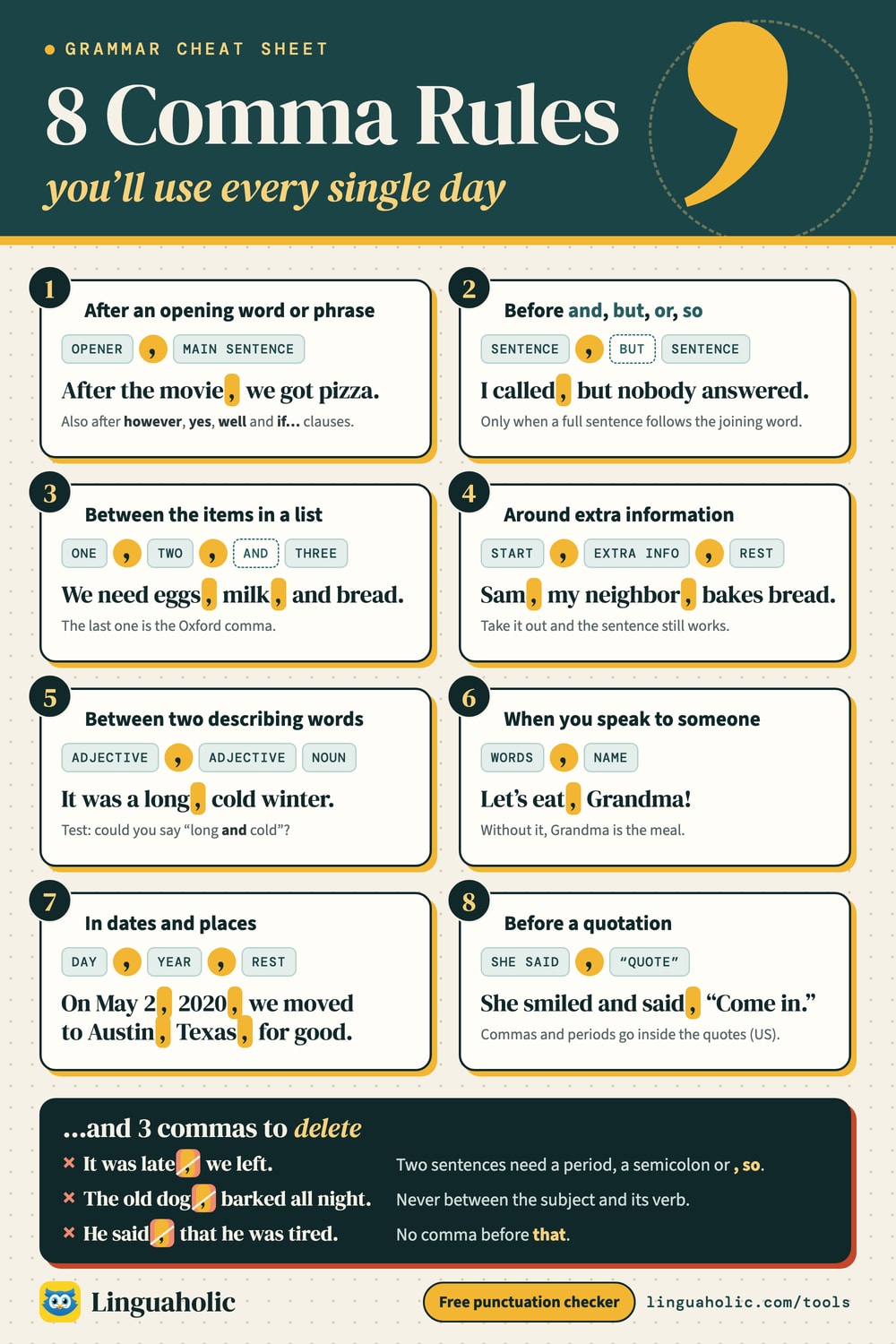
Comma rules chart: the 8 rules you need most
Eight rules cover almost every comma you will ever write, and three more tell you which commas to delete. The chart shows each rule as a pattern with one example. Save it, print it or pin it for later.

- After an opening word or phrase. After the movie, we got pizza. The same goes for however, yes, well and clauses that start with if or when.
- Before and, but, or, so when a full sentence follows. I called, but nobody answered.
- Between the items in a list. We need eggs, milk, and bread. The last comma is the Oxford comma.
- Around extra information. Sam, my neighbor, bakes bread. Take the extra part out and the sentence still works.
- Between two describing words. It was a long, cold winter. The test: you could say “long and cold.”
- When you speak to someone. Let’s eat, Grandma!
- In dates and places. On May 2, 2020, we moved to Austin, Texas, for good. A comma follows the year and the state as well.
- Before a quotation. She smiled and said, “Come in.”
And the three commas to delete: the comma that joins two full sentences on its own (It was late, we left), the comma between a subject and its verb (The old dog, barked all night), and the comma before that (He said, that he was tired).
Apostrophe checker
An apostrophe does two jobs in English: it marks the missing letters in a contraction (don’t, it’s) and it shows possession (the dog’s bowl). It does not make a plural. Tap Apostrophes only, or use this link, to run the tool as an apostrophe checker. It looks for four things.
- Contractions typed without the apostrophe. Only spellings that are never a word on their own are flagged. Were, well, shell, ill and wed are real words, so the checker does not guess that you meant we’re or we’ll.
Before: I dont think theyre ready.
After: I don't think they're ready. - its and it’s, in clear cases. It’s means it is or it has; its shows that something belongs to it. A quick test: if you can say it is in its place, write it’s.
Before: Its a long way to the coast.
After: It's a long way to the coast.
Before: The dog chased it's own tail.
After: The dog chased its own tail. - A plural with an apostrophe after a number word.
Before: We adopted two cat's.
After: We adopted two cats. - Decades. This one is a suggestion, since a few publications still print the apostrophe.
Before: The house was built in the 1990's.
After: The house was built in the 1990s.
| Typed | Corrected |
|---|---|
| dont | don't |
| didnt | didn't |
| isnt | isn't |
| wouldnt | wouldn't |
| cant | can't |
| youre | you're |
| theyre | they're |
| thats | that's |
| theres | there's |
| couldve | could've |
| childrens | children's |
What it cannot do is find a possessive that has no apostrophe at all, as in the dogs bowl. A sign that reads apple’s for sale is also beyond it, because the apple’s color is perfectly correct. For those, ask whether something belongs to the word. If nothing does, it is a plain plural and needs no apostrophe.
Semicolon checker (and colons)
A semicolon has three standard uses. It joins two complete sentences that belong together: “The rain stopped; the sun came out.” It comes before however, therefore and similar words when they link two sentences. And it separates the items of a list when the items contain commas of their own: “Paris, France; Lima, Peru; and Austin, Texas.” Choose Semicolons & colons, or open this link, to use the tool as a semicolon checker.
- Capital letter after a semicolon. A semicolon does not end the sentence, so the next word stays lowercase unless it is a name.
Before: The rain stopped; The sun came out.
After: The rain stopped; the sun came out. - Semicolon before and or but. A comma is the normal mark there, so the checker suggests one. In a long sentence that already has commas, the semicolon is fine, and the checker says nothing.
Before: We waited for an hour; but nobody came.
After: We waited for an hour, but nobody came.
A colon introduces a list, an explanation or a quotation, and what comes before it should be a complete sentence. That is why a colon straight after a verb or a preposition is flagged as a suggestion. A colon at the end of a line that leads into a list set out below it is left alone. Guides: how to use semicolons and how to use colons.
Before: The colors are: red, green and blue.
After: The colors are red, green and blue.
Quotation marks and brackets
The checker first makes sure every quotation mark and every bracket has a partner. An opening mark that is never closed is underlined, but not fixed for you: only you know where the quotation ends. It then looks at the marks around the quotation. Guide: commas with quotation marks.
- A comma between the quotation and the speaker. After a quoted question, the question mark replaces the comma.
Before: She said "We are leaving now."
After: She said, "We are leaving now."
Before: "Are you coming?", he asked.
After: "Are you coming?" he asked. - Commas and periods inside the closing mark (American style).
Before: She called it "a small win", and we agreed.
After: She called it "a small win," and we agreed. - One kind of mark. Text pasted together from several places often mixes straight marks (") with curly ones (“ ”). The checker offers to make them all match.
- A comma before an opening bracket. The comma belongs after the closing bracket.
Before: After the show, (which ran long) we walked home.
After: After the show (which ran long), we walked home.
American and British punctuation
American and British English share almost all of their punctuation. The few differences are matters of convention, not of right and wrong, and the Style setting covers the ones a rule can check. The table shows the same typed text under both settings.
| Point | As typed | American setting | British setting |
|---|---|---|---|
| Period with a closing quotation mark | He called the plan "bold". | He called the plan "bold." | No change |
| Comma with a closing quotation mark | She called it "a small win", and we agreed. | She called it "a small win," and we agreed. | No change |
| A quoted phrase typed the American way | He called the plan 'bold.' | No change | He called the plan 'bold'. |
| Comma after e.g. and i.e. | Bring a snack, e.g. an apple or some nuts. | Bring a snack, e.g., an apple or some nuts. | No change |
| Period in etc. | We need plates, cups, etc for the party. | We need plates, cups, etc. for the party. | No change |
| which without a comma | We took the old road which is closed in winter. | We took the old road, which is closed in winter. | No change |
The best-known difference is the first one. American style places a comma or period inside the closing quotation mark whether or not it belongs to the quoted words. British style places it by sense: inside if it is part of the quotation, outside if it is not. In both, a question mark goes inside only when the quoted words are the question, and colons and semicolons go outside.
Some differences are not checked, because either form may be exactly what you intend:
- American writing uses double quotation marks first and single marks for a quotation inside a quotation. Many British publishers do it the other way round.
- American English writes Mr., Mrs. and Dr. with a period. British English usually writes Mr, Mrs and Dr without one.
- An American date is written month first, with commas: March 3, 2021. A British date is written day first, with none: 3 March 2021.
- In British English, which often introduces essential information with no comma, where American editors prefer that. See comma before which in British English.
Hyphens and dashes
A hyphen (-) joins words or parts of words: well-known, mother-in-law. A dash separates parts of a sentence, a little more strongly than a comma. The hyphen is the easy key to reach, so dashes are often typed as hyphens. The checker corrects two habits: two hyphens in a row, and a single hyphen with a space on each side.
Before: The view--all hills and sky--was worth the climb.
After: The view—all hills and sky—was worth the climb.
With the en dash setting:
Before: The view - all hills and sky - was worth the climb.
After: The view – all hills and sky – was worth the climb.
The em dash without spaces is the form in the Chicago Manual of Style, APA and MLA. AP style puts a space on each side of the dash. The en dash with spaces is common in British publishing. Hyphens inside compound words, number ranges and command-line options such as --help are left alone.
Spacing and the end of the sentence
The simplest rules catch the most common typing slips. No space goes before a comma, period or question mark, and one space goes after it. A sentence starts with a capital letter and ends with a closing mark. One mark is enough, an ellipsis has three dots, and a single space follows a period, which is what AP, APA, Chicago and MLA all ask for.
Before: We left early , but the road was busy .
After: We left early, but the road was busy.
Before: The store was closed. we went home
After: The store was closed. We went home.
A sentence such as “Dr. Lee arrived at 5:30 p.m. and paid $3.50.” passes untouched: the checker knows that the periods in Dr. and p.m., the colon in 5:30 and the point in $3.50 are not sentence punctuation.
What a rule-based checker can and cannot do
This tool does not use a language model, and it does not send your text anywhere. It runs a fixed list of rules in your browser. That makes it fast, private and predictable: the same text always gives the same result, and every finding names the rule that produced it. It also sets clear limits.
- It will miss mistakes. A comma missing after a long opening clause, a possessive without its apostrophe, or a question that ends in a period all depend on meaning. A rule cannot see meaning.
- Suggestions need your judgment. They are worded as “Possible …” because the checker has found a pattern that is often wrong, not one that is always wrong.
- It checks punctuation, not grammar or spelling. A sentence can be perfectly punctuated and still say the wrong thing.
Tips for cleaner punctuation
- Do not place commas by ear. “Put a comma where you would pause” produces comma splices and stray commas between a subject and its verb. Ask what the comma is doing: separating list items, setting off an opener or an aside, or joining two sentences with and or but. Our comma cheat sheet lists the jobs on one page.
- Choose one style and keep it. American or British quotation style, Oxford comma or not, em dash or en dash: readers notice a switch more than they notice the choice.
- Clean pasted text first. Text copied from a PDF often has a line break in the middle of every sentence. Join the lines with remove line breaks before you check it.
- Check headings and sentence length too. Headings take no period and follow their own capital rules, which the title capitalization tool applies. Heavy punctuation is often a sign of sentences that try to do too much: the sentence counter shows your longest ones, and the word counter gives you the totals.
All our comma guides
Most comma questions are about one particular word. Linguaholic has a guide for each of the words below, with the rule, the exceptions and example sentences. When the checker flags one of these words, the finding links to its guide.
Comma before a word
- Comma before according to
- Comma before after all
- Comma before albeit
- Comma before along with
- Comma before and
- Comma before anyway
- Comma before as well as
- Comma before based on
- Comma before before
- Comma before both
- Comma before by
- Comma before considering
- Comma before due to
- Comma before especially
- Comma before etc
- Comma before even
- Comma before except
- Comma before for example
- Comma before hence
- Comma before if
- Comma before including
- Comma before indeed
- Comma before like
- Comma before LLC
- Comma before no matter
- Comma before nor
- Comma before not
- Comma before per se
- Comma before please
- Comma before provided
- Comma before rarely
- Comma before rather
- Comma before really
- Comma before regardless
- Comma before respectively
- Comma before resulting in
- Comma before since
- Comma before such as
- Comma before than
- Comma before that
- Comma before then
- Comma before thereby
- Comma before though
- Comma before through
- Comma before too
- Comma before unless
- Comma before until
- Comma before via
- Comma before whenever
- Comma before where
- Comma before whereas
- Comma before which
- Comma before which in British English
- Comma before who
- Comma before whom
- Comma before whose
- Comma before with
- Comma before without
- Comma before yesterday
Comma after a word
- Comma after after all
- Comma after and
- Comma after apparently
- Comma after basically
- Comma after beforehand
- Comma after besides
- Comma after best regards
- Comma after by the way
- Comma after congratulations
- Comma after currently
- Comma after during this time
- Comma after e.g.
- Comma after especially
- Comma after eventually
- Comma after finally
- Comma after first
- Comma after for example
- Comma after furthermore
- Comma after happy birthday
- Comma after hello
- Comma after hence
- Comma after hey
- Comma after hopefully
- Comma after last but not least
- Comma after luckily
- Comma after next
- Comma after occasionally
- Comma after of course
- Comma after often
- Comma after oh
- Comma after overall
- Comma after perhaps
- Comma after please
- Comma after recently
- Comma after sometimes
- Comma after sorry
- Comma after suddenly
- Comma after thank you
- Comma after then
- Comma after therefore
- Comma after today
- Comma after tomorrow
- Comma after typically
- Comma after ultimately
- Comma after usually
- Comma after welcome
- Comma after yes
- Comma after yesterday
Comma before or after a word
- Comma before or after also
- Comma before or after although
- Comma before or after despite
- Comma before or after either
- Comma before or after however
- Comma before or after in addition
- Comma before or after in fact
- Comma before or after in particular
- Comma before or after instead
- Comma before or after meanwhile
- Comma before or after nonetheless
- Comma before or after not to mention
- Comma before or after now
- Comma before or after obviously
- Comma before or after or
- Comma before or after parentheses
- Comma before or after per se
- Comma before or after so
- Comma before or after thus
- Comma before or after unfortunately
- Comma before or after yet
Comma rules by situation, and other marks
- Comma cheat sheet
- Common comma mistakes
- Unnecessary commas
- Commas with and, but, or, so (FANBOYS)
- Comma before and in a list
- Commas with quotation marks
- Comma after a quotation
- Comma before a name you address
- Comma before subordinate clauses
- Commas before relative pronouns
- Comma before a relative clause
- Commas in addresses
- Comma after a city and a state
- Comma after salutations
- Comma before or after names
- Comma after abbreviations
- Comma before a gerund
- Comma before a verb
- Commas with brackets
- How to use semicolons
- How to use colons
- The history of punctuation marks
For teachers, bloggers & clubs
Put the Punctuation Checker on your website
Give your readers this tool right on your page. Copy the code, paste it into your site, done: no sign-up, no account.
- Free for any website
- No ads, no cookies
- Fits phones and sidebars
- Always up to date
Please keep the small credit line under the tool; you may add rel="nofollow" to its link. How it works & the rules

› Show the code
Frequently asked questions
- How do I check my punctuation?
- Paste or type your text into the box. The checker underlines each finding in your text as you type; tap one to see what is wrong, the rule behind it and the corrected version, then tap Apply. Fix all errors corrects every clear mistake at once.
- Is the punctuation checker free?
- Yes. It is free, needs no sign-up and has no daily limit. You can check up to 20,000 characters at a time, which is about 3,000 words.
- Does the punctuation checker use AI?
- No. It applies a fixed list of punctuation rules in your browser, so the same text always gives the same result and every finding names its rule. It does not understand meaning, which is why it will miss some mistakes and marks uncertain cases as suggestions.
- Can it tell me whether a sentence needs a comma?
- In many common cases, yes: after an opening word such as However or For example, around an interrupter, before and or but joining two sentences, in dates, after a city and state, and before a name you address. Choose Commas only to use it as a comma checker.
- Does it find comma splices?
- Yes. A splice with however, as in “I wanted to go, however, I was tired,” is marked as an error and fixed with a semicolon. Other likely splices, where two full sentences are joined by a comma alone, are marked as suggestions for you to judge.
- Does it check the Oxford comma?
- Only if you ask it to, because both styles are correct. Set Oxford comma to Require it or Avoid it, and the checker flags every list of three or more that does not match your choice.
- Does it check apostrophes, including its and it's?
- Yes. It finds contractions typed without an apostrophe, such as dont and youre, clear mix-ups of its and it's, plurals written with an apostrophe after a number word, and decades such as 1990's. Choose Apostrophes only to see just these.
- Does it check semicolons and colons?
- Yes. It flags a capital letter after a semicolon, suggests a comma where a semicolon stands before and or but, and suggests removing a colon placed right after a verb or preposition, as in “The colors are: red and blue.”
- Does it follow American or British punctuation?
- American by default: commas and periods go inside closing quotation marks and a comma follows e.g. and i.e. Switch Style to British to place them by sense instead and to turn off the American-only rules.
- Is my text private?
- Yes. The punctuation checker runs entirely in your browser. Your text is never uploaded, stored or used for anything else.
About this page
The Punctuation Checker is a free tool from Linguaholic, made by Marcel Iseli. It runs in your browser, with no sign-up. Last updated .
Keep exploring
More free tools
 Run-On Sentence CheckerFind comma splices and fused sentences, see why each was flagged, and fix them in one click.
 Title Capitalization ToolCapitalize titles in APA, MLA, Chicago or AP style, with the rule behind every word.
 Sentence CounterCount sentences and words per sentence, and spot sentences that run too long.
 Word CounterCount words, characters, sentences, and paragraphs as you type.
 Case ConverterTitle case by APA, MLA, Chicago or AP, sentence case, upper, lower and code cases.
 Random Word GeneratorRandom English words with definitions for Pictionary, charades, and writing.